
Decoding the Digital Gender: SVM-Based Text Mining in E-mail Forensics
Gender-preferential text mining of e-mail discourse
The paper presents a framework for Gender-Preferential Text Mining in e-mail discourse, utilizing a Support Vector Machine (SVM) to attribute author gender. By combining stylometric markers, structural e-mail traits, and gender-specific linguistic features, the authors achieve an F1-score of up to 71.1% in binary gender classification.
TL;DR
In the realm of computer forensics, identifying the gender of an anonymous e-mail sender can be a crucial lead. This paper explores the use of gender-preferential language features—such as high-intensity adverbs and structural e-mail markers—mapped through a Support Vector Machine (SVM). The study moves beyond simple "bag-of-words" models to capture the stylistic "fingerprint" of gender in electronic discourse, achieving an F1-score of over 70%.
The Forensic Challenge: Why E-mail is Different
Traditional authorship attribution often relies on long-form literature. E-mail, however, is a hybrid of spoken and written communication. It utilizes "emotext"—a para-language of intentional misspellings, lexical surrogates (e.g., "hmm"), and visual character arrangements (emoticons).
The authors argue that despite the lack of face-to-face cues, social identity is still embedded in the text. Specifically, they lean on the sociolinguistic theory that:
- Men favor "report talk": Assertive, problem-solving, and hierarchically oriented.
- Women favor "rapport talk": Reactive, supportive, and emotionally intensive.
Methodology: Feature Engineering for Gender
The researchers didn't just look at what was said, but how it was structured. They extracted 222 features categorized into:
- Style Markers: Vocabulary richness (e.g., Brunet’s W, Honore’s H) and character-level statistics.
- Structural Features: The "forensic" metadata of an e-mail—presence of signatures, use of HTML tags, and the positioning of re-quoted text in replies.
- Gender-Preferential Features: Specifically targeting adverbs (suffix "-ly"), adjectives (suffixes "-able", "-ive"), and markers of politeness or apology ("sorry", "apolog-").

The engine behind this is the SVM (Support Vector Machine). Unlike simpler classifiers, SVMs handle high-dimensional feature spaces without immediate overfitting, making them ideal for the 222-feature vector used here. Specifically, a Polynomial Kernel (Degree 3) was found to be the most effective at finding the hyperplane separating male and female cohorts.
Experimental Insights
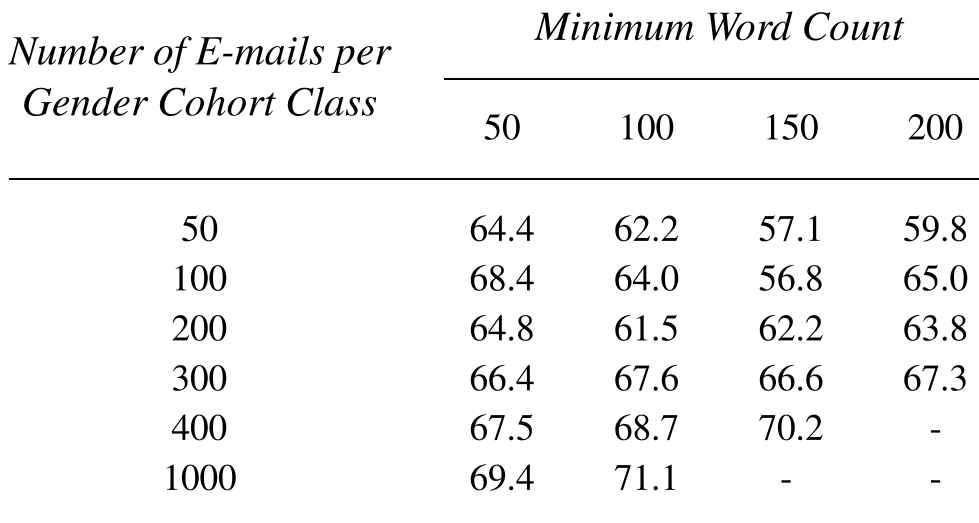
The study utilized a real-world corpus of ~4,400 e-mails. Two key variables were tested: the length of the e-mail (minimum word count) and the size of the training cohort.
Key Findings:
- The "Function Word" Supremacy: The most striking result from the ablation study was that Function Words (like "a", "about", "very") are the most potent discriminators. Removing them caused the F1-score to plummet from 70.2% to 64.0%. This confirms that gender is revealed not through the topic (nouns/verbs) but through the connective tissue of language.
- Volume Matters: Performance peaked at an F1-score of 71.1% when the model was trained on larger e-mail cohorts (1,000 documents).
- Structural Value: Interestingly, structural features like e-mail signatures and reply positions also contributed significantly, proving that the formatting of an e-mail is as telling as the words within.
Critical Analysis & Future Outlook
While the results are "promising," the authors note a few limitations. The current set of gender-specific attributes (only 11) provided only a marginal improvement over baseline stylometric features. This suggests that "gendered" language is deeply subtle and may require more complex N-gram analysis (bi-graphs or tri-graphs) to fully capture.
Furthermore, the dataset was sourced from a single academic organization. In the real world, factors like educational background, age, and cultural origin would likely "blur" these gender lines.
Summary Takeaway
This work serves as a foundational step for digital forensics. It proves that gender is not just a personal identity but a linguistic one that persists even in the rarefied, cue-inhibited environment of the e-mail inbox. For future forensic investigators, the "style" is often the most revealing "substance."