
Bridging the Linguistic Divide: Using Transfer Learning for Gender Recognition Across Informal and Formal Text
Gender Recognition in Informal and Formal Language Scenarios via Transfer Learning
This paper presents a cross-domain gender recognition framework using Bi-LSTM and multi-resolution CNNs to classify gender from text. It achieves state-of-the-art performance (up to 75% accuracy) by leveraging a transfer learning strategy to bridge the gap between informal social media data (PAN17) and formal call-center transliterations.
TL;DR
Researchers have successfully demonstrated that deep learning models can be "taught" gender recognition in the chaotic environment of Twitter and then "refined" to perform equally well in formal call-center scenarios. By combining Parallel CNNs and Transfer Learning, this study achieves 75% accuracy in both domains, even when formal training data is extremely limited.
Perspective: Why Formal Language is a Challenge
Most existing research in Demographic Information Retrieval focuses on social media. Why? Because social media is a goldmine of metadata—emojis, mentions, and specific slang act as "easy" features for models to identify gender.
However, when you move to a formal scenario—like a call-center transliteration or a government request—these markers vanish. There are no "sparkle" emojis or "LOLs" to provide hints. This creates a domain gap where models trained on Tweets fail miserably when reading professional dialogues. This paper addresses this gap by asking: Can we transfer the underlying "linguistic intuition" from Twitter to more structured conversations?
Methodology: RNNs vs. CNNs
The authors explored two primary architectures to tackle the temporal nature of text:
- Bi-LSTM (Recurrent): Designed to capture long-term dependencies by reading sequences both forward and backward.
- Multi-Resolution CNN: Unlike traditional image CNNs, this model uses parallel filters of different sizes (n-grams) to look at 3-word, 4-word, or 5-word phrases simultaneously in the temporal dimension.
Architecture Highlight
The parallel CNN structure is particularly clever. It treats text as a 1D signal and applies varying temporal resolutions to extract features regardless of sentence length.
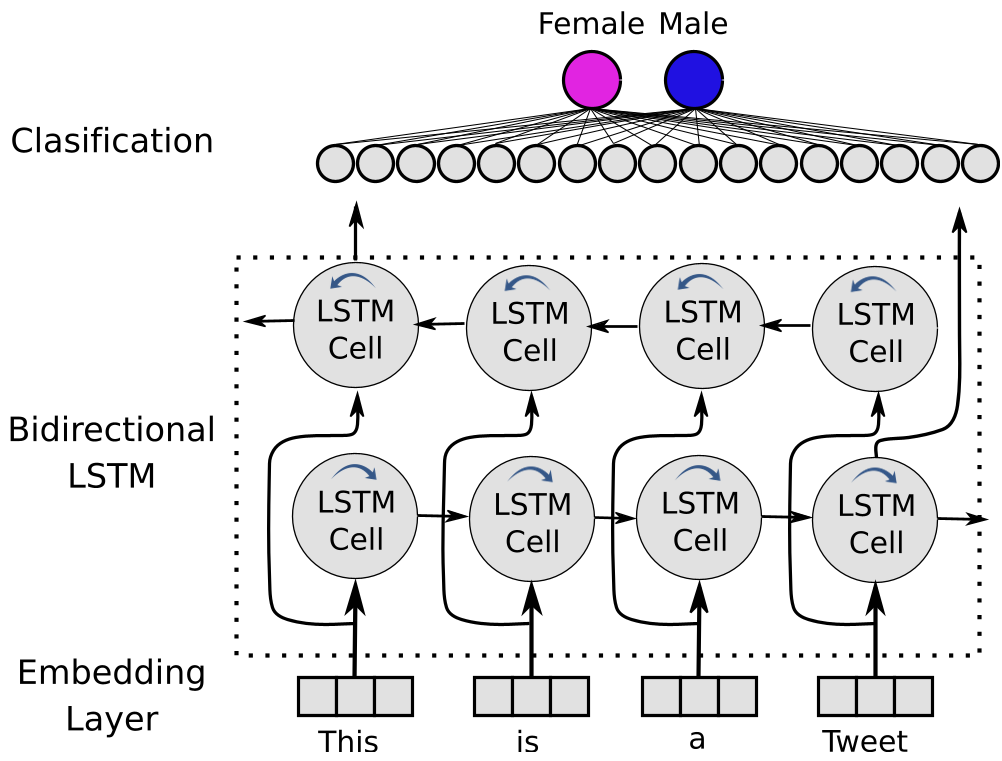 Figure 1: The Bi-LSTM approach (top) and Parallel CNN approach (bottom) used for training.
The Power of Transfer Learning
The most significant contribution of this work is the Transfer Learning (TL) strategy. The authors first pre-trained their models on the massive PAN17 corpus (420,000 Tweets). They then "froze" the embedding layer—preserving the "dictionary" the model learned—and fine-tuned the classification layers on a small set of 220 call-center conversations.
The Motivation: Collecting 200,000 call-center transcripts is expensive and ethically complex. Collecting 200,000 Tweets is trivial. If we can bridge the two, we solve the data scarcity problem in formal sectors.
Experimental Results: Stability and Success
The results from the call-center database (Formal Language) reveal a stark contrast between training from scratch and using Transfer Learning:
- Without Transfer Learning: The CNN achieved only 55.9% accuracy—slightly better than a coin flip.
- With Transfer Learning: The CNN soared to 75.0% accuracy.
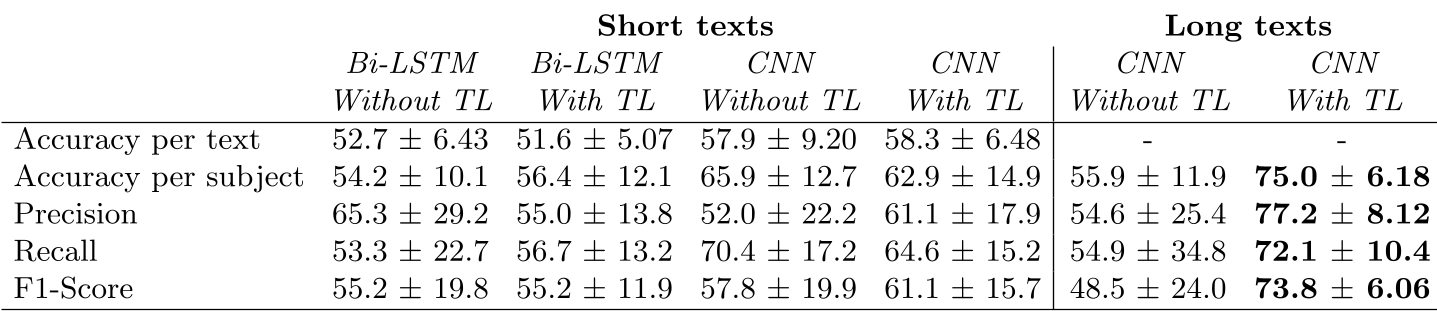 Table 2: Significant performance jumps when applying Transfer Learning (With TL).
Crucially, the standard deviation dropped from 11.9 to 6.18, meaning the model became not just more accurate, but much more stable and reliable across different test samples.
Key Takeaways & Limitations
- Long Text Wins: For both datasets, feeding the "Full assessment" (the whole conversation or all concatenated Tweets) into the CNN outperformed looking at short individual segments.
- CNNs > RNNs for Length: The study noted that Bi-LSTMs suffered from vanishing gradients when texts became too long, making CNNs the preferred choice for full-document analysis.
- Limitations: The vocabulary is still limited (5,000 tokens for PAN17; 1,500 for Call-Center). In the era of Large Language Models (LLMs), these specific embeddings might be seen as small-scale, but the underlying methodology remains highly relevant for specialized, privacy-sensitive tasks where deploying a massive GPT-scale model isn't feasible.
Conclusion
This research proves that business-level NLP tasks don't always need massive, domain-specific datasets. By cleverly leveraging the "noise" of social media through Transfer Learning, companies can build robust demographic profiling tools for formal service environments with a fraction of the manual labeling effort.