
GenderPredictor: Refining E-commerce Demographics via Behavioral Logs and Label Updating
GenderPredictor: A Method to Predict Gender of Customers from E-commerce Website
GenderPredictor is a specialized classification architecture designed to predict user gender from e-commerce product viewing logs. By combining Gradient Boosting Decision Trees (GBDT) with a novel label updating function based on product viewing statistics, it achieves a significant 3-5% F1-score improvement over traditional baselines like SVM and Random Forest, particularly for the underrepresented male class.
TL;DR
GenderPredictor is an architecture tailored for the e-commerce sector that predicts user gender by analyzing product viewing logs. It effectively tackles the "minority class" problem and "cold-start" product issue by combining a Gradient Boosting Decision Tree (GBDT) model with a secondary Label Updating Function. This hybrid approach yields a 3-5% boost in F1-score for male users, who are typically harder to identify in female-dominated shopping datasets.
Problem & Motivation: The Sparsity and Imbalance Trap
While demographics like gender and age are goldmines for personalized recommendation, most e-commerce platforms suffer from a lack of explicit user profiles. Predicting gender from "clickstreams" or "viewing logs" is the standard solution, but it faces two critical hurdles:
- Data Imbalance: In many datasets (like the PAKDD'15 data used here), female users outnumber male users 4 to 1, leading models to develop a heavy bias toward the majority class.
- The Cold-Start Product: New products appear in test sets that the model never saw during training, making "product ID" features useless without a fallback strategy.
The authors' insight was simple yet powerful: Don't just rely on the model to "learn" gender; use the statistical "gender-affinity" of the products themselves to correct the model's mistakes.
Methodology: The Hybrid Architecture
The system operates in two distinct phases:
1. The Machine Learning Component (GBDT)
The authors use GBDT because of its robustness against overfitting and its efficiency. To handle the imbalance, they employ cost-sensitive learning (assigning a higher penalty for misclassifying males) and down-sampling of the female majority.
- Features included: Temporal patterns (e.g., males shop more on Saturday evenings; females shop more during the day) and general category preferences (e.g., Category 'A2' vs 'A1').
2. The Label Updating Function
This is the core innovation. For every product, a probability is calculated based on who viewed it in the training set. If a user was classified as female by GBDT but viewed several "male-leaning" products, the function shifts the confidence score toward male.
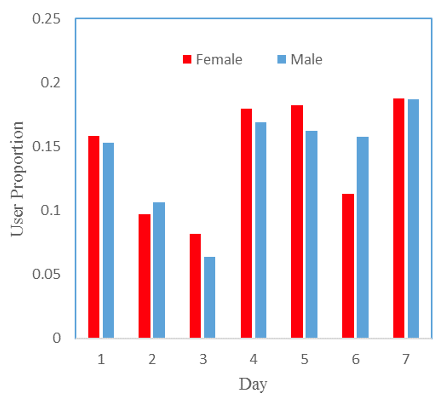 Figure: Temporal behavioral differences—males (right) showing higher activity in the evening compared to females.
To solve the new product problem, the authors use:
- Context-based estimation: If a new product always appears with "male" products and , is assumed to be a male product.
- Interpolation: Since product IDs are often sequential, products with similar IDs likely share similar demographic affinities.
Experiments and Performance
The "Hybrid" configuration was tested against SVM, Factorization Machines (FM), and Random Forests.
Key Results:
- Recall Breakthrough: The biggest win was in male recall. While SVM only caught 57.8% of male users, the Hybrid model caught 70.5%.
- Imbalance Resolution: The model balanced the precision/recall trade-off much better than standard GBDT (ML-only).
 Table 1: Performance comparison showing the Hybrid model's superiority in the Male F1-score.
The Parameter: Finding the Balance
The parameter controls the weight of the ML model vs. the Label Updating function. Interestingly, the best results occur at , proving that the "intuition" of the product statistics is just as valuable as the "learning" of the GBDT model.
 Figure 6: Influence of the weighting parameter on F1-score.
Critical Insight & Conclusion
The GenderPredictor paper highlights a transition period in data science where "pure" machine learning was being augmented by "statistical heuristics" to overcome data quality issues.
Takeaway: In domains with high sparsity and skew (like retail), a hard-coded "correction layer" based on entity-attribute probabilities can outperform even the most complex ensemble models. While modern approaches might use Graph Embeddings or LLMs to solve this today, the fundamental logic of using "co-occurrence context" to bridge the gap for new items remains a cornerstone of robust engineering.