
Bridging the Trust Gap: Generalizing Automated ML Explanations to Academic Healthcare
Testing the Generalizability of an Automated Method for Explaining Machine Learning Predictions on Asthma Patients’ Asthma Hospital Visits to an Academic Healthcare System
This study evaluates the generalizability of an automated rule-based explanation method for machine learning predictions on asthma hospital visits within an academic healthcare system (UWM). Using a dual-model approach combining XGBoost with class-based association rules, the method successfully explained 87.6% of accurate predictions while maintaining high diagnostic performance (AUC 0.902).
Executive Summary
Predictive modeling in healthcare faces a dual challenge: the need for high-performance "black-box" models and the absolute requirement for clinical interpretability. This paper validates an automated rule-style explanation method designed to provide clinicians with the "why" behind an XGBoost model's prediction of asthma-related hospitalizations.
The study is an essential piece of "translational" AI research. It tests whether an explanation framework developed for non-academic settings can generalize to the University of Washington Medicine (UWM)—a complex academic environment with a sicker, more diverse patient population. The results are a victory for interpretable AI, showing that association rules can explain nearly 88% of accurate predictions without sacrificing a shred of accuracy.
The Problem: The "Black Box" Barrier in Clinical Practice
While traditional regression models are easy to understand, they are often insufficiently accurate for identifying high-risk asthma patients (often showing sensitivity < 50%). Modern algorithms like XGBoost solve the accuracy problem but fail the "trust test"—a clinician cannot see why a patient was flagged, making it nearly impossible to recommend specific interventions.
Furthermore, the generalizability gap is real. A model trained on a general population might use features that don't exist or carry different weights in an academic medical center where patients often present with multiple comorbidities and higher acuity.
Methodology: The Dual-Model Architecture
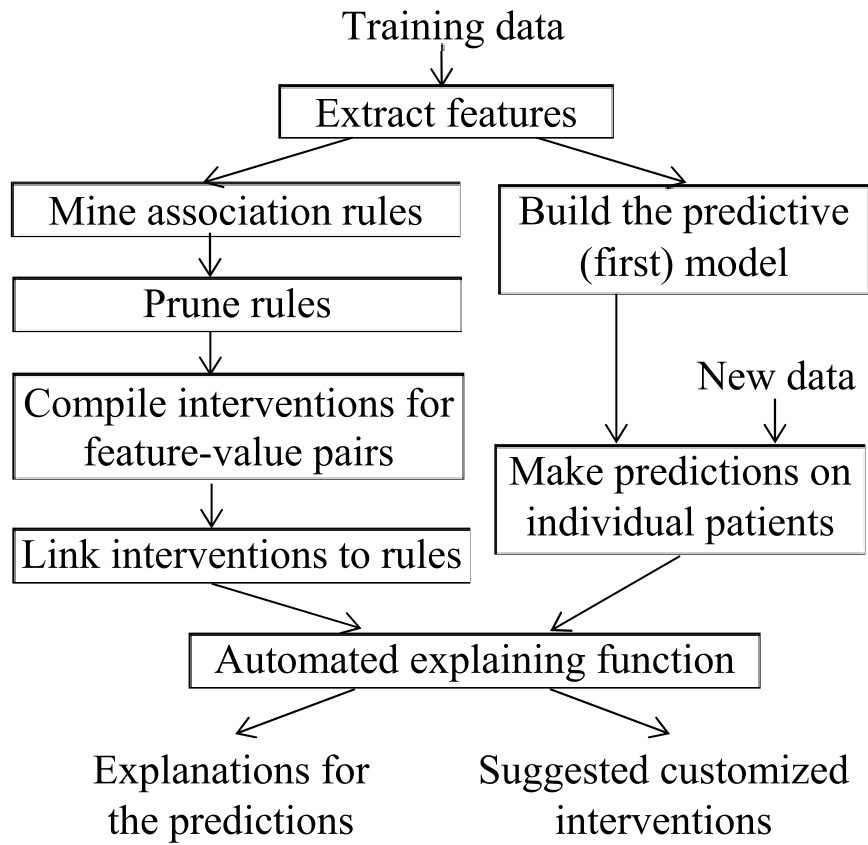
The core innovation is the separation of prediction and explanation. Instead of forcing a complex model to be simple, the authors use a two-pronged strategy:
- The Predictor: A high-accuracy XGBoost model (71 features) that determines the risk of hospital visits in the next 12 months.
- The Explainer: A set of class-based association rules mined from historical data. These rules take the form:
IF (Factor A) AND (Factor B) THEN (Outcome C).
Actionable Insights through Mining
The method transforms continuous variables (like respiratory rate) into categories through automated discretization. To keep the rule set manageable, the authors apply three pruning techniques:
- Dropping specific rules if a more general rule has similar confidence.
- Restricting rules to the top features identified by XGBoost's gain/importance.
- Clinical Expert Tagging: Ensuring that only medically logical correlations are presented to the end-user.
Experimental Results: Proving Generalizability
The study analyzed 82,888 data instances from UWM (2011-2018). The XGBoost model maintained high performance (AUC 0.902). But the real success was in the explainer:
- Success Rate: The method provided logic for 87.6% of correctly identified high-risk patients.
- Rule Density: While some patients satisfied thousands of overlapping rules, the system collapsed these into an average of 26.62 unique actionable items (e.g., frequent ED visits, systemic corticosteroid use, or high respiratory rates).
Visualizing Patient Distribution
The authors discovered that while some patients are "simple" to explain with a few rules, others satisfy a "long tail" of complex patterns.
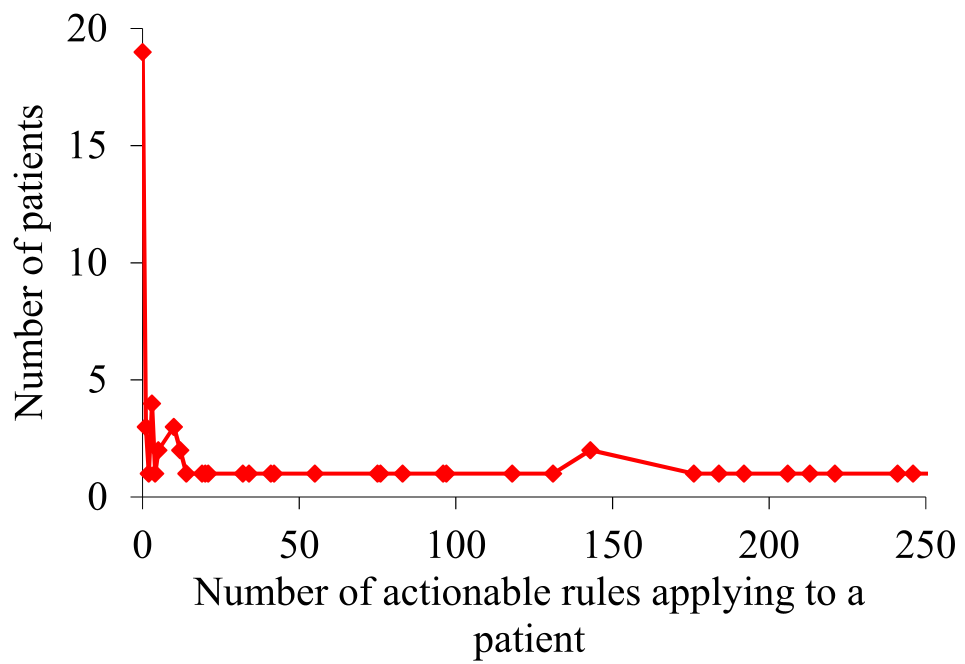
Figure: The distribution of rules shows a "long tail" where a subset of complex patients satisfies a high number of association rules.
Deep Insight: Why Rule-Based Explanations Win
Unlike gradient-based explanations (like Saliency Maps) or local surrogate models (like LIME), rule-style explanations mimic the clinical reasoning process. For example:
- Rule Example: "Patient had ≥7 ED visits AND ≥4 systemic corticosteroid orders."
- Intervention: "Advise better adherence to daily control medications."
This direct mapping from Feature Pattern to Intervention is the "holy grail" of clinical AI. The study proves that even in different healthcare ecosystems, these fundamental clinical patterns remain consistent enough for automated mining to be effective.
Critical Analysis & Conclusion
Takeaway: This work demonstrates that automated explainability is not just a "nice-to-have" but a scalable tool that maintains its utility across disparate healthcare systems. By decoupling explanation from prediction, we can have our "accuracy cake" and eat the "transparency" too.
Limitations:
- The study is limited to structured tabular data. Extending this to deep learning models (RNNs/Transformers) dealing with longitudinal "events" remains an open frontier.
- It relies on expert tagging, which, while beneficial for safety, introduces a manual step in an otherwise "automated" pipeline.
Future Outlook: The next step for this technology is real-time integration into Electronic Health Records (EHR), allowing care managers to see not just a "Risk Score," but a "Risk Story."