
sitIT.cz: Revolutionizing Knowledge Management for SMEs through Conceptual Multigraphs
Generic Private Social Network for Knowledge Management
The paper introduces sitIT.cz, a generic web-based professional social network designed to facilitate knowledge management (KM). It moves beyond standard social connections by implementing a conceptual multigraph architecture that supports structured profiles (SP) and multiple entity types like Companies, Projects, and Offer/Demands to bridge the gap between academic and business expertise.
TL;DR
Knowledge in Small to Medium Enterprises (SMEs) is often locked in "digital graveyards" like old email threads and unindexed shared drives. This paper presents sitIT.cz, a generic, non-commercial professional social network that uses a Conceptual Multigraph architecture and Structured Profiles to turn static employee data into a dynamic, searchable knowledge ecosystem. It provides an affordable, privacy-focused alternative to high-end Enterprise Social Networks (ESNs).
The "Knowledge Silo" Problem in SMEs
For many companies, the most valuable asset—employee expertise—is invisible. If a company needs a COBOL specialist for a legacy banking project, how do they find one internally?
Current limitations include:
- Inaccessibility: E-mails and mass mailings are not indexed for long-term knowledge retrieval.
- Cost Barriers: Solutions like IBM Connections or Jive are priced for Fortune 500 companies, not local SMEs.
- Privacy Risks: Public platforms (LinkedIn, ResearchGate) are unsuitable for sensitive internal corporate data.
- Entity Minimalism: Most social networks only treat the "User" as a first-class citizen, ignoring the complex relationships between Projects, Demands, and Skill Taxonomies.
Methodology: The Power of the Conceptual Multigraph
The core of sitIT.cz is its mathematical foundation: the Typed Multigraph. Unlike a simple graph where nodes are people and edges are "friends," sitIT recognizes that an IT ecosystem is far more complex.
1. Actor Diversity
The system defines specific classes of actors:
- V1 (User): Individual specialists.
- V2 (Groups): Companies, Projects, result clusters, and institutions.
- V3 (Offer/Demand): Specific market or internal needs.
- V4 (Skill Taxonomy): The knowledge backbone.
2. The Structured Profile (SP)
Perhaps the most significant technical contribution is the Structured Profile. By using the ACM Computing Classification System, sitIT converts a vague "I know Java" into a weighted vector: {(D.2.4, 3), (D.2.8, 1)}.
- This allows for Vector-Based Matching: A project’s requirements (the demand vector) can be mathematically compared against an employee's expertise (the supply vector) to find the perfect fit.
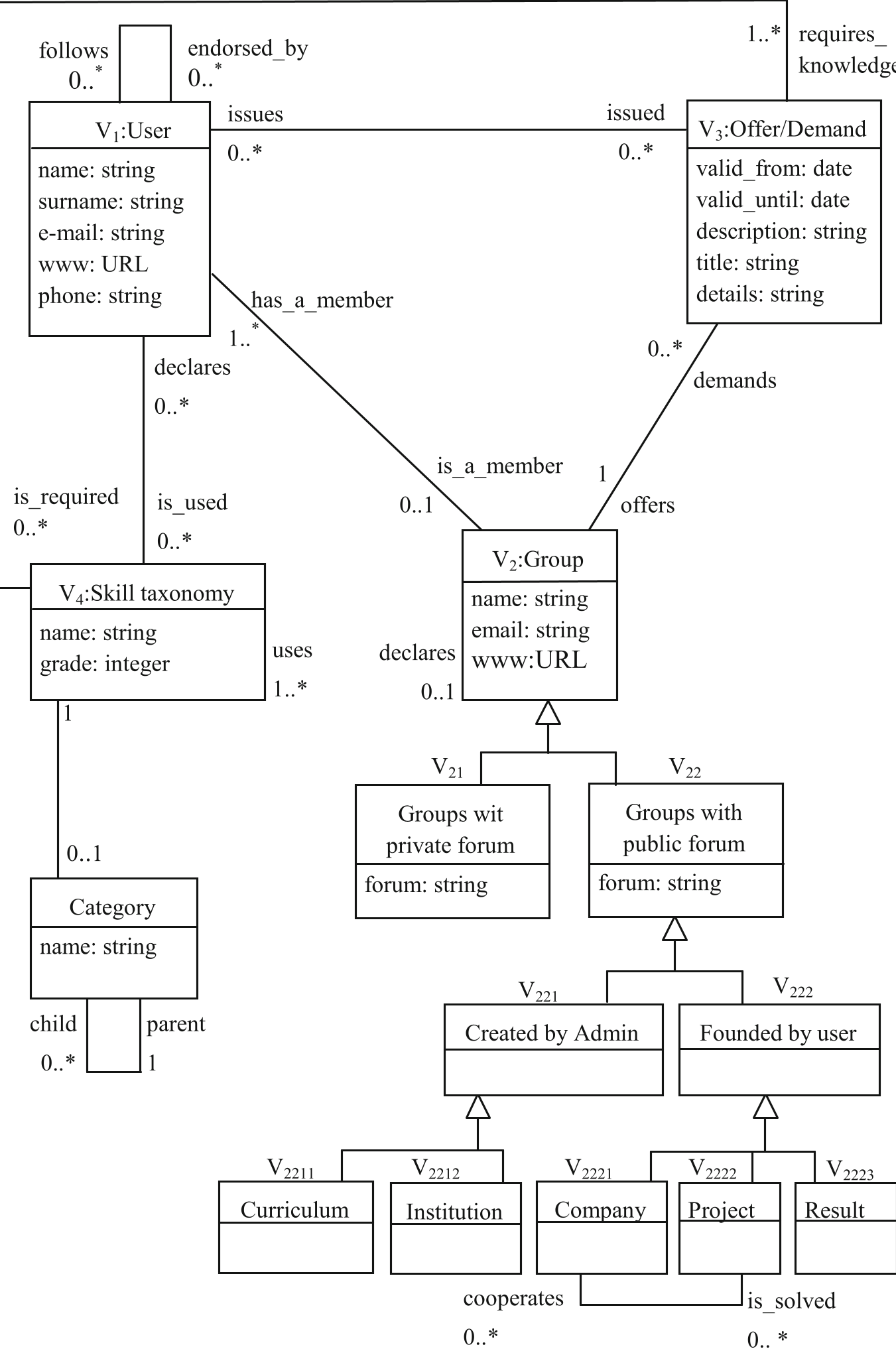 Fig 1: The UML diagram illustrating the complex interplay between Users, Groups, and Demands within the sitIT architecture.
Moving From CVs to Real-Time Networks
A major hurdle in Knowledge Management is data entry. The authors propose a "command-based" approach for SMEs where HR data (CVs) are parsed using machine learning (Conditional Random Fields) to automatically populate user profiles.
Quantifying the SME Gap
The paper provides a sobering look at social media adoption in European businesses.
- Internal Knowledge Sharing: Very few companies use social tools for internal opinion exchange (only 4% in the Czech Republic).
- The Size Constraint: Small businesses are significantly less likely to adopt Wiki-based or social networking tools compared to large enterprises.
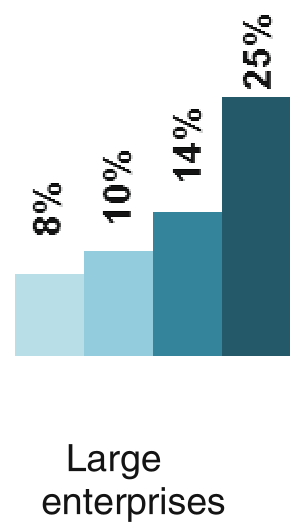 Fig 2: Adoption rates of social media types across different enterprise sizes, showing the distinct disadvantage faced by small businesses.
Implementation & Adaptability
The sitIT portal is built on a robust stack: Spring MVC, Hibernate, and PostgreSQL. Its "generic" nature comes from its XML-driven configuration. By simply replacing an XML file, the entire skill taxonomy can be switched from ICT (ACM) to Law, Medicine, or Manufacturing, making it a universal tool for domain-specific knowledge management.
Critical Insight & Conclusion
The sitIT project proves that the "Social Network" paradigm is not just for leisure; it is a superior architecture for Organizational Memory. By treating skills as a weighted hierarchy rather than just keywords, sitIT enables a level of "Internal Headhunting" that was previously impossible for SMEs.
Future Outlook: The next step for this technology lies in automation—fully automating the "CV-to-Profile" pipeline and integrating trust metrics to ensure that self-reported skills align with actual project outcomes. As the knowledge society evolves, tools like sitIT will be essential to ensure that the collective memory of a company remains its competitive advantage.