
e-NABLE: Tracking the Anatomy of a Crowdsourcing Revolution
On the Genesis of an Assistive Technology Crowdsourcing Community
This paper presents a comprehensive case study of e-NABLE, a global crowdsourcing movement that leverages 3D printing to provide free upper-limb assistive devices. Using Social Network Analysis (SNA) and Natural Language Processing (NLP) on historical Google+ data, the authors track the community's evolution from a tight-knit group to a fragmented global entity.
TL;DR
The e-NABLE movement represents a landmark in "philanthropic micromanufacturing," using 3D printing to provide thousands of prosthetics worldwide. However, this study reveals that rapid growth is a double-edged sword. By analyzing three years of community data, the authors demonstrate how a community's social fabric begins to fray once it scales beyond a certain cognitive limit, providing a roadmap of the "early warning signs" for social fragmentation.
Background: From a Shop Accident to a Global Movement
The genesis of e-NABLE is the stuff of digital legend: a South African carpenter and a Washington State artist collaborated online to create a 3D-printable hand. What started as a Google Map "mashup" exploded into a global confederation of makers. Yet, as the community moved from its original Google+ home to a fragmented network of local chapters, researchers wanted to know: Is this a sign of healthy decentralization or institutional decay?
The Problem: The "Governance Gap" in Rapid Scaling
Platform limitations often throttle social entrepreneurship. While Google+ was excellent for "vanilla" social networking, it lacked the specialized tools for:
- Micromanufacturing Governance: Managing quality control across 2,000+ distributed makers.
- Information Recall: Vital design iterations were getting buried in a chronological "stream."
- Social Cohesion: As the group grew, the "everyone knows everyone" feel vanished, replaced by friction and philosophical divides.
Methodology: High-Dimensional Community Analysis
The researchers didn't just look at post counts; they looked at the structure of interactions.
1. Social Network Analysis (SNA)
By using a sliding 20-week window, they mapped the community as a graph. They tracked the Largest Connected Component (LCC)—the "information economy" of the group—and measured density via the Clustering Coefficient.
2. Topic Modeling (LDA)
To understand what people were actually talking about, they used LDA to extract 19 distinct topics, ranging from technical manufacturing process discussions to international outreach in Brazil and Spain.
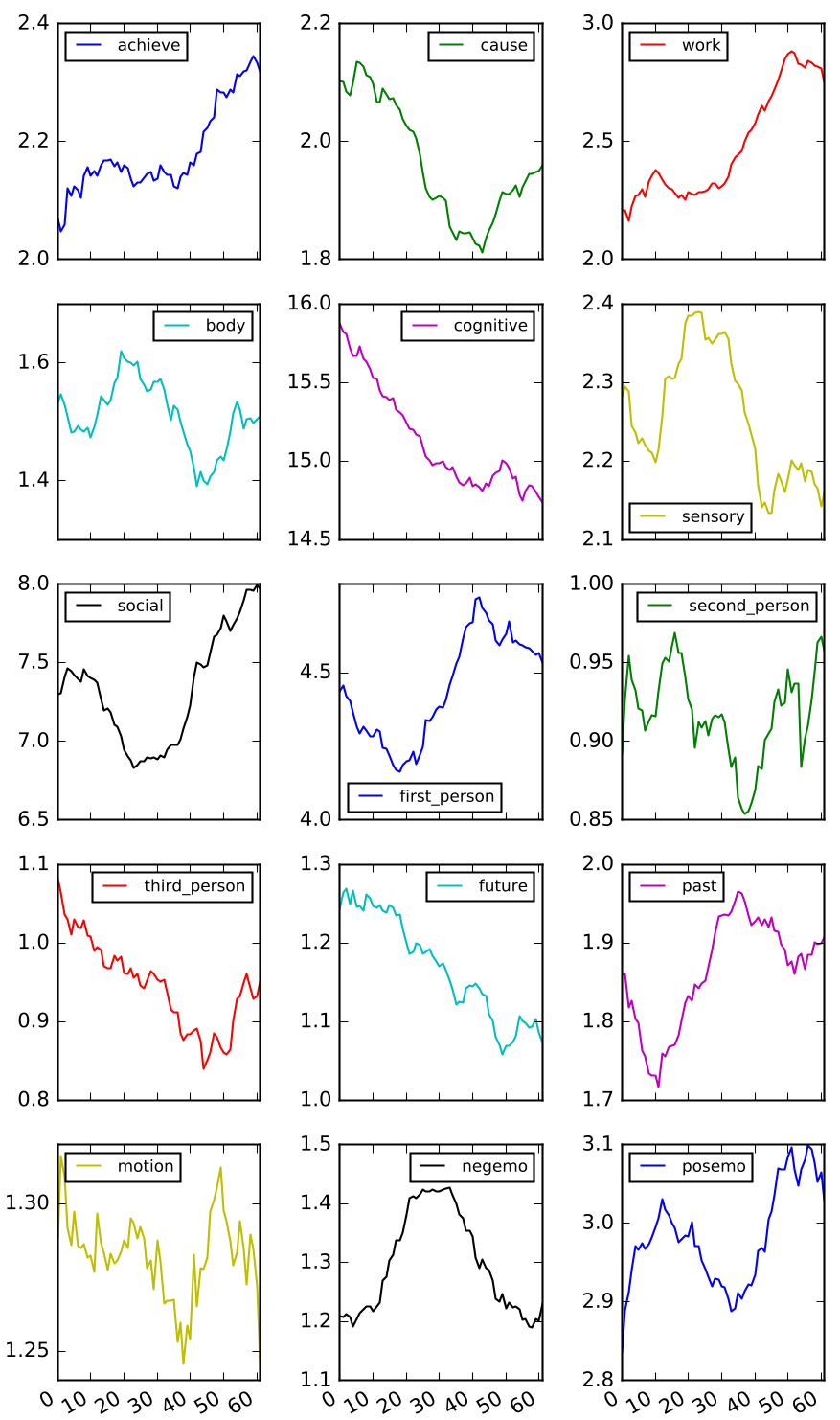 Figure: LDA-discovered topics showing the shift from "general enthusiasm" to specific technical and regional roles.
Key Insights: The Anatomy of Fragmentation
The "Dunbar Breakpoint"
The data revealed a striking phenomenon around "Time 20" (roughly 40 weeks in). Even though the network was growing, the average number of triangles and clustering coefficients dropped precipitously.
- Insight: When the active participants reached ~500, the "small world" feel broke down. Members became more selective in their Establishing links, making the overall graph sparser. This is where informal self-governance usually fails.
Linguistic Shifts as Early Warnings
The use of Negative Emotion (Negemo) words peaked early in the middle year—long before the actual community split occurred in year three. This suggests that NLP can serve as an "early warning system" for moderators to identify simmering tensions before they lead to factionalism.
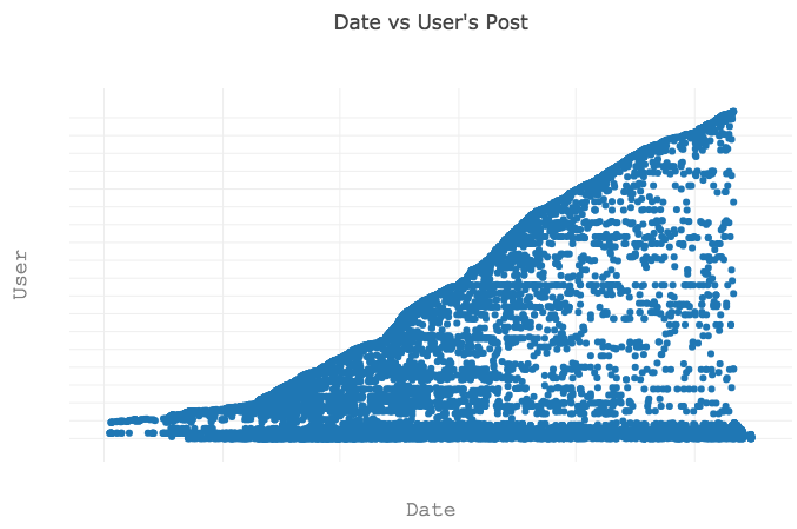 Figure: Visualization of posts by all users over time, highlighting the "explosion" phase and subsequent stabilization.
Critical Analysis & Future Outlook
This paper serves as both a tribute to e-NABLE and a cautionary tale.
- Contribution: It provides quantitative benchmarks (like the drop in LCC and coreness) that other social ventures can use to gauge their own health.
- Limitation: The study relies on Google+ data, which may not capture the deep technical collaborations happening on platforms like GitHub or private CAD sharing sites.
- The Big Takeaway: Scaling a community requires more than just more people; it requires a structural evolution. If you move from 100 to 1,000 members without shifting from "flat" to "modular" or "hierarchical" governance, the social network metrics suggest that fragmentation is not just likely—it's inevitable.
Conclusion
The "Genesis" of e-NABLE proves that crowdsourcing can change lives, but its "Evolution" shows that maintaining that impact requires rigorous attention to the social architecture of the community itself.