
Deciphering Optimization: Combining Genetic Algorithms and Data Mining for Job Shop Scheduling
A Genetic Algorithm AND Data Mining to resolve a Job Shop Schedule Parent 1 a b c Parent2 f b g Child1 b b f Child2 b a i
This paper presents a hybrid optimization approach for the Job Shop Scheduling Problem (JSSP) by combining Genetic Algorithms (GA) with C4.5 Decision Tree data mining. The GA is utilized to generate a diverse population of near-optimal schedules, which are then analyzed to extract interpretable dispatching rules for operation sequencing.
TL;DR
Optimization in manufacturing often feels like a "black box." While Genetic Algorithms (GA) are powerful at finding the shortest completion time (makespan), they don't explain why certain operations come first. This paper proposes a hybrid framework: use a GA to find the best schedules, then use C4.5 Decision Trees to mine those results for simple, human-readable rules that can guide future scheduling decisions.
Problem & Motivation: Beyond the Black Box
The Job Shop Scheduling Problem (JSSP) is a classic NP-hard challenge where multiple jobs must be processed on specific machines in a set order. While modern metaheuristics (like GAs) can solve these efficiently, they lack interpretability.
The authors' motivation stems from a critical need: if we can understand the patterns of optimal schedules, we can derive dispatching rules that are easier to implement on the factory floor than running a full simulation every time a minor change occurs.
Methodology: From Evolution to Induction
The proposed workflow is a two-stage pipeline:
1. The Evolutionary Discovery
The researchers developed a GA tailored for a 6x6 Muth & Thomson benchmark.
- Coding: They used a sequence-based representation where each gene identifies a (Job, Operation) pair.
- Selection & Crossover: A combination of elitism and "Low order Crossover" ensures that the relative order of operations is preserved—a crucial factor in maintaining valid schedules.
- Diversity: By running the GA 1,000 times, they gathered a large "learning population" of optimal solutions.
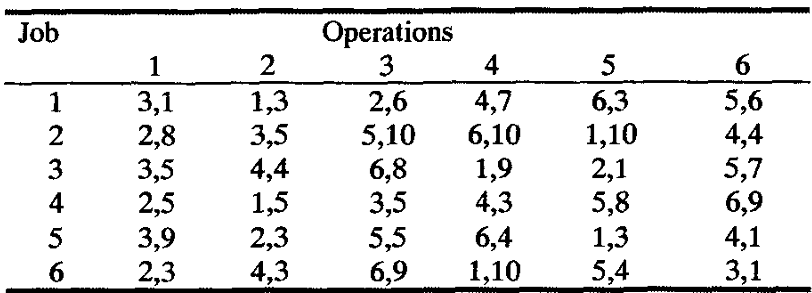 Figure 1: The 6x6 benchmark problem data showing machine assignments and processing times.
2. Knowledge Extraction via Data Mining
Once 106 unique optimal sequences were filtered, the authors applied the C4.5 Decision Tree algorithm. They characterized operations using three attributes:
- Process Time: How long the task takes.
- Job Position: Is this the first or last task for a specific product?
- Remaining Time: How much work is left for the entire job?
This allows the system to move from "scheduling by trial and error" to "scheduling by logic."
Experiments & Results
The GA was remarkably effective, with 92.7% of the population reaching the optimization target. By analyzing the frequency of operation positions (as shown in the characterization table below), they found a high level of consistency in "what makes a schedule optimal."
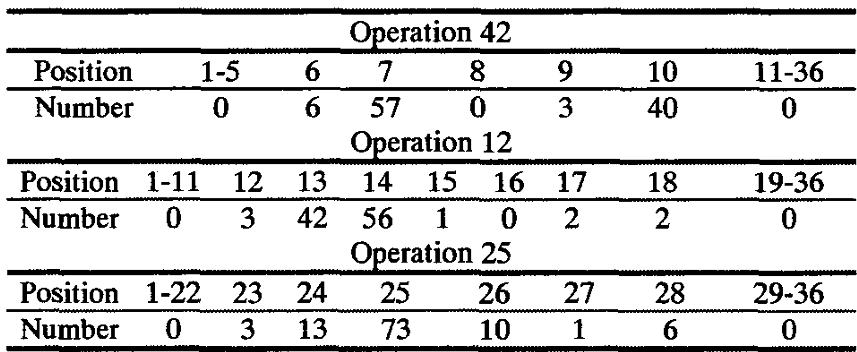 Figure 2: Statistical distribution of operation positions across optimal solutions.
The final output is a set of affectation orders for each machine. For example, on Machine 1 (M1), the sequence consistently followed the order: (4,2) -> (3,4) -> (1,2) -> etc. These patterns are what the Decision Tree eventually converts into if-then rules.
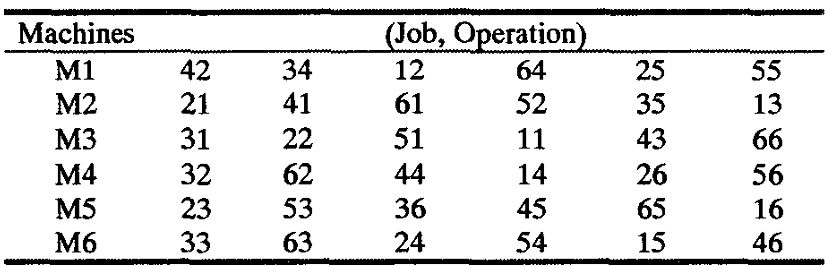 Figure 3: Induced affectation orders for each of the six machines.
Critical Insight & Conclusion
The brilliance of this work lies in its hybrid nature. It doesn't just settle for a numeric solution; it seeks the underlying grammar of efficiency.
Takeaway for Practitioners: If you are using GAs for complex logistics, don't just throw away your "failed" or "alternative" optimal solutions. They contain the data needed to build simpler, faster decision trees that can handle real-time scheduling when the full GA is too slow to run.
Future Outlook: The authors suggest adding reliability indicators (machine health) into the attributes. In a real factory, a rule that accounts for both "remaining time" and "machine breakdown probability" would be the ultimate tool for resilient manufacturing.