
Genetic Programming: Deciphering the Hidden Logic of Mosquito Populations
Towards the use of genetic programming in the ecological modelling of mosquito population dynamics
This study investigates an evolutionary computation approach to ecological modeling, specifically using Tree-based Genetic Programming (GP) to predict mosquito abundance (Cx. pipiens) in Italy's Piedmont region. By evolving symbolic expressions, GP outperformed state-of-the-art machine learning models like XGBoost and Random Forest in terms of generalization and interpretability.
TL;DR
Predictive ecology is often a battle between the simplicity of linear models and the "black-box" accuracy of modern Machine Learning. This research breaks the stalemate by applying Genetic Programming (GP) to predict mosquito abundance—the primary vector for West Nile Virus. By evolving mathematical expressions rather than just tuning weights, the authors discovered a model that generalizes better than XGBoost and Random Forest, while offering a transparent formula that ecologists can actually read and validate.
The Challenge: Why Typical ML Fails in the Wild
Ecological data is notoriously "messy"—a cocktail of satellite imagery (NDVI), weather station logs (Rainfall, Temp), and spatial geographical constants. For years, experts relied on Generalized Linear Mixed Models (GLMMs). However, GLMMs require humans to guess the relationship structure first.
When researchers turn to modern heavy-hitters like Random Forest (RF) or Extreme Gradient Boosting (XGBoost), they often hit a wall: Overfitting. As shown in the study, while RF can memorize training data (2002–2005) with high precision, its performance collapses when faced with the "unseen" future (2006).
The Methodology: Evolving the Solution
The authors propose using Genetic Programming (GP). Unlike a Neural Network that optimizes a massive matrix of numbers, GP evolves a population of computer programs (represented as trees) to find the best mathematical fit for the data.
1. Symbolic Architecture
The terminals included variables like T_WEEK (Land Surface Temperature), RAIN, NDVI, and distances to urban centers (DISTU) or woodlands (DISTW). The functions were simple arithmetic: .
2. The Model Architecture
Note: The study utilized a rigorous 75/25 split for training and validation within the 2002-2005 data to ensure the evolved "individuals" could generalize before even seeing the 2006 test set.
Experiments: Performance vs. Generalization
The results revealed a startling truth about "over-engineered" ML. While RF and XGBoost looked dominant on paper, the Overfitting Gap (Difference between Learning and Test RMSE) told a different story:
| Method | Test RMSE | Overfitting Gap |
|---|---|---|
| GP (Genetic Programming) | 83.8 | 1.8 |
| Random Forest | 83.0 | 46.1 |
| XGBoost | 87.9 | N/A (High Bias) |
| MLP (Neural Net) | 83.7 | 17.4 |
GP provided a much more stable bridge between historical data and future predictions.
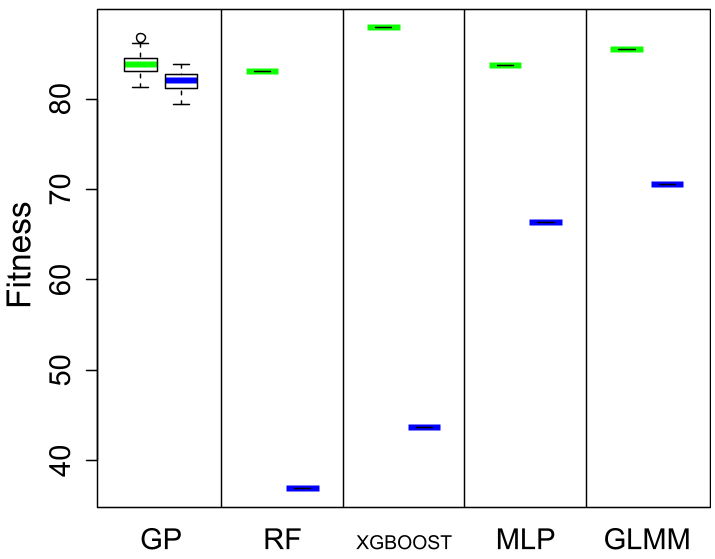 Figure 1: Comparison of learning (green) vs test (blue) performance. Note how GP remains consistent, while RF and XGBoost show significant variance and gap.
Ecological Insights: Opening the Black Box
One of the most powerful outcomes of GP is the Symbolic Expression. The paper highlights an evolved formula (Eq. 1) that allows researchers to see which variables are doing the heavy lifting.
Key Findings:
- Feature Selection: GP automatically discarded
RAIN,NDVI, andELEVas non-informative for this specific dataset, simplifying the model. - Biological Realism: The model confirmed that
T_WEEKhas a positive correlation with growth (warmer temps = faster larvae development) and that proximity to Rice Fields acts as a major breeding catalyst. - The Woodland Shield: Interestingly,
DISTW(Distance to Woodland) was a strong predictor. The model suggests that forests, likely due to bird predation, are less hospitable for these mosquitoes than urban catch basins.
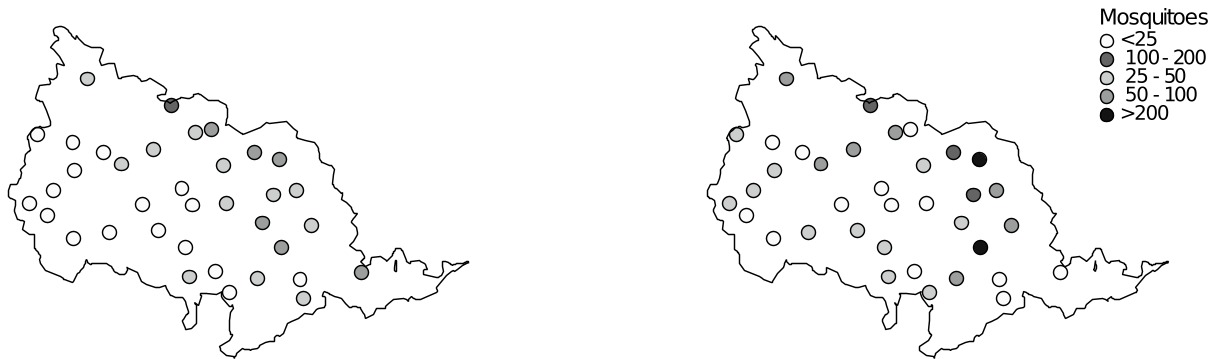 Figure 2: Real vs. Predicted distribution maps. The GP model accurately captured the high-risk clusters in the Casale Monferrato region.
Conclusion & The Path to VE-GP
The study concludes that GP's ability to act as a feature selector and interpretable regressor makes it uniquely suited for public health surveillance.
However, the authors identify a limitation: the reliance on an artificial SIN variable to handle seasonality. They suggest that the next frontier is Vectorial Genetic Programming (VE-GP), which can treat environmental variables as true time-series vectors, potentially uncovering deeper temporal dependencies without human-designed seasonal cues.
Final Takeaway: In fields where understanding "Why" is as important as knowing "What," symbolic evolution via Genetic Programming remains a formidable competitor to deep learning.