
Geo-Social Relevance: Bridging the Gap Between Social Media Trends and Geographic Credibility
The geo-social relevance ranking: A method based on geographic information and social media data
The paper introduces the Geo-social Relevance (GSR) ranking method, a novel approach for Geographic Information Retrieval (GIR) that enhances news search by integrating Weibo-style microblog data. It combines traditional spatio-textual metrics with social signals, specifically using a location affinity algorithm to estimate user locations from social interactions to validate the credibility of geographic news.
TL;DR
Information Retrieval (IR) is evolving from "What you say" to "Who says it and where they are." This paper introduces Geo-Social Relevance (GSR), a ranking mechanism that uses social media interactions (Twitter/X) to validate the importance of news articles. By inferring where users are actually located through their social circles and posts, the system boosts the ranking of news that is verified by "local" social engagement.
The Problem: The "Silent" 94% and the Credibility Gap
In Geographic Information Retrieval (GIR), we don't just care about keywords; we care about the geographic scope. Current systems suffer from two major flaws:
- Credibility blindness: A news report about a flood in Orlando is more "relevant" if locals are sharing it, but traditional PageRank treats all links similarly.
- Missing Metadata: To use social signals, you need to know where users are. However, research shows only about 5.34% of users fill out the location field in their profiles.
Existing methods often treat ranking as a simple linear combination of text match and distance, ignoring the "human" validation element inherent in social networks.
Methodology: The Geo-Social Engine
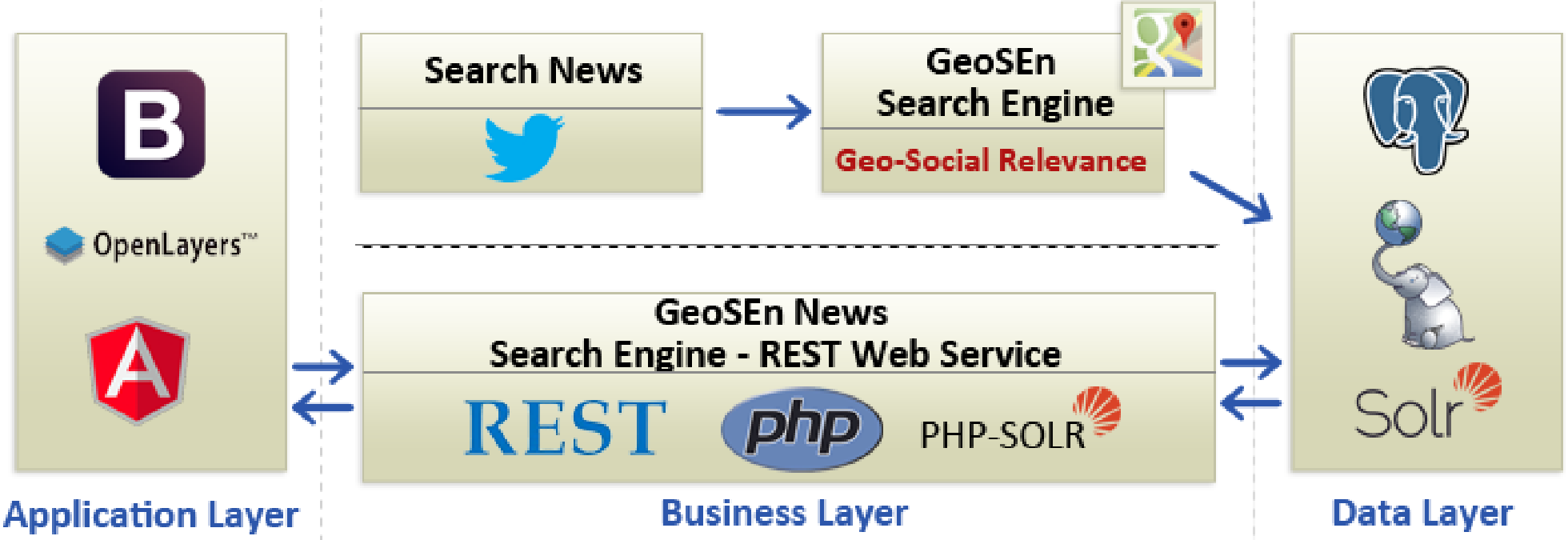
The core of the paper lies in a 3-layer architecture called GeoSEn News. It doesn't just crawl the web; it crawls human behavior.
1. The Location Affinity Algorithm
Because most users don't disclose their location, the authors developed a multi-factor formula:
- Post Content: Analysis of toponyms (place names) in a user's tweets.
- Geocoded Metadata: Using the tiny fraction of GPS-tagged posts.
- Social Context: Analyzing where a user's friends live.
- Georeferencing Expansion: Using a "Geotree" (e.g., if you are in San Francisco, you have an implicit affinity to California).
2. Geo-Social Relevance (GSR) Calculation
The GSR factor is calculated during the indexing stage. If a news article mentions location , its score increases every time a user who has a high affinity to retweets it.
Experiments & Results
The authors validated their approach using a dataset of Brazilian news companies and Twitter accounts.
High-Precision Location Inference
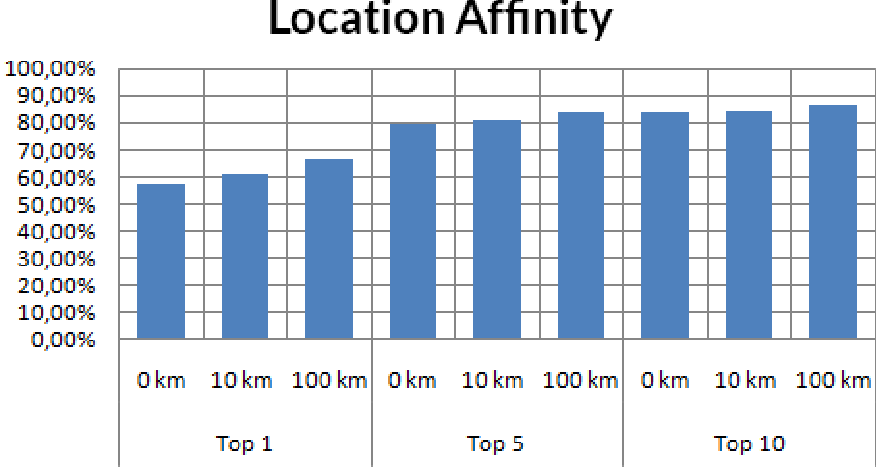
The algorithm's ability to "guess" where a user lives was tested against known profiles. Even in the most restrictive "Top-1" test (choosing only the single most likely location), the system achieved a 57.8% success rate with 0km error. As the tolerance increased to a Top-10 list, the accuracy soared, as shown in the performance curve below.
User Acceptance
A survey of 36 volunteers performing complex spatial queries confirmed the system's effectiveness. Using Kendall's Tau correlation, the researchers found that participants largely agreed with the system's GSR-boosted ranking, with 71% of queries showing moderate to very strong correlation with human "ideal" ordering.
Critical Insight & Future Outlook
This paper's logic is a precursor to the "social signals" used by modern AI-driven news feeds. The physics behind the math is intuitive: local news is validated by local voices.
Limitations: The system's performance is still tied to the accuracy of its Geoparser. If the parser fails to distinguish "London, Ontario" from "London, UK," the social affinity becomes noise.
Future Work: As we move toward 2026, integrating this with LLM-based entity extraction could solve the ambiguity issues mentioned by the authors, making Geo-Social Relevance a standard feature for decentralized and localized news platforms.
Index Terms: GIR, Social Network Analysis, Geoparsing, Relevance Ranking.