
Decoding the DNA of Data Sharing: Why Culture Matters More Than Technology in GIS
Research on geographic information sharing in different cultural backgrounds
This research investigates geographic information sharing (GIS) through a behavioral and cross-cultural lens, utilizing a model that integrates the Theory of Planned Behavior, Grid-Group Culture Theory, and Hofstede’s cultural dimensions. The study validates this model across China, Egypt, and the Netherlands, identifying how cultural backgrounds dictate individual and organizational data-sharing tendencies.
TL;DR
While we often blame technical formats for the failure of geographic information sharing, this paper argues the real barrier is "Soft Interoperability." By analyzing 23 hypotheses across China, Egypt, and the Netherlands, the study proves that national culture—specifically dimensions like Collectivism and Power Distance—predicts whether individuals and organizations will collaborate or hoard data.
Beyond Code: The Motivation Behind the Map
For decades, the GIS community has chased the "Holy Grail" of technical interoperability—standardizing APIs, metadata, and schemas. Yet, data remains siloed. The authors of this paper argue that geographic information sharing is an inherently social phenomenon.
The core insight is simple yet profound: Individuals do not act in isolation. Their willingness to share a shapefile or a database is governed by their organizational climate and, more broadly, their national culture. The researchers set out to solve why similar technical environments yield vastly different sharing outcomes in different countries.
The Analytical Framework: The Omran Model
To quantify "culture," the study utilizes a multi-layered model combining the Theory of Planned Behavior (TPB) and Hofstede’s Cultural Dimensions.
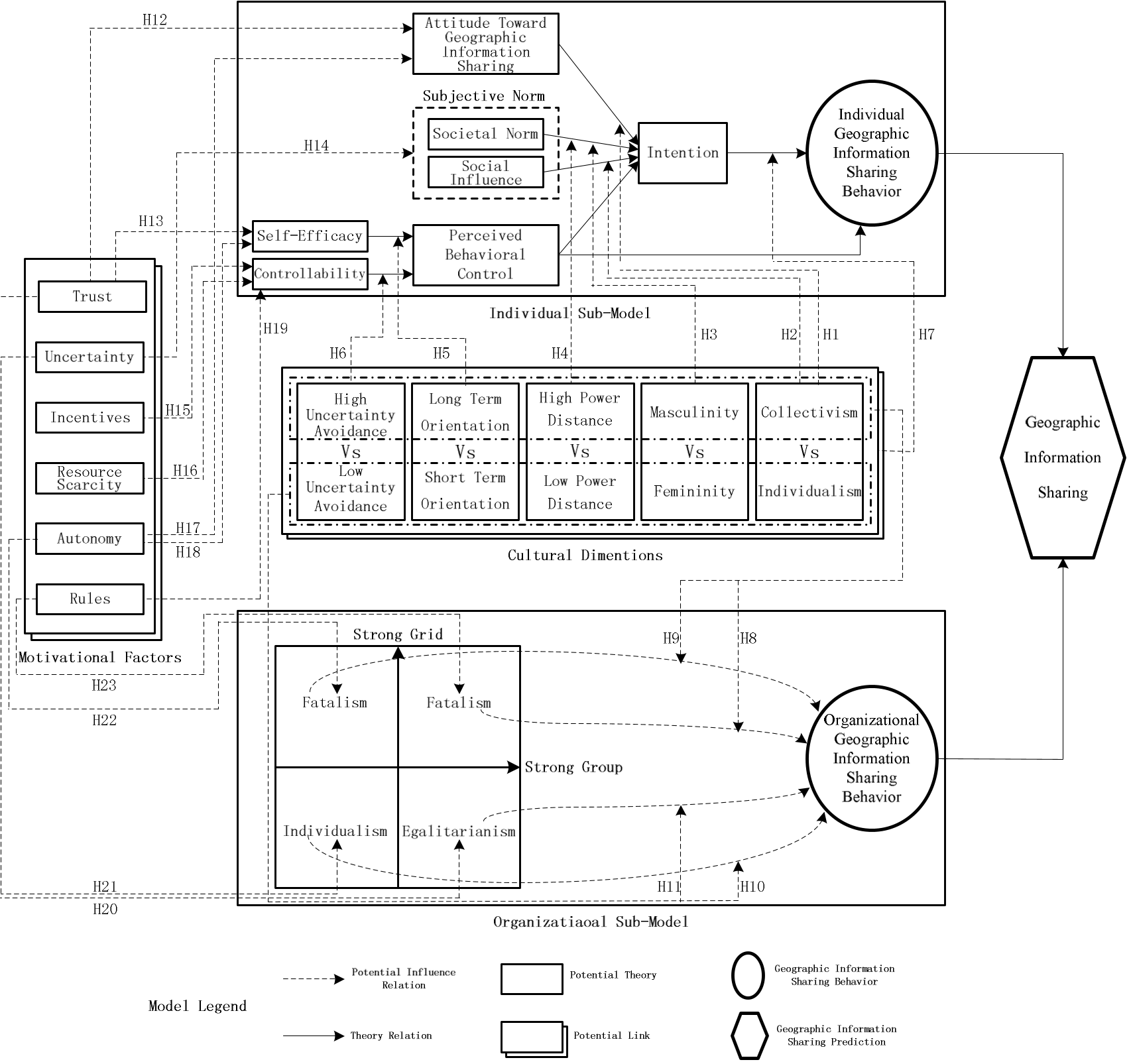
The model bridges two levels:
- Micro Level (Individual): Focuses on attitudes and social norms.
- Macro Level (Organizational): Focuses on hierarchical vs. egalitarian structures.
- The Glue: Cultural dimensions (Power Distance, Individualism, etc.) and motivational factors (Trust, Incentives, Rules) that influence both levels simultaneously.
Global Experiment: East vs. West
The study provides a fascinating contrast by comparing three vastly different cultural scores:
| Dimension | China | Egypt | Netherlands |
|---|---|---|---|
| Individualism | 20 (Low) | 38 (Low) | 80 (High) |
| Power Distance | 80 (High) | 80 (High) | 38 (Low) |
| Long-term Orientation | 118 (High) | - | 44 (Medium) |
Key Findings:
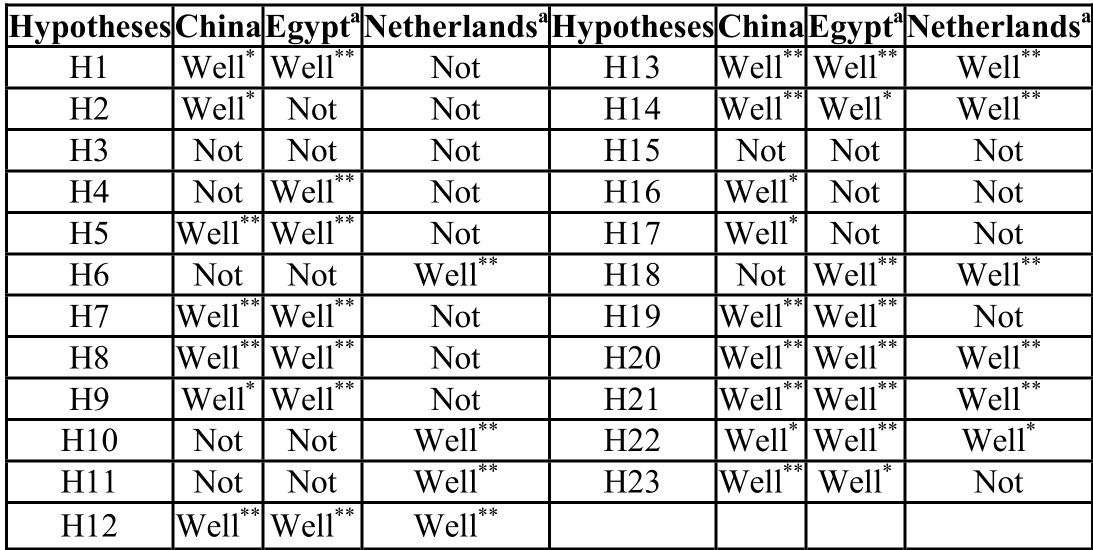
- Collectivism vs. Individualism: In China and Egypt (Collectivist), social norms and organizational hierarchy have a much stronger positive impact on the intention to share data compared to the Netherlands.
- The Role of Authority: In high Power Distance cultures (China/Egypt), formal rules and hierarchical mandates are effective drivers for sharing. In the Netherlands, these same rules can sometimes be less effective than egalitarian, trust-based networks.
- Universal Constants: Trust and Organizational Rules were found to be positive drivers in all cultures. Regardless of where you are, if people don't trust the recipient or the system, the data stays locked away.
Critical Insight: The Failure of Incentives
Interestingly, Hypothesis 15 (Incentives) was not supported in any of the three nations. This suggests that simple financial or external rewards might not be the "magic bullet" for data sharing. Instead, intrinsic motivators—like reducing uncertainty and fostering organizational trust—are far more potent.
Conclusion and Future Outlook
This paper serves as a wake-up call for GIS managers and policymakers. To build a robust National Spatial Data Infrastructure (NSDI), we must:
- Prioritize Trust: Invest in transparent data-sharing agreements.
- Respect the Hierarchy: In cultures like China’s, top-down mandates and formal rules are not just "red tape"—they are essential psychological scaffolding for sharing.
- Define Property Rights: Clear rules reduce the "perceived risk" of sharing, which is a major hurdle in conservative organizational cultures.
As we move toward a world of automated data streams and AI-driven GIS, understanding the "human in the loop" remains the ultimate frontier of interoperability.