
Space vs. Place: Decoding the Geographical DNA of Social Networks
Geographical impacts on social networks from perspectives of space and place: an empirical study using mobile phone data
This research investigates the geographical impacts on mobile social networks by distinguishing between the concepts of space (Euclidean distance) and place (spatio-temporal co-occurrence). Using a massive dataset of 145 million call records, the study confirms the distance decay effect while demonstrating that interaction-based "place" measures are superior predictors of friendship strength.
TL;DR
Is geographical distance still the primary constraint on our social lives in the digital age? By analyzing over 145 million mobile call records, this study discovers a paradox: while physical distance dictates who we might know (Distance Decay), it is the shared "place"—the rhythmic co-occurrence in time and space—that defines the strength of those bonds.
Field Positioning: This is a seminal empirical study that bridges theoretical human geography with big data analytics, moving beyond simple Euclidean metrics to a nuanced, activity-based understanding of "Spatially-embedded Social Networks."
The Core Conflict: Why Proximity Isn't Enough
For decades, researchers used the Distance Decay Effect as the "Golden Rule": the further apart two people live, the less likely they are to be friends. However, this is a "Space" perspective—treating humans as dots on a 2D map.
The authors argue that this ignores "Place". Place is space imbued with meaning and activity (e.g., your favorite coffee shop or your office). The pain point of prior work was using distance as a proxy for social opportunity while ignoring the actual interactions that occur within these locales.
Methodology: From Euclidean Dots to Spatio-Temporal Paths
The researchers utilized a massive dataset from Harbin, China, covering 3.3 million users. They split their analysis into two distinct lenses:
1. The Space Perspective (Top-Down)
To prove distance matters, they built a Null Model. They compared the distances of actual "friend" pairs (reciprocal callers) against a random distribution.
- Finding: Real social ties decay much faster than the null model. If distance didn't matter, half of our friends would live 80km away. In reality, only 5% do.
2. The Place Perspective (Bottom-Up)
This is where the paper shines. The authors identified Spatio-temporal Co-occurrences: instances where two people were at the same cell tower within the same hour. They didn't just count these; they categorized them by "Place Semantics":
- NHH: Non-home co-occurrence during home time.
- NHW: Non-home co-occurrence on weekends (high social signal).
- NWW: Non-workplace co-occurrence during work hours.
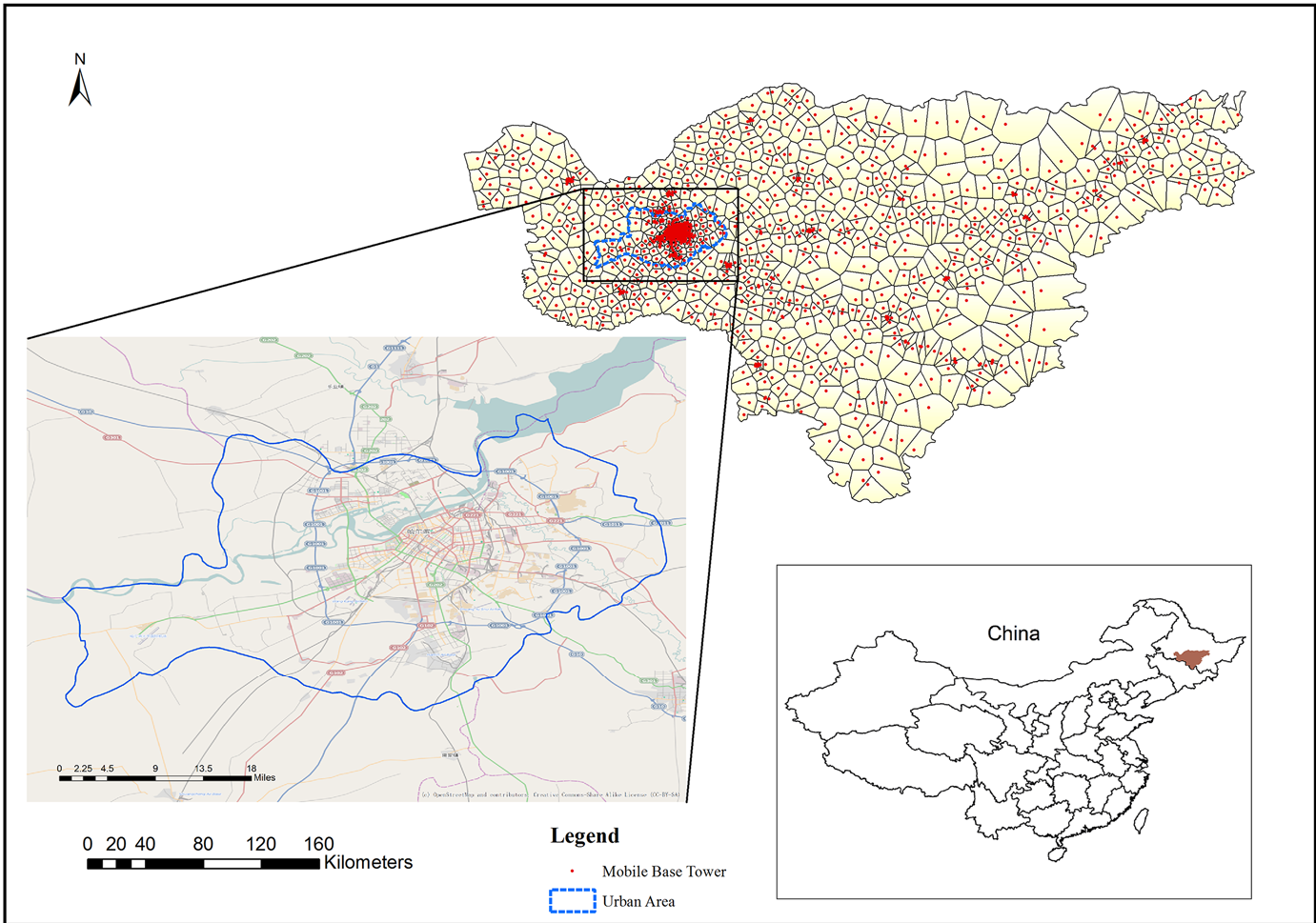 Above: The distribution of mobile base towers used to discretize "Space" into "Place" locales.
The "Place" Factor: A Better Predictor of Friendship
Through Factor Analysis, the authors combined these metrics into a "Spatial Factor." Their findings dismantled the reliance on distance:
- Distance Correlation: -0.025 (Almost zero relationship with call frequency).
- Interaction (Place) Factor Correlation: 0.285 (Significant positive relationship).
In simpler terms: You don't necessarily call someone more just because they live next door, but you definitely call them more if you frequently spend time in the same places on Sunday afternoons.
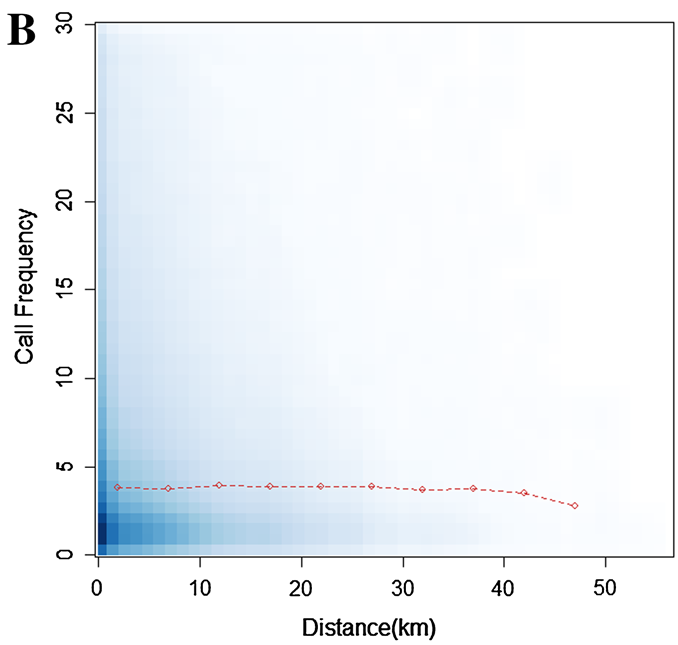 Figure: The density plots clearly show that while call frequency is scattered randomly against distance (Right), it shows a clear upward trend when mapped against the Spatial Factor Score (Left).
Critical Analysis & Conclusion
The Two-Tier Reality
The paper concludes that geography exerts its influence at two different scales:
- Macro-scale (Space): Distance acts as a filter, shaping the overall "pool" of potential connections.
- Micro-scale (Place): Co-occurrence acts as the catalyst, strengthening specific ties through shared experience.
Limitations
While the study is robust, it relies on Call Detail Records (CDR). CDR data only captures location when a call is made. This "sparsity" means many co-occurrences are likely missed. Furthermore, the 2.26km spatial error (based on tower coverage) might mask interactions in dense urban environments (e.g., two people in the same building vs. across the street).
Future Outlook
This research provides a blueprint for the next generation of Friend Recommendation Engines. Current systems often suggest "People you may know" based on mutual friends. By integrating the "Place" perspective, platforms could suggest "Friends you should reconnect with" based on overlapping weekend trajectories, significantly increasing the "Sense of Place" in digital social interactions.
Key Takeaway: In the geography of friendship, Euclidean distance is the stage, but spatio-temporal interaction is the play.