
Geometry of Lightning Self-Attention: Beyond Parameter Counting
Geometry of Lightning Self-Attention: Identifiability and Dimension
This paper provides a rigorous geometric analysis of "Lightning Self-Attention" networks—un-normalized versions of the Transformer attention mechanism—using tools from algebraic geometry. The authors characterize the "neuromanifold" of these networks, identifying the generic fibers of their parametrization and deriving precise formulas for the dimension of the resulting function space across single and deep layers.
TL;DR
Researchers from the University of Toronto and KTH have finally peeked under the hood of Lightning Self-Attention—the high-speed, un-normalized cousin of the standard Transformer. By treating these networks as complex polynomial systems, they’ve mapped out the neuromanifold (the space of all possible functions the network can represent). The verdict? Our models are often redundant. In common configurations, we might have 50% more parameters than we actually need to define the function, and the "shape" of this functional space naturally nudges models toward simpler, low-rank solutions.
Why Geometry Matters: The Problem of Identifiability
In deep learning, we usually talk about What a model can do (expressivity) or How it learns (optimization). This paper asks Where the model lives.
If two different sets of weights produce the exact same output for every possible input, the model is non-identifiable. This creates "flatness" in the loss landscape—entire valleys where moving the weights doesn't change the performance. While this can help with optimization (providing more paths to a solution), it makes it incredibly hard to calculate Sample Complexity (how much data you actually need). To fix this, we need to know the true Dimension of the function space, not just the number of entries in the weight matrices.
Methodology: High-School Algebra on Steroids
Lightning attention is defined by the map: This is effectively a polynomial. Specifically, it is tri-linear in the weights and cubical in the input . Because it's polynomial, the authors used Algebraic Geometry to find "fibers"—the sets of weights that map to the same point in function space.
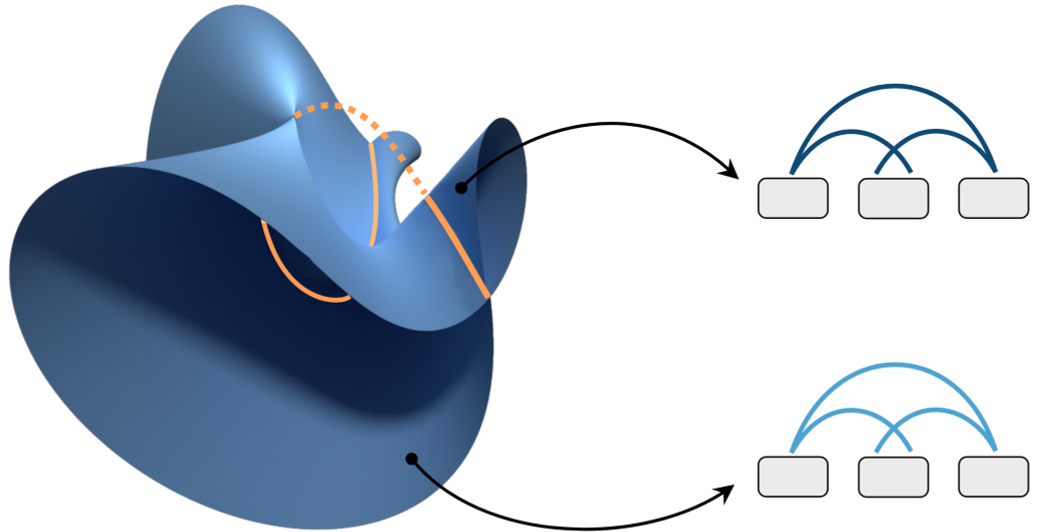 Figure 1: A 2D slice of the 5-dimensional neuromanifold for a small attention model. The yellow line shows the "singular locus" where the model's behavior fundamentally changes.
The Three Symmetries of Deep Networks
For deep networks, the authors discovered that there are only three ways to change the weights without changing the function:
- Scalar Rescaling: Scaling one layer up and another down.
- Query-Key Balance: Multiplying by a matrix and by its inverse.
- Inter-layer Telegraphing: Passing a transformation from the output of layer into the input of layer such that they cancel out.
Key Results: The "Parameter Gap"
The most striking takeaway is the formula for the dimension of the neuromanifold (the true degrees of freedom).
In a standard setup where the hidden dimension and attention head size are equal:
- Parameter Count:
- True Dimension:
- The Gap: The number of parameters is 50% larger than the actual variety of functions the network can represent.
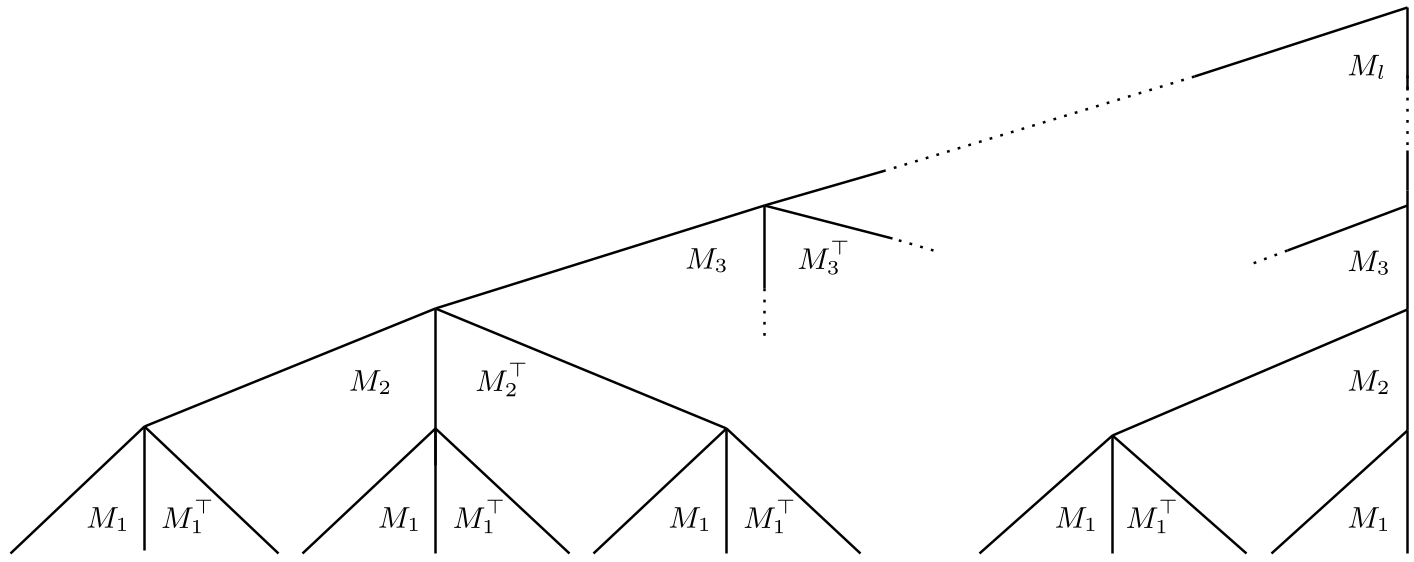 Figure 2: A recursive unrolling used to prove that the deep structure doesn't hide "secret" symmetries beyond the ones identified.
Singularities and Implicit Bias
The paper proves that the "singular points" of this space (where the manifold isn't smooth) occur exactly when the attention weights and value weights are low-rank (rank ). In Information Geometry, these singularities often act as "magnets" during training. This suggests that Transformers are mathematically biased toward low-rank simplicity—a phenomenon researchers have seen in practice but hadn't fully explained for attention mechanisms.
Comparison: Lightning vs. Traditional Softmax
Does adding Softmax (the "Traditional" way) change things? The authors conjecture (and numerically verify) that Softmax breaks the scaling symmetries. This means that in a standard Transformer, the parametrization is nearly one-to-one. Softmax effectively "solidifies" the parameter space, though the dimensional difference remains negligible for very large models.
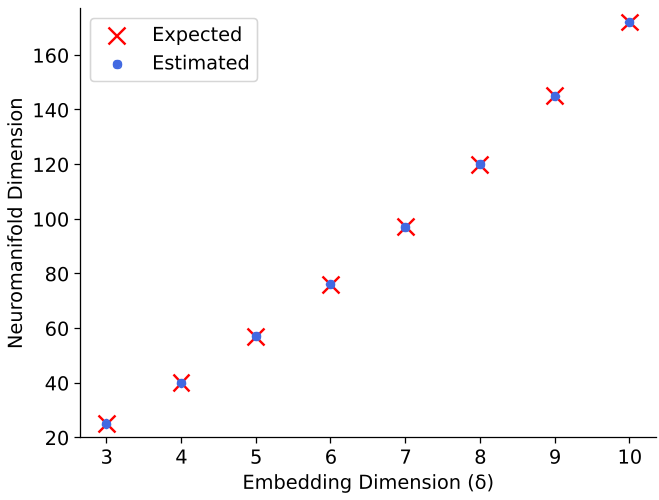 Figure 3: Numerical proof that the theoretical dimension formula (Expected) matches the Jacobian rank of the actual model (Estimated).
Critical Insight & Conclusion
This paper is a significant "academic anchor." It moves us away from guessing how many parameters a Transformer needs and toward a formal understanding of Neuroalgebraic Geometry.
Limitations: The study currently omits Skip Connections and Multi-head Attention. Skip connections likely break the remaining scaling symmetries, potentially making the model even more identifiable, while Multiple Heads will introduce Head-permutation symmetries (similar to MLPs).
Future Outlook: By defining the boundary and singular points of attention, this work opens the door for Singular Learning Theory to be applied to Transformers, potentially explaining why they generalize so well despite being massive over-parameterized systems.