
GeoTruCrowd: Balancing Trust and Efficiency in Spatial Crowdsourcing
GeoTruCrowd: Trustworthy Query Answering with Spatial Crowdsourcing
The paper introduces GeoTruCrowd, a spatial crowdsourcing framework designed to maximize the assignment of location-based tasks to workers while ensuring result validity. It models worker reliability through reputation scores and task reliability via confidence thresholds, achieving a trustworthy "wisdom of crowds" effect through majority voting.
TL;DR
GeoTruCrowd addresses the "Garbage-in, Garbage-out" problem in spatial crowdsourcing. By treating worker reliability as a probability (reputation) and tasks as confidence-seeking queries, the system assigns multiple workers to the same location-based task until a collective trust threshold is met. The proposed HGR algorithm matches the accuracy of high-end optimization while running 250x faster.
Context: When Crowds Meet Geography
Spatial crowdsourcing (SC) moves the digital task into the physical world. Whether it's a news agency requesting riot photos or a map service verifying a restaurant's status, workers must physically travel to a location. However, the system faces a dual challenge:
- The Trust Deficit: Unlike controlled sensor networks, human workers can be malicious or simply prone to error.
- The Complexity of Locality: We cannot just pick the "best" workers; we must pick the closest workers who are available and whose combined expertise meets a specific confidence level.
The Core Challenge: The MCTA Problem
The authors define the Maximum Correct Task Assignment (MCTA) problem. To ensure a task is performed correctly with confidence , the SC-server must aggregate the reputation scores of a set of workers using a Majority Voting model.
The math behind the Aggregate Reputation Score (ARS) is defined as:

This captures the probability that the majority of workers in a group will return the correct answer. The researchers prove that maximizing assignments under these conditions is NP-hard via reduction from the 3-Dimensional Matching problem.
Methodology: From Greedy to "Heuristic-Smart"
While an exhaustive search for the best worker-task matching is computationally impossible for real-time apps, the authors propose three layers of heuristics:
- Filtering (Pruning): If task can be completed by worker set , there is no reason to ever consider the set for that same task. This reduces the search space significantly.
- Least Worker Assigned (LWA): Prioritize assignments that use the fewest workers possible to "save" human resources for other pending tasks.
- Least Aggregate Distance (LAD): Minimize the total distance traveled by the assigned worker group.
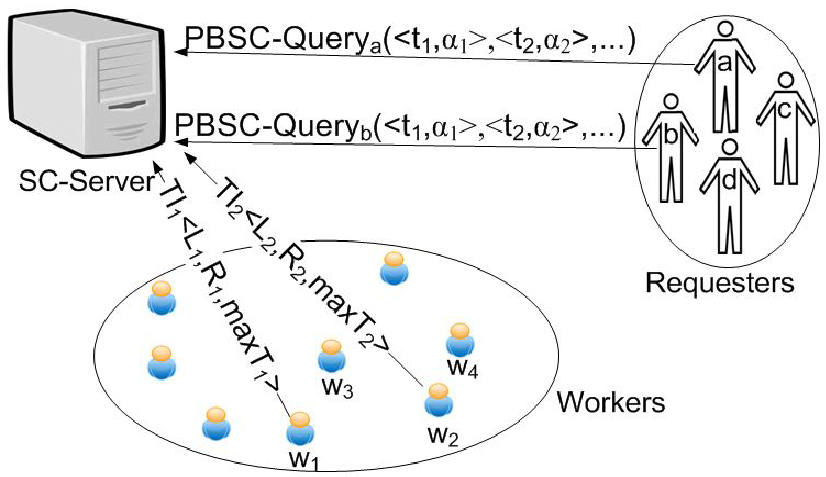
System Architecture
The workflow balances Requester needs (Tasks + Confidence) with Worker constraints (Location + Capacity).
Experimental Insights
The researchers tested their approach against a standard Greedy (GR) approach and a Local Optimization (LO) approach using Gowalla check-in data.
- Efficiency: The HGR approach produced 40-50% more assignments than the standard Greedy approach.
- Speed: While LO was accurate, its CPU cost was astronomical. HGR provided "optimization-level" results at "greedy-level" speeds.
- Travel cost: HGR consistently showed the lowest aggregate distance, proving it is the most "worker-friendly" algorithm.
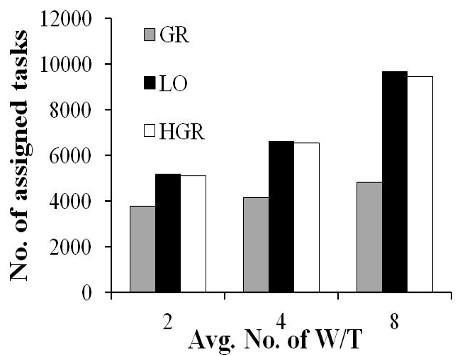 Figure: HGR matches the task assignment performance of LO while remaining scalable.
Conclusion and Practical Value
GeoTruCrowd proves that you don't need to sacrifice speed for trust. By mathematically modeling the "Wisdom of Crowds" and applying spatial heuristics, SC-servers can handle thousands of untrusted workers efficiently.
Limitations: The current model assumes a static reputation score. In reality, worker reliability changes over time. Future systems will likely need to integrate reinforcement learning to update reputation scores dynamically based on the "correctness" of previous assignments.
Future Outlook: Integrating Location Privacy remains the next frontier. How can we assign tasks to specific locations without forcing workers to reveal their exact GPS coordinates to the server?