
GESCONDA: Bridging Statistics and AI for Environmental Knowledge Discovery
GESCONDA: An intelligent data analysis system for knowledge discovery and management in environmental databases
GESCONDA is an intelligent data analysis system specifically designed for knowledge discovery and management in environmental databases. It integrates statistical pre-processing with various AI-driven data mining techniques (Clustering, Decision Trees, Case-Based Reasoning) into a unified Java-based platform to support Environmental Decision Support Systems (IEDSS).
TL;DR
GESCONDA is an intelligent data analysis system designed to extract deep insights from environmental databases. By merging statistical filtering with advanced machine learning (Clustering, Rule Induction), it helps environmental scientists transform raw monitoring data from wastewater plants and meteorological stations into actionable management patterns.
Background: The Complexity of the Environment
Environmental systems are notoriously "ill-structured." Whether it is a wastewater treatment plant (WWTP) or a seismic activity monitor, the data involves complex interactions between biological, chemical, and physical variables.
Traditional mathematical models often hit a wall because:
- They cannot handle qualitative information (the "expert feel" of an operator).
- They are sensitive to noisy data and missing values.
- General-purpose tools like WEKA or business BI suites ignore the temporal/dynamic nature of environmental processes.
Methodology: A Four-Layer Intelligence Architecture
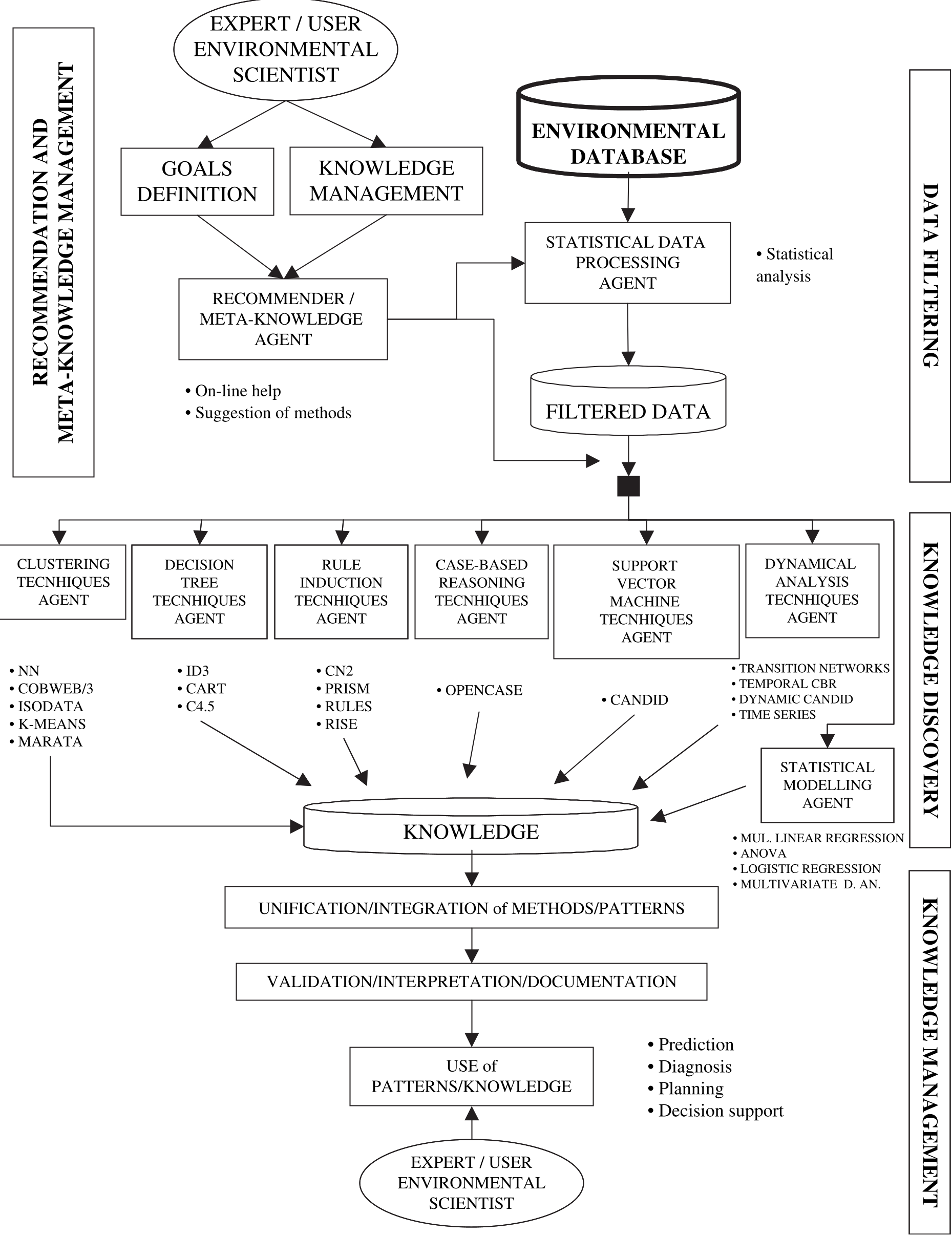
The core innovation of GESCONDA (an acronym for Knowledge Discovery and Management in Environmental Databases) lies in its unified multi-layer architecture. Instead of jumping straight into AI, it emphasizes a structured pipeline.
The 4-Level Pipeline
- Data Filtering: Statistical cleaning (outlier analysis, variable transformation).
- Recommendation Agent: Helps the user define goals and choose the right algorithm.
- Knowledge Discovery: The "Engine room" featuring K-means, COBWEB, ID3, C4.5, and Case-Based Reasoning.
- Knowledge Management: Validates and integrates patterns into Decision Support Systems.
Why This Works: The Hybrid Workflow
One of the unique insights the authors share is the power of hybridized techniques. In a typical GESCONDA session:
- Step 1: An unknown database is first processed through Clustering to identify "typical situations" (e.g., identifying different operational states of a plant).
- Step 2: These clusters are treated as new labels, and an Inductive Decision Tree is then used to find the best attributes for predicting these states.
This "unsupervised-to-supervised" transition allows the system to discover concepts that were previously hidden in the data without requiring manual labeling.
Real-World Impact & Results
The system was validated through its application to Wastewater Treatment Plants. By analyzing historical data, GESCONDA helped build an IEDSS (Intelligent Environmental Decision Support System) that supports operators in predicting toxic substance expansions and managing geomorphological descriptions.
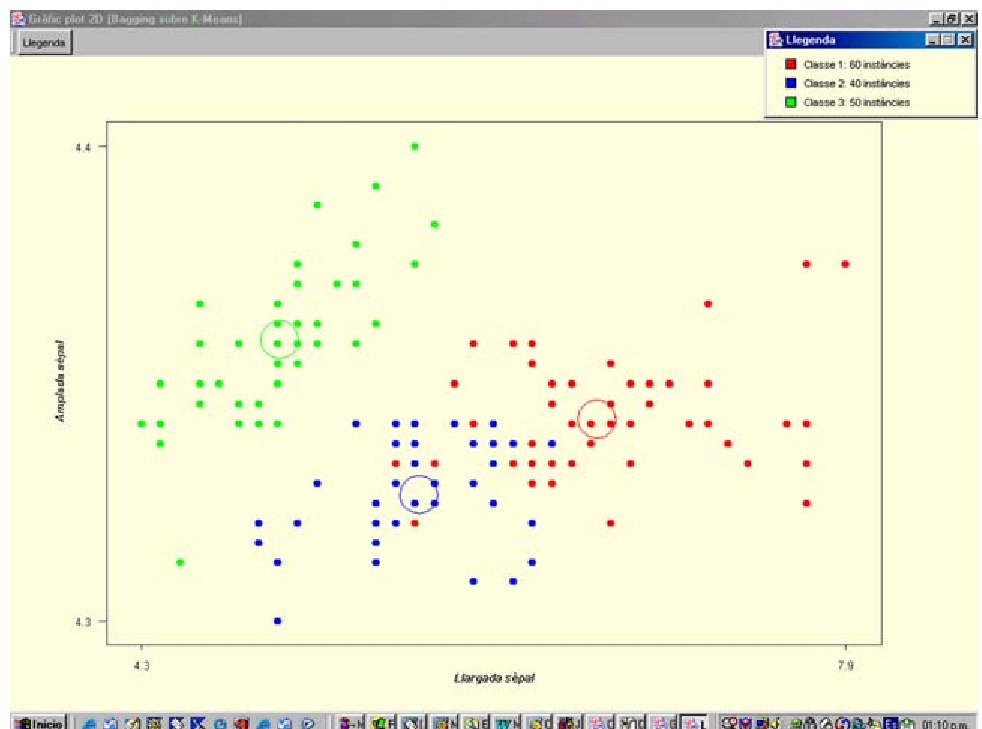
The visualization tools allow experts to see "prototypes" of different environmental states, bridging the gap between raw data and human-readable expertise.
Critical Analysis & Conclusion
Takeaway
GESCONDA proves that domain specificity matters. By embedding statistical filtering directly into the ML suite and focusing on the dynamic/temporal nature of environmental data, it outperforms generic "black-box" AI tools.
Limitations & Future Work
While revolutionary for its time (2005), the original system faced limitations:
- Data Types: It primarily handled tabular data, with plans to expand into raster (gridded) data used in Earth Sciences.
- Automation: Future versions aim to include a Support Vector Machine (SVM) agent and more automated "recommender" modules to help non-experts choose the best model parameters.
In an era where environmental crises are increasingly complex, tools like GESCONDA represent a foundational step toward truly "intelligent" planet management.