
Get out of MySpace! Navigating the Socio-Learning Divide in Higher Education
Get out of MySpace!
This study investigates the student experience with social software in Higher Education (HE) across four UK universities. Using a mixed-methods approach, the authors identify a significant "socio-learning divide" and propose a framework for integrating Web 2.0 technologies while respecting personal boundaries.
TL;DR
Higher education institutions often rush to adopt social software, assuming that because students are "digital natives," they want to learn where they socialize. This paper reveals a stark reality: students frequently view their social media as a private "fun" zone and actively resist academic intrusion—a phenomenon the authors call the Socio-Learning Divide.
The Core Conflict: Privacy vs. Pedagogy
The central tension in modern educational technology isn't just a lack of tools; it's a lack of boundary respect. The authors identify a significant gap between students' enjoyment of technology and their willingness to use it for "painful" academic tasks. When an interviewer asked about embedding social software in learning, one student's response became the anthem of the study: "No! Get out of MySpace! ...social software is for fun you know, not for study!"
Why current methods struggle:
- Context Collapse: Students maintain different personas. Dragging "academic" self into "social" spaces feels intrusive.
- Information Overload: Constant notifications turn learning into a "machine-like" experience of chasing assignments.
- The Faculty Gap: Students perceive lecturers as out-of-date or lacking the pedagogical passion to integrate these tools effectively.
Methodology: Mapping the Divide
The researchers utilized a mixed-methods approach across four universities, looking at both quantitative usage patterns and qualitative "student voices."
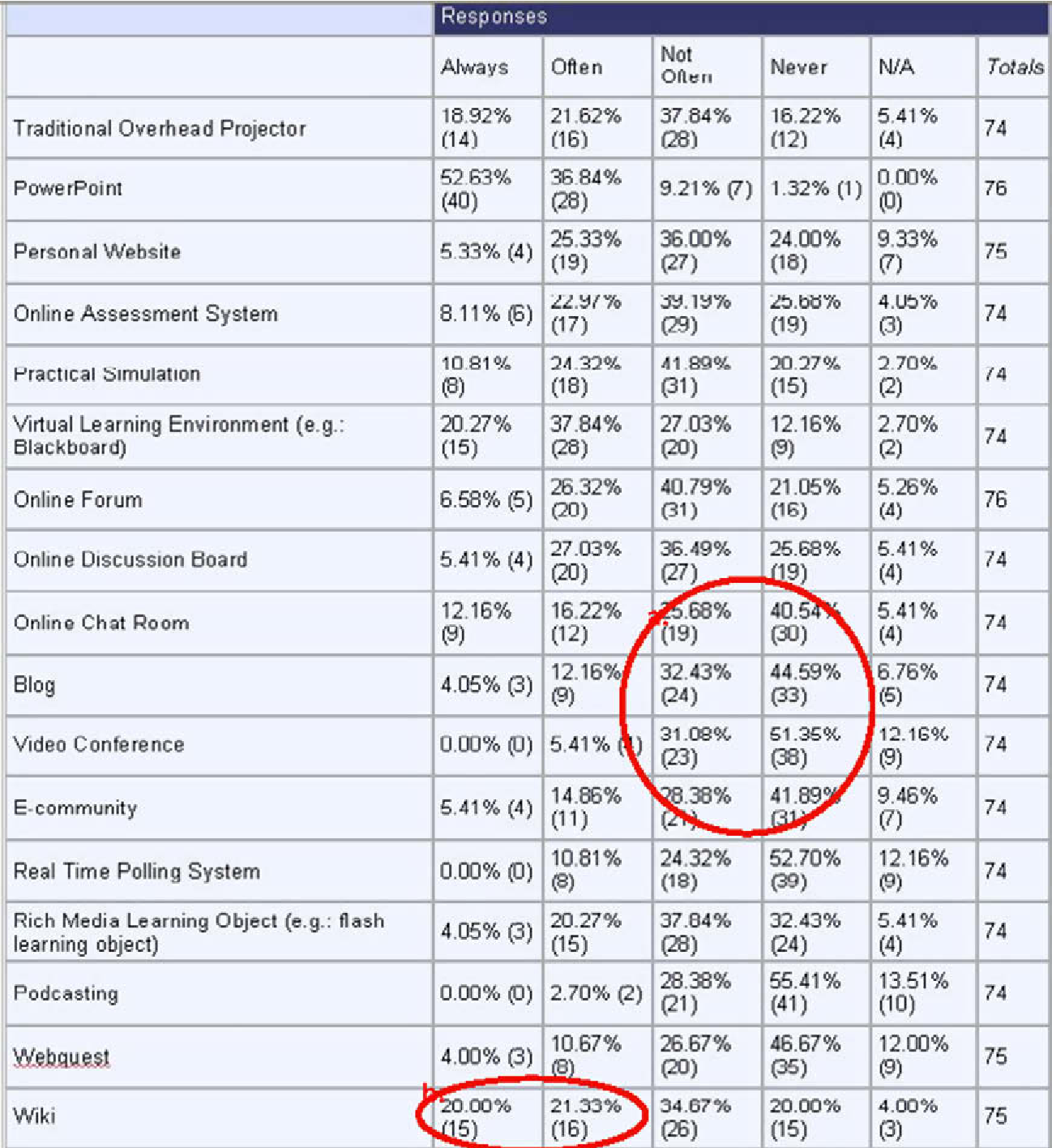 Figure 1: Comparison of traditional tech (PowerPoint/VLE) vs. social software (Blogs/Wikis) usage.
The data shows that while PowerPoint (89%+) and VLEs are king, social tools like Blogs and Podcasts lag behind significantly. The only outlier is Wikis, which bridge the gap due to their utility as reference points.
Theoretical Insight: The Vygotsky Connection
The authors ground their findings in Vygotsky’s Paradigm, which argues that learning is inherently social and cannot be separated from cultural interaction. However, the study adds a critical nuance: unlike Vygotsky's era, modern digital culture allows for a granular "Continuum of Choice."
 Figure 2: The Socio-Learning Divide Model.
The paper argues that designers must build systems that allow for overlapping personas without forcing a total merger of social and academic identities.
Key Takeaways for Institutions
What can universities do to leverage social software without alienating students?
- Promote Independent Learning: Use tools like Wikis not just for "socializing," but to foster employability skills and independent research.
- Institutional Policy over Ad-hoc Adoption: Universities need clear guidelines on IP, copyright, and privacy before asking students to post their thoughts on public-facing "Web 2.0" sites.
- Academic Support (The ABC Model): Focus on "Awareness Before Change." Lecturers need to understand the why of the tool, not just the how.
Critical Perspective & Limitations
Writing from the perspective of 2009, the paper accurately predicted the privacy fatigue we see today in platforms like Facebook/Meta. However, its limitation is the focus on now-extinct or transformed platforms (like MySpace). Today’s "Generation Alpha" may have even more complex boundaries, involving decentralized platforms and AI-driven collaborative spaces.
Final Thought
The lesson remains timeless: Technology cannot fix a lack of pedagogical passion. Authentic social learning happens when the community is built on trust and shared inquiry, not just on forced participation in a digital space.