
Get Satisfaction: How Social Media is Redefining Collaborative Software Development
Get Satisfaction: Customer Engagement in Collaborative Software Development
This empirical study explores "distributed End-User Development (EUD)" through the Get Satisfaction platform, a social-media-based customer engagement tool. It identifies how collaborative interactions between users, developers, and power-user "champions" drive long-term software product evolution.
TL;DR
This study investigates the phenomenon of Distributed End-User Development (EUD) within the Get Satisfaction platform. By analyzing user-developer interactions, the researchers demonstrate how social media artifacts—such as "likes," "threaded discussions," and "status updates"—act as mediators that allow customers to directly influence and implement new product features over long-term cycles.
The Evolution from CRM to "Mutual Development"
For decades, the boundary between software "producers" and "consumers" was rigid. Feedback was often lost in the black hole of traditional CRM systems. The authors argue that we are shifting toward a Mutual Development model. In this setup, the software product isn't just a finished tool; it's a mediating artifact that customers and developers collaboratively refine.
The challenge, however, is scaling this: How do you filter through thousands of requests without drowning the development team?
Methodology: Interaction Analysis & Artifact Mediation
The researchers utilized Interaction Analysis, focusing on the "micro-mechanics" of conversation. They viewed every post, "like," and "mood" indicator as a signal that mediates the relationship between human activity and the technical object.
The Role of the "Champion"
A critical discovery in the Get Satisfaction ecosystem is the Champion. These are high-skill "outsiders" (unpaid users) who eventually become part-time "insiders." They act as brokers, translating raw user frustration into actionable technical requests and managing expectations when development timelines stretch into years.
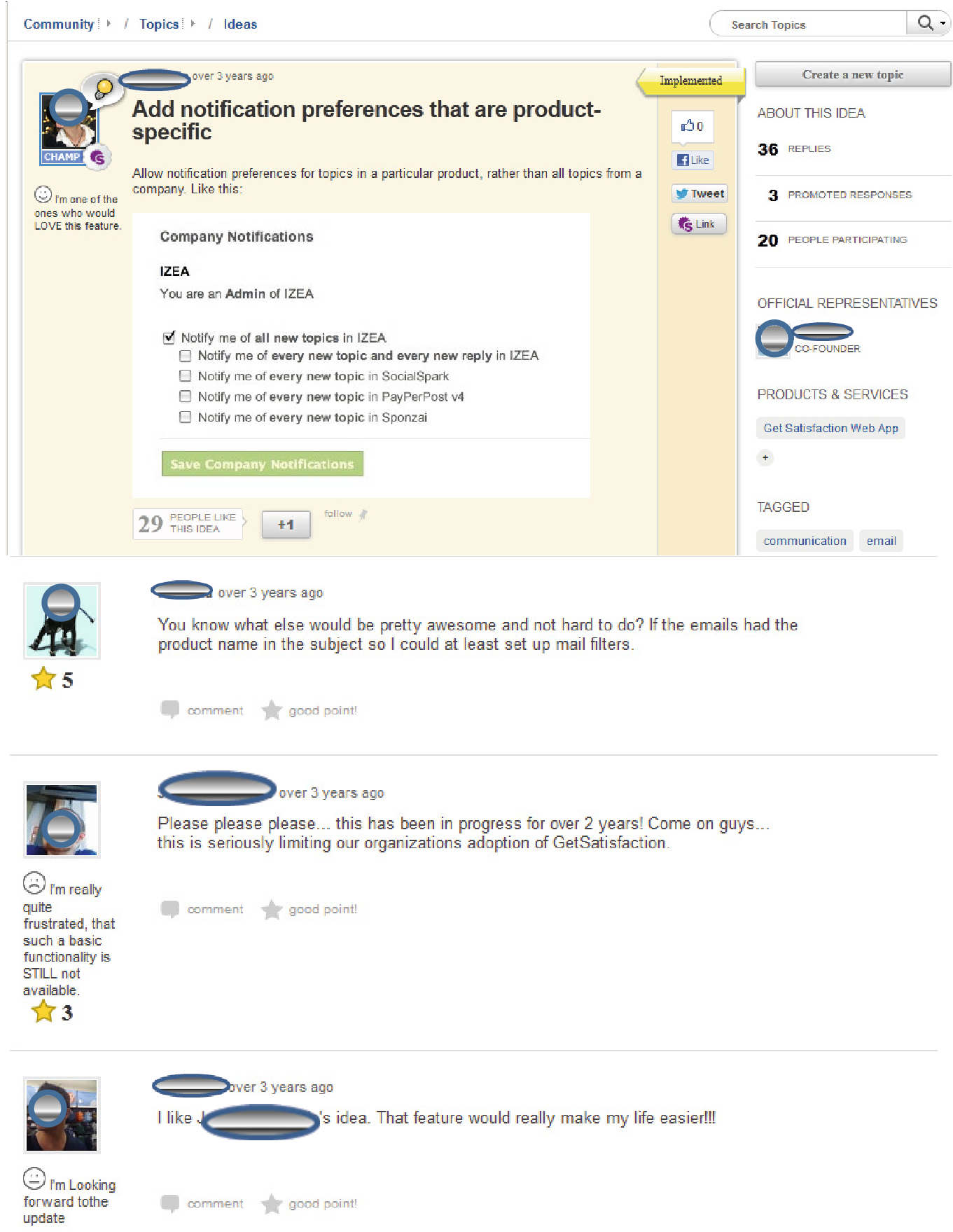 Figure 1: A typical Get Satisfaction thread showing the integration of social signals (likes/topics) with technical discourse.
Case Study: A Three-Year Development Cycle
The paper deep-dives into a specific feature request: "Add notification preferences that are product-specific."
- The Spark: A Champion proposes the idea.
- The Momentum: Multiple "Outsiders" (customers) chime in, providing specific use cases (e.g., filtering Gmail folders) and technical suggestions.
- The Friction: The process takes over three years. Users express frustration ("Please please please... this has been in progress for 3 years!").
- The Resolution: An "Insider" (Director of Product Management) eventually announces the launch of the feature, citing the community's patience and input.
This sequence proves that EUD is no longer just about individuals tweaking their own code; it is a distributed, social effort where the "crowd" provides the requirements and the "company" provides the implementation.
Key Insights: The Power of Non-Textual Mediation
The study highlights that non-textual signals are just as important as the text itself.
- The "Like" Button: With 29+ people liking an idea, developers receive a quantitative "heat map" of what features deserve resources.
- Emotional Signaling: Use of smileys and "praise" helps maintain the social fabric of the community during long delays, preventing the relationship from becoming purely transactional.
Critical Analysis & Future Outlook
While the "Get Satisfaction" model empowers users, the authors leave us with several provocative questions:
- Exploitation vs. Engagement: Is it ethical for companies to profit from the free labor of "Champions" and active users who spend years "co-developing" a product?
- Feature Creep: Does listening to the loudest users lead to "overspecialized" products that are too complex for the average consumer?
- The Silent Majority: How do "lurkers"—the millions of users who read but never post—influence this process?
Conclusion
The study successfully frames social media not just as a place for "chatting," but as a sophisticated infrastructure for distributed EUD. For product managers, the takeaway is clear: success in modern software development requires moving beyond "support" and toward "collaborative engagement."
Takeaway for Practitioners: To leverage distributed EUD, identify your "Champions" early and provide them with the social tools (likes, status tags, direct pipelines) to broker between your engineering team and your customer base.