
Gifts and Parasites: How Paro the Robot Redefines the Ethics of Care
Gifts and Parasites - Paro the Healthcare Robot and the Logics of Care
This paper introduces a socio-theoretical framework to analyze the shifting "logics of care" in post-industrial societies, focusing on the transition from care-as-gift to care-as-parasite. It uses the social robot Paro as a primary case study to demonstrate how care robotics decouples the traditional necessity of reciprocity in human relations.
TL;DR
In the landscape of aging societies, social robots like the baby seal Paro are heralded as the future of healthcare. However, this paper argues that robots shift the fundamental logic of care from a "Gift" (based on reciprocity) to a "Parasite" (a one-way arrow of taking). While robots solve issues of labor shortage, they fundamentally alter the subjectivity of the care-receiver by removing the possibility of "giving back."
The Problem: The Death of Reciprocity
In traditional sociological thought (Mauss), care is a Gift. It involves moral obligations: giving, receiving, and—crucially—returning. Even when an elderly parent is cared for by a child, there is a sense of "positional giving" where the debt is paid forward or backward across generations.
Modern healthcare markets have already wounded this logic by turning care into a Commodity. When care is bought, the patient is a "customer" who owes nothing but money. Care robots push this to the extreme. A robot has no needs, no soul, and no desire for a "cup of coffee" in return. It invites the human to be a total Parasite.
Methodology: The Serresian Lens
The authors utilize the theories of French philosopher Michel Serres. In this context, a "Parasite" isn't necessarily a pejorative term; it is a structural position in a relation where one takes "hard" things (care, energy) and gives back "soft" things (noise, words, or in the case of robots, nothing).
The Analytical Framework: Logics of Care
The paper categorizes care interactions into a 2x2 matrix based on the possibility of reciprocity:
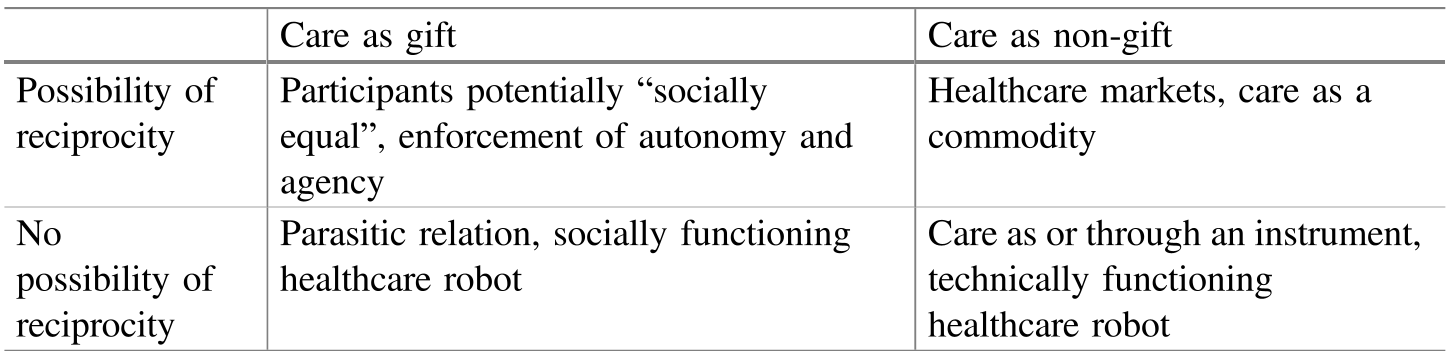
- Care as Gift: Socially equal participants, high autonomy.
- Care as Commodity: Market-based balanced reciprocity (money for service).
- Care as Parasite: Found in social robots like Paro where the user receives without the burden/opportunity of returning.
The Paradoxes of Paro
Paro is a masterpiece of Emotional Labor. It simulates the needs of a baby seal to trigger the "nurturing instinct."

The authors point out a deep irony:
- Imitation of Life: Paro "cries" when hit and "waggles" when stroked. This is a quantifiably programmed response—it does not "feel," yet it demands "correct" moral behavior from the user.
- The One-Way Mirror: The user "nurtures" the seal to get positive feedback for themselves. The user is actually the parasite, consuming the sensation of being a giver, while the robot is a host that actually takes nothing of value.
- Noiseless Interaction: Human care is "noisy"—it involves disagreement, tired caregivers, and complex emotions. Paro is "noiseless" and predictable, which the authors argue makes the interaction "lifeless."
Critical Analysis: Robots as "Systemic Noise"
The most profound insight of the paper is the idea of the robot as Parasitic Noise. In information theory, noise is what interrupts a message, but it also forces the system to reorganize.
The introduction of care robots isn't just a technological upgrade; it is an "exciter" that makes the flaws of our current healthcare system visible. If we are comfortable replacing a human with a robot, it suggests that we have already reduced the human caregiver to a "robot-like" state through overwork and strict efficiency protocols (alienation).
Conclusion & Takeaways
The paper concludes that while robots like Paro are effective therapeutic tools, we must be wary of the "Logic of the Parasite."
- Autonomy through Giving: True autonomy for the elderly often comes from the ability to be a "host"—to offer a cup of coffee to a nurse or a story to a child.
- Future Design: Should robots be designed to "need" things? Should they be able to say "thank you" or participate in actual reciprocity?
By stripping away the "noise" of human interaction, we risk creating a healthcare system that is technically perfect but socially void.