
The Sound of Silence: Using Machine Learning to Detect Childhood Anxiety through Speech
Giving Voice to Vulnerable Children: Machine Learning Analysis of Speech Detects Anxiety and Depression in Early Childhood
This paper introduces a machine learning framework for detecting internalizing disorders (anxiety and depression) in children aged 3–7 using audio analysis of a 3-minute speech task. By applying logistic regression and SVM to vocal features, the system achieves 80% diagnostic accuracy, significantly outperforming traditional parent-report screening tools.
TL;DR
Early childhood anxiety and depression are often "invisible" disorders. Researchers have now developed a machine learning approach that analyzes a mere 3-minute speech to identify these conditions with 80% accuracy. By focusing on vocal "press" responses rather than just content, this method provides an objective alternative to biased parent reports and lengthy clinical interviews.
Context & Motivation: The Gap in Early Detection
Nearly 20% of children suffer from internalizing disorders, yet most cases remain undetected until adolescence, when the risk of substance abuse and suicide increases. The primary bottleneck is two-fold:
- Limited Communication: Children under 8 struggle to articulate abstract feelings of "anxiety" or "despair."
- Parental Bias: Well-intentioned parents often dismiss symptoms as "temporary phases" or lack the clinical insight to recognize internal distress.
This paper shifts the paradigm from subjective reporting to objective physiological sensing using audio signal processing.
Methodology: The 3-Minute "Stress Test"
The researchers used an adapted Trier Social Stress Task for Children (TSST-C). Children were asked to prepare and deliver a 3-minute speech while being judged by a "neutral" experimenter. Crucially, the task included sudden buzzer interruptions to measure the child's reaction to stress.
Feature Engineering & Architecture
The team extracted 164 features, including:
- Mel Frequency Cepstral Coefficients (MFCCs): To capture the "texture" or timbre of the voice.
- Zero Crossing Rate (ZCR) of the z-scored PSD: To measure tonal complexity and inflection variances.
- Formants and Spectral Flatness: To assess the clarity and "breathiness" of the speech.
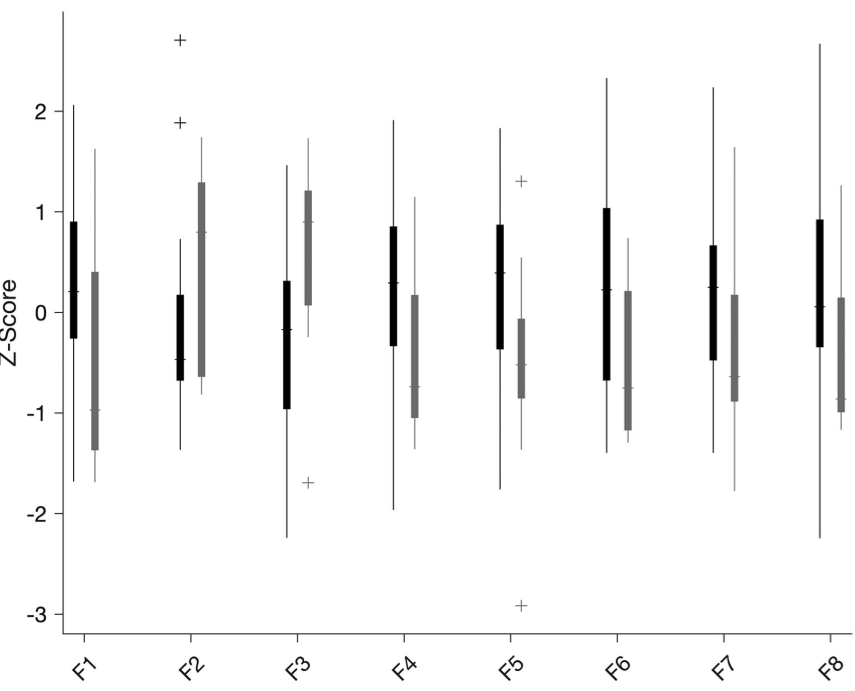 The figure above illustrates how specific vocal features (F1-F8) significantly diverge between children with (gray) and without (black) internalizing diagnoses.
Key Results: Outperforming the Gold Standard
The Machine Learning (ML) models—specifically Logistic Regression (LR) and Linear SVM (SL)—showed a clear edge over the traditional Child Behavior Checklist (CBCL).
- ML Accuracy: 80% (High Specificity of 93%)
- CBCL Accuracy: 67% - 77% (Low Sensitivity, often missed kids entirely)
What does Anxiety "Sound" Like?
The study’s most fascinating contribution is the qualitative description of the "depressed/anxious voice" in children:
- Low Pitch & Monotone: Much like adult clinical depression, affected children often have a lower average pitch and flat affect.
- Repetitive Inflection: Low variance in tonal shifts, potentially mirroring "rumination" or cognitive rigidity.
- Sharp Reactions: A high-pitched response to the buzzer (surprising stimuli), indicating a heightened startle response.
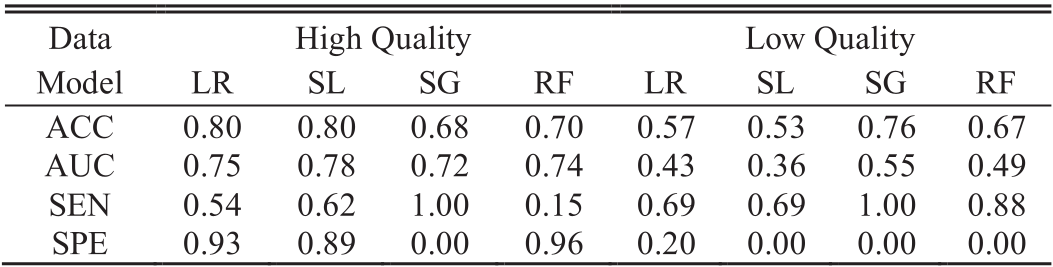 Performance metrics across different models and data quality tiers.
Critical Insight: The "Garbage In, Garbage Out" Challenge
A vital takeaway from this study is the impact of Data Quality. When recordings were "Low Quality" (background noise, siblings interrupting), the ML model's accuracy plummeted to ~54%—barely better than a coin flip. This highlights that while the algorithm is ready for the clinic, the hardware/environment for pediatric screening must be carefully controlled to ensure signal integrity.
Future Outlook
This work paves the way for "Digital Medicine" tools that can be deployed on ubiquitous devices like smartphones. Imagine a 5-minute app-based screening during a routine pediatric check-up that alerts a doctor to potential mental health risks years before they manifest as severe crises.
Takeaway: The voice is more than just a medium for words; it is a high-resolution window into a child's internal emotional state. By listening to the way a child speaks, not just what they say, we can give a voice to the most vulnerable.