
Global Agendas: Tracking the Pulse of Multilingual Twitter via Neural Summarization
Global Agendas: Detection of Agenda Shifts in Cross-National Discussions Using Neural-Network Text Summarization for Twitter
This paper introduces a neural-network-based method for near-real-time agenda detection in cross-national Twitter discussions using Longformer and T5 summarization models. Applied to the #jesuischarlie dataset, the study successfully tracks how "news-driven" content shifts to "interpretation-based" issues across English, French, and German segments.
TL;DR
Researchers have developed a method to detect "agenda shifts"—the transition from reporting news to interpreting issues—in real-time across multiple languages. By leveraging Longformer and T5 models to summarize Twitter streams, the study reveals that while global discussions (English) quickly turn to abstract principles like freedom of speech, local discussions (French) stay grounded in contextualized news for much longer.
The "Real-Time" Gap in Social Science
For decades, scholars have tracked how media agendas influence public opinion. However, in the era of Twitter, agendas shift in minutes, not days. Traditional computational methods like Latent Dirichlet Allocation (LDA) are too slow for real-time institutional responses (e.g., for the UN or EU) and often produce "word clouds" that are difficult for humans to interpret quickly.
The authors argue that we need a way to see not just what words are trending, but how the narrative is being framed across different cultures and languages simultaneously.
Methodology: From Clusters to Summaries
Instead of clustering words, this paper uses Neural Text Summarization. The core intuition is that a summary provides a coherent "agenda snapshot" that a list of keywords cannot.
The Technical Pipeline
- Data Slicing: The team divided a massive dataset of 420,080 tweets (#jesuischarlie) into 300-tweet increments.
- Transformer Models:
- Longformer: Used for English due to its ability to handle long sequences with linear attention scaling.
- T5 (Text-to-Text Transfer Transformer): Used for French and German segments.
- Sentiment-Based Validation: To ensure the AI wasn't "hallucinating," the authors compared the sentiment scores of the AI summaries against the average sentiment of the source tweets using a multilingual BERT model.
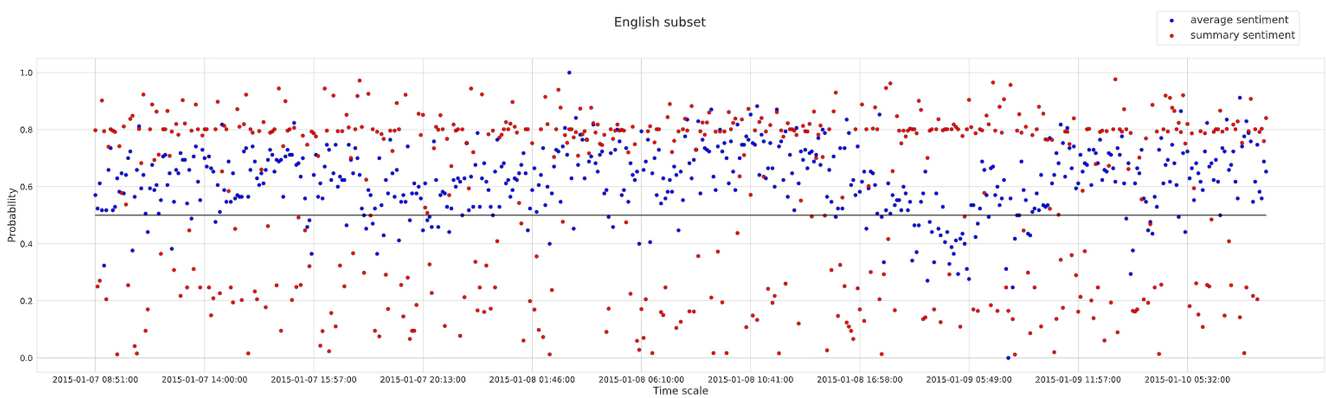 Figure: The correlation between original tweet sentiment (blue) and summary sentiment (red) serves as a proxy for model fidelity.
Key Insights: Global vs. Local Dynamics
The study highlights a fascinating divergence in how different language groups process a crisis:
- The Interpretation Outburst: In dense discussion segments (English and French), the shift from "what happened" (news) to "what it means" (solidarity, freedom of expression) occurs within the first hour.
- The Global Indicator: The English-language segment often serves as a "leading indicator," with major interpretational themes appearing 60 to 90 minutes before they stabilize in other languages.
- Contextualization Wall: French summaries remained "local" in 50% of cases, focusing on specific cartoonists and students. Conversely, English and German summaries were almost entirely "global," treating the event as a springboard for abstract rhetoric.
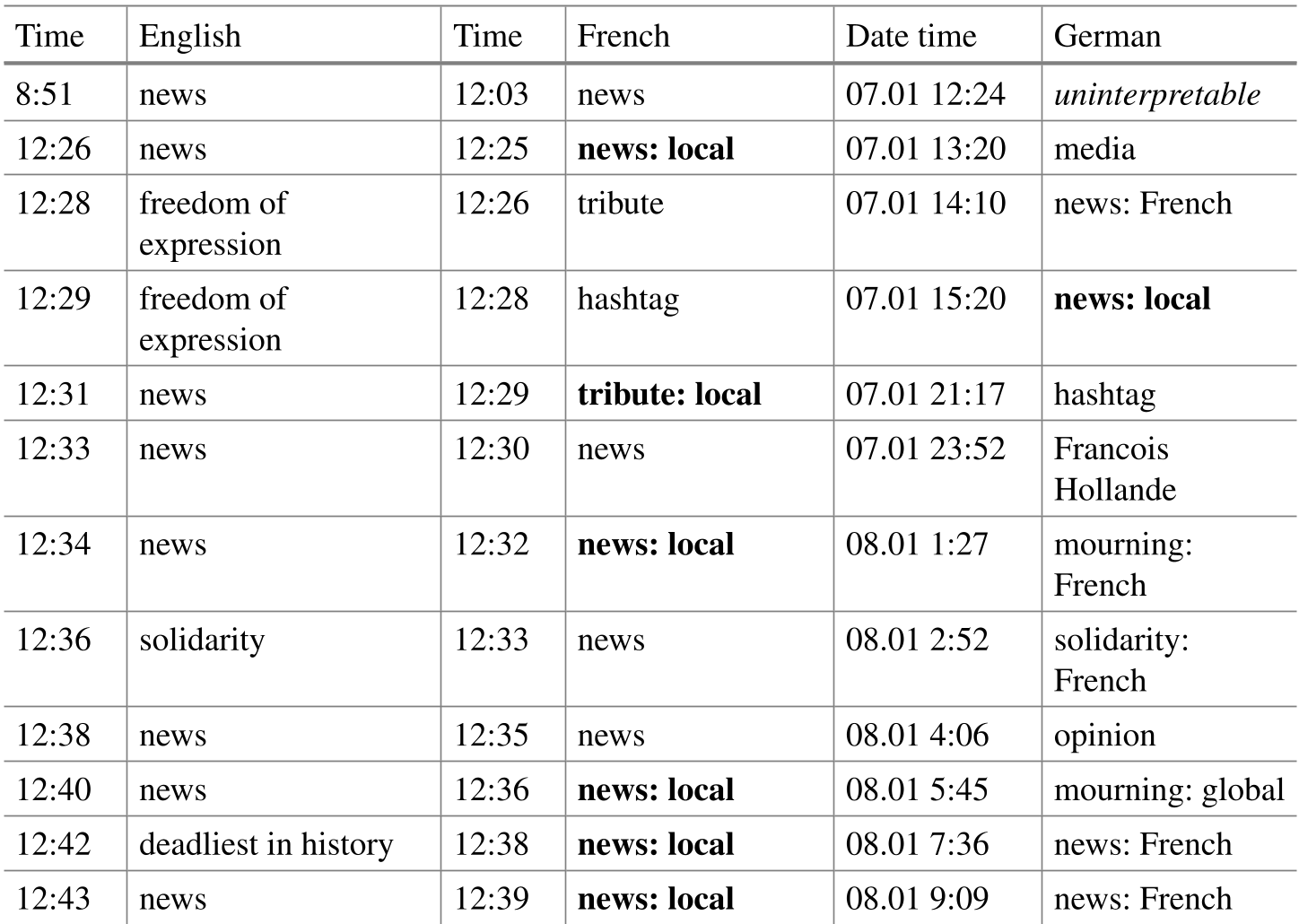 Table: Categorization of summaries into News vs. Opinion, showing the temporal progression of the discussion.
Critical Analysis & Future Outlook
While the Longformer performed admirably, the researchers noted significant "broken sentences" in the T5 summaries for French and German. This suggests that while Transformer architectures are powerful, they require fine-tuning on specific social media dialects to be truly reliable for sensitive political analysis.
The Takeaway: For international organizations, monitoring English-language Twitter may provide the fastest route to identifying the "global agenda," but understanding the local impact requires more sophisticated, context-aware models that don't lose the nuances of local culture in the process of abstraction.
Future Research Directions
The authors suggest that future work should focus on improving the T5 model’s stability and exploring whether these agenda shift patterns hold true for "slower" crises, such as climate change or economic recessions, where the shift from news to interpretation might take days rather than minutes.