
Beyond Hubs: Leveraging Global Diversity and Local Features to Identify Network Power-Spreaders
Using global diversity and local features to identify influential social network spreaders
This paper introduces a two-step framework for identifying influential spreaders in social networks by combining global diversity (via k-shell entropy) and local features (degree centrality). The method consistently outperforms or matches classical centralities like PageRank and Betweenness, achieving superior stability across diverse collaboration and communication datasets.
TL;DR
In the complex architecture of social networks, who are the most influential spreaders? While we often look for "hubs" (nodes with many friends), this paper argues that the diversity of those connections matters just as much. By combining K-shell Entropy (global diversity) with Neighborhood Degree (local power), the authors propose a new metric that consistently identifies the most effective initial spreaders across scientific, musical, and communication networks.
Background: Why Degree Centrality Isn't Enough
If you want to start a viral marketing campaign or detect a disease outbreak early, you need to find the "Super Spreaders." Historically, researchers relied on:
- Local Metrics: Like Degree Centrality (how many neighbors do I have?).
- Global Metrics: Like Betweenness (am I on many shortest paths?) or K-shell (am I in the core of the network?).
The problem? A node in the "core" (high k-shell) might only be connected to other core nodes, creating a redundant echo chamber. Conversely, a high-degree node might be stuck in a peripheral "cluster" with no path to the rest of the network. This paper introduces a two-step framework to solve this by measuring how well a node bridges different network "layers."
Methodology: The Two-Step Framework
The authors' core insight is that an influential node should be "globally diverse" and "locally powerful."
Step 1: Global Diversity via Entropy
Using k-shell decomposition, the network is peeled like an onion into layers. The authors then apply Shannon Entropy to the neighbors of a node.
- Low Entropy: Your neighbors are all in the same layer.
- High Entropy: Your neighbors are spread across the core and the periphery. This indicates a "bridge" node.
Step 2: Local Feature Integration
A node must also have strong local reach. The authors calculate the log-sum of the degrees of all immediate neighbors. This ensures that even if you only have a few friends, if those friends are themselves "hubs," your spreading potential remains massive.
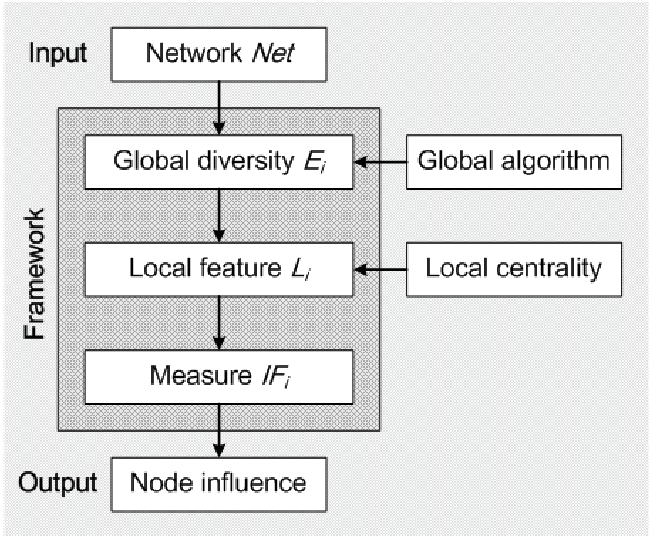
The final influence score is a simple yet elegant product: .
Experiments: Dominating the Leading Group
To test this, the authors used the SIR (Susceptible-Infective-Recovered) model—the gold standard for simulating epidemics—on 13 real-world datasets, ranging from Enron emails to Jazz musician collaborations.
Performance vs. Stability
The researchers tracked the "Leading Group" (LG), a set of methods that performed within 1% of the absolute best spreader in each scenario.
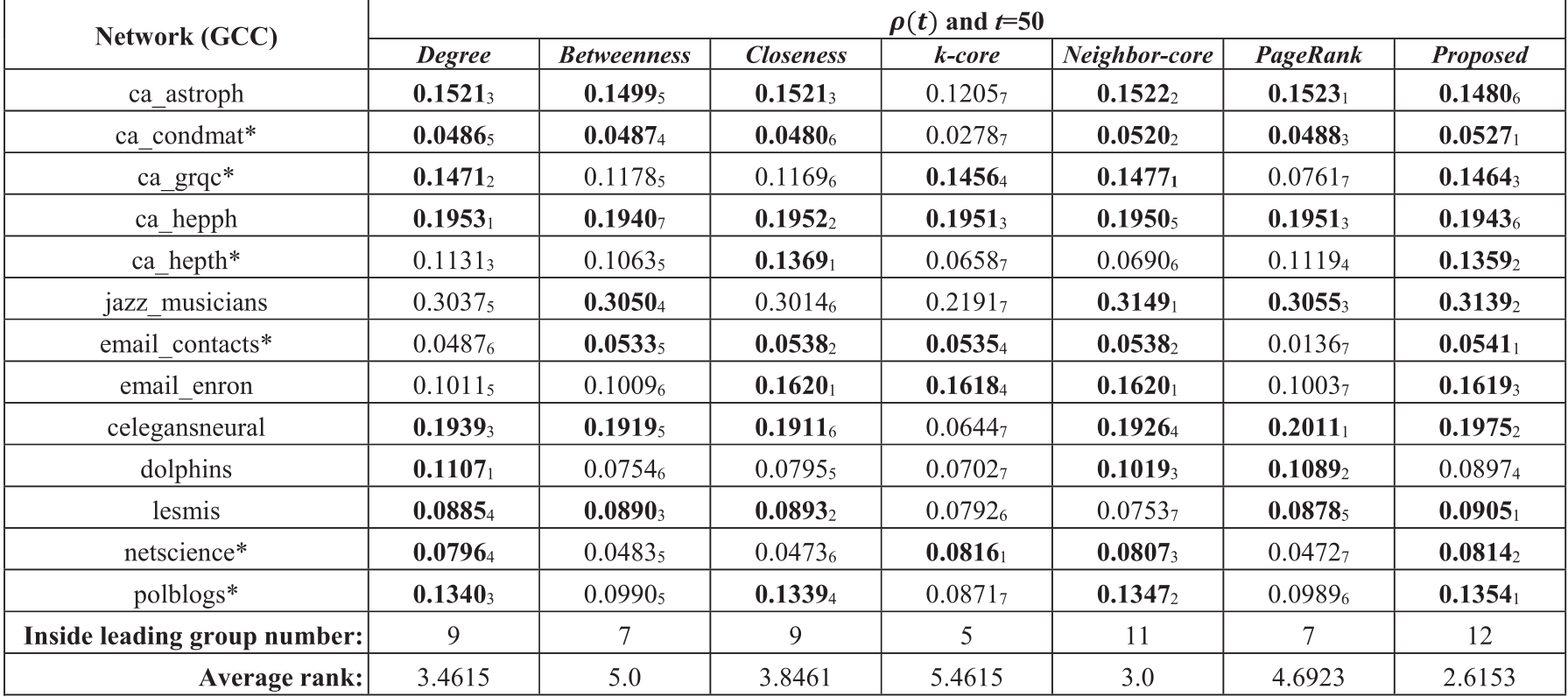
- The Proposed Method: Entered the Leading Group in 12 out of 13 networks.
- Neighbor-core: Entered 11 times.
- K-shell: Only entered 5 times.
This proves that while k-shell is a good indicator of being in the "thick of it," it lacks the granularity to identify the best individual starting points. The proposed method's average rank of 2.61 makes it the most reliable tool in the toolbox.
Critical Insight: The "Connector Hub" Advantage
The success of this method lies in the trade-off between coreness and diversity. The traditional "Core" nodes (nucleus of the network) are great for sustaining an infection that is already widespread. However, entropy-based diversity identifies Connector Hubs—nodes that might not be in the absolute center but have the unique "reach" to jump across community boundaries and layers.
Limitations
- Low-Degree Bottle-necks: If a node has high global diversity but extremely low degree, its spreading capacity is bottlenecked by its neighbors' abilities.
- Small-Scale Networks: In very small networks (like the "dolphins" dataset), global diversity is less meaningful because there aren't enough layers to provide meaningful entropy.
Conclusion
This research shifts the focus from "how many people you know" to "where those people sit in the global hierarchy." For anyone working in viral marketing, public health, or information security, the takeaway is clear: identify nodes with connections that span across the core and the periphery. Those are your true social network sensors.
Looking ahead, the authors plan to investigate how community structure (not just shells) impacts this diversity and how to optimize for multiple initial spreaders simultaneously.