
The Hidden Power of Ordinary Users: How Network Assortativity Redefines Global Influence
Studying the Global Spreading Influence and Local Connections of Users in Online Social Networks
This paper investigates the relationship between a user's local connectivity (degree and assortativity) and their global spreading influence (measured by k-shell coreness) in Online Social Networks (OSNs). By analyzing both real-world datasets and the RDC theoretical model, it demonstrates that influence follows a power-law dependence on degree, but the strength of this relationship is governed by the network's assortativity.
TL;DR
In the world of Online Social Networks (OSNs), we often assume that "influencers" are defined solely by their number of followers (degree). This paper reveals a more nuanced reality: while high-degree users are generally influential, the assortativity of a network—the pattern of who connects to whom—can empower ordinary users to trigger massive information cascades. Specifically, in networks like Facebook where users cluster with similar peers, local connection patterns can outweigh raw follower counts.
Problem & Motivation: Beyond the "Hub" Obsession
For years, the "Super-spreader" hypothesis dominated network science: find the hubs with the most edges, and you find the source of viral growth. However, empirical evidence has increasingly shown that "ordinary" users can cause large-scale diffusion.
The authors identify a gap in understanding: Why does the predictive power of a user's degree fluctuate across different networks? They hypothesize that the missing link is Assortativity—a measure of whether "popular" users hang out together (assortative) or link to "unpopular" users (disassortative).
Methodology: The Coreness vs. Degree Power-Law
To bridge local metrics and global impact, the researchers employ two primary tools:
- k-shell Decomposition: A method that prunes the network to find the "inner core." A higher coreness () represents a significantly higher global spreading potential.
- Power-law Modeling: They propose the relationship . The exponent represents the "intensity" of how much influence depends on degree.
The Architecture of Influence
The paper utilizes the RDC (Reaction-Diffusion-like Coevolving) Model to simulate how OSNs grow and how users activate based on local dynamics. This allows for a controlled environment to test how different assortativity levels affect the spreading coefficient.
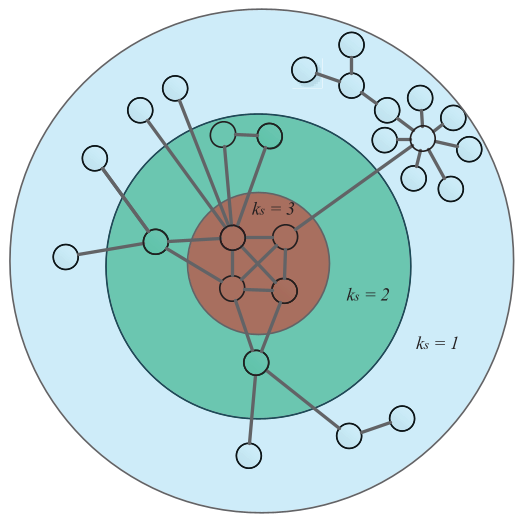 Figure 1: The k-shell structure allows us to see beyond immediate neighbors to a user's position within the global topology.
Experiments & Results: The "Beta" Factor
The researchers analyzed six diverse datasets, including Facebook (Assortative), Digg (Disassortative), and Gowalla (Neutral).
- Disassortative Networks (): In networks where high-degree nodes connect to low-degree nodes, the degree is a near-linear predictor of influence. Here, "Super Users" are easy to spot.
- Assortative Networks (): In clustered networks, the relationship weakens. Influence is "distributed," and the local pattern of connections allows low-degree nodes in the right "shell" to punch far above their weight.
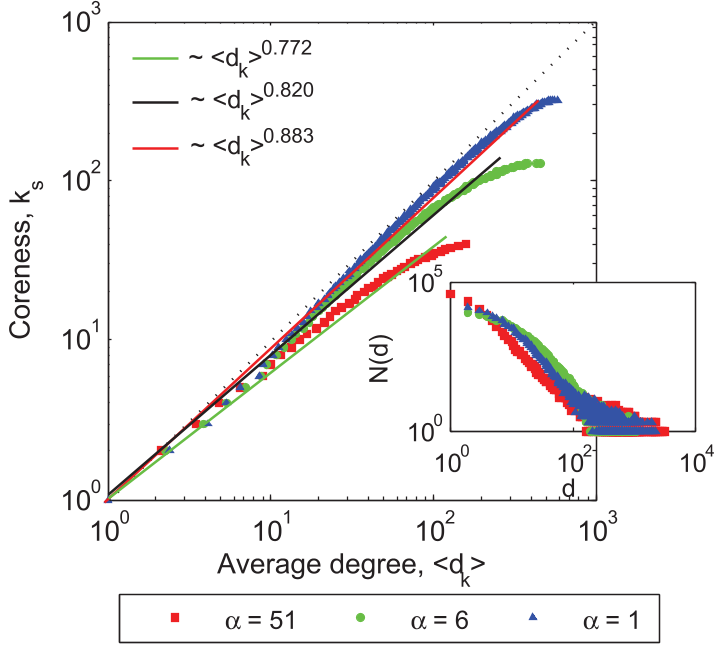 Figure 2: Empirical results showing the steep slope () for disassortative networks compared to the flatter slope for assortative networks.
Evolutionary Trends
Intriguingly, as networks grow, these traits consolidate. In assortative networks, decreases over time, meaning as the network matures, it becomes even more likely for ordinary users to have significant spreading power, as the structure becomes more vital than the individual.
Critical Analysis & Conclusion
Takeaway
The core value of this research is the theoretical validation of the "ordinary influencer." It shifts the focus from how many connections one has to where those connections sit in the network's structural hierarchy.
Limitations & Future Work
The study primarily focuses on static topological features. Future research could explore:
- Temporal Dynamics: How the speed of connection growth (rather than just final size) shifts influence.
- Content Variation: Does the type of information (news vs. entertainment) change the value of the exponent?
In conclusion, if you are looking to start a movement on an assortative platform like Facebook, don't just chase the celebrities—find the users deeply embedded in active, core clusters.