
Mannadjuvant: Rewiring the Innate Context to Supercharge mRNA Vaccines
A glycan-based adjuvant expands the breadth and duration of protection of mRNA-based vaccines.
This study introduces mannadjuvant (MA), a glycan-based adjuvant combining fungal mannan and aluminum hydroxide that targets the dectin-2 receptor. When co-formulated with SARS-CoV-2 mRNA vaccines, MA significantly enhances the magnitude, durability, and breadth of the immune response, providing robust protection against highly evasive variants like Omicron (BA.5, XBB.1.5) in both mice and non-human primates.
TL;DR
Researchers have developed a fungal-derived "mannadjuvant" (MA) that, when added to standard mRNA vaccines, breaks the barriers of antigenic imprinting and waning immunity. By triggering a specific IL-1 and Type I Interferon loop, the adjuvant forces the immune system to produce a more diverse and durable array of antibodies, capable of neutralizing even the most evasive SARS-CoV-2 variants like XBB.1.5 and BA.5.
Background: The Problem of "Original Antigenic Sin"
The COVID-19 pandemic highlighted a critical flaw in our current vaccine technology: the immune system's memory is often too good. Once primed by a specific strain (the ancestral WA1), later exposures to updated boosters often fail to generate new types of antibodies. Instead, the body simply ramps up old ones—a phenomenon known as antigenic imprinting. Coupled with the fact that mRNA-induced protection typically fades within months, the search for a way to "broaden" and "lengthen" our defense has become the "holy grail" of vaccinology.
The "Why": Leveraging Fungal Secrets
Why use mannan? Evolutionarily, mammals have spent eons recognizing the complex sugar patterns (glycans) on the cell walls of fungi like Candida albicans. These patterns are recognized by Pattern Recognition Receptors (PRRs) like Dectin-2. The authors hypothesized that by mimicking a fungal infection at the site of injection, they could "trick" the immune system into a higher state of alert, fostering more robust and flexible B-cell education in the germinal centers.
Methodology: Tuning the Inflammatory Dial
The team combined fungal mannan with aluminum hydroxide (alum) to create Mannadjuvant (MA). Unlike alum alone, MA doesn't just sit at the injection site; it actively reprograms the transcriptional landscape of the draining lymph node (dLN).
The Core Mechanism: The IL-1 / IFN Feedback Loop
Through bulk RNA-sequencing, the researchers discovered that MA-vaccinated subjects didn't just have more inflammation; they had different inflammation. Specifically:
- IL-1 Signaling: MA triggers the inflammasome, producing IL-1β.
- Type I Interferon (IFN): This IL-1 production initiates a positive feedback loop that sustains IFN levels in the lymph node for several days.
- B-Cell Diversity: This sustained signal expands Germinal Centers, allowing a diverse set of B-cells to undergo Somatic Hypermutation (SHM). This leads to antibodies that can recognize mutated "escape" versions of the virus.
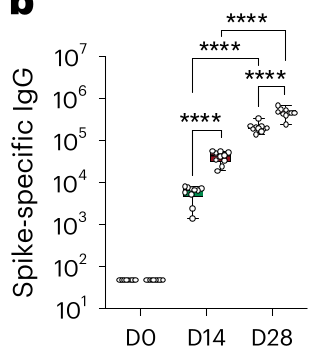 Figure 1: Comparison of standard mRNA vs. mRNA+MA demonstrates the dramatic increase in neutralizing antibody titers against both ancestral and Omicron BA.1 strains.
Experimental Battlefront: Mice to Primates
The study’s strength lies in its cross-species validation. In Cynomolgus monkeys, those given the MA-enhanced vaccine showed significantly higher antibody titers that lasted up to 180 days, whereas standard mRNA groups saw a more rapid decline.
Furthermore, the researchers tested the ability to overcome imprinting. They primed mice with the original vaccine, then "challenged" them with an updated XBB.1.5 booster. Only the mice that received the MA-boosted version managed to generate high levels of antibodies that effectively targeted the new variant.
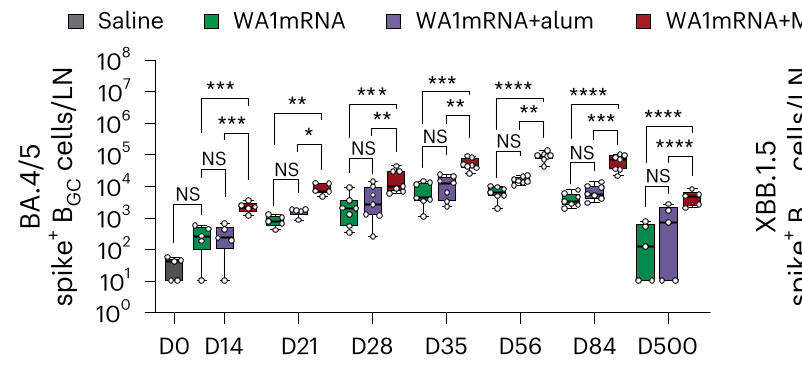 Figure 2: MA-enhanced vaccines (purple) consistently outperform standard mRNA (blue) and alum-added mRNA (green) across all variants, including XBB.1.5 and BA.5.
Clinical Insight: Impact on Human Cells
To ensure this wasn't just a murine phenomenon, the team tested MA on human Peripheral Blood Mononuclear Cells (PBMCs). The results were consistent: MA induced robust IL-1β, IL-6, and TNF production in human myeloid cells, suggesting that the pathway is highly conserved and likely to translate effectively to human clinical trials.
Critical Analysis & Future Outlook
While the results are impressive, there are several points to consider:
- Reactogenicity: While the study showed no significant increase in fever or weight loss in primates, "turning up" the inflammatory dial always carries a risk of increased local side effects (soreness, swelling).
- Storage and Complexity: Admixing an additional adjuvant to mRNA vaccines adds a layer of complexity to manufacturing and distribution.
Conclusion
This work marks a shift from simply changing the "software" (the mRNA sequence) of a vaccine to upgrading the "hardware" (the innate immune environment). By shifting the focus to PRR modulation, the researchers have provided a roadmap for creating vaccines that are not only stronger but smarter—potentially ending the perpetual "catch-up" game we play with viral mutations.