
Going Farther Together: Does Social Capital Prevent the "Leaky Bucket" of Open Source?
Going Farther Together: The Impact of Social Capital on Sustained Participation in Open Source
This paper investigates the impact of social capital on the sustained participation of contributors in Open Source Software (OSS) on GitHub. By combining longitudinal survival analysis of 58,091 developers with a user survey, it identifies how network structures and expertise diversity mitigate disengagement risks, particularly focusing on gender disparities.
TL;DR
Is Open Source a meritocracy of code, or a network of humans? This research suggests the latter. By analyzing nearly 60,000 GitHub contributors, the authors find that Social Capital—the resources derived from one’s social network—is a primary predictor of whether a developer stays or leaves. Critically, for women, who face higher risks of disengagement, the "antidote" isn't just more bonding, but diversity in team expertise.
Background: The Retention Crisis
The survival of Open Source Software (OSS) is precarious. Most contributors drop out within the first two years. This "retention crisis" is even more acute for women, who exhibit significantly higher disengagement rates than men (see Figure 1).
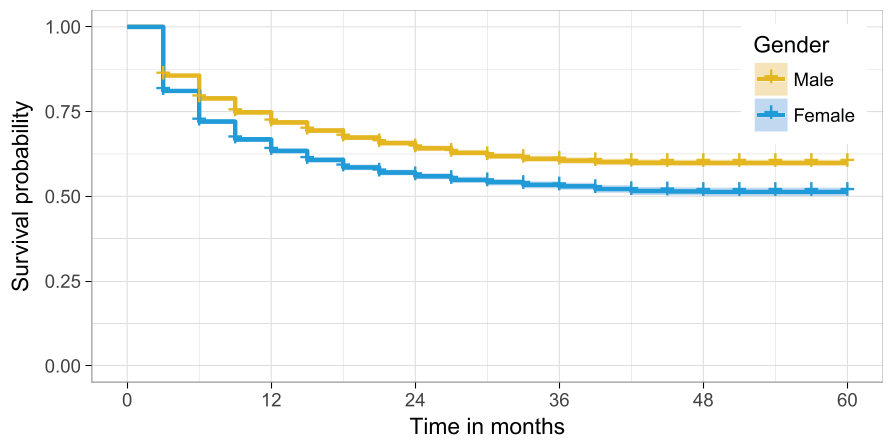 Fig 1: Kaplan-Meier estimators showing that women disengage significantly earlier than men.
The "Why": Social Capital as a Survival Tool
The authors argue that developers don't just write code; they build social capital. This comes in two flavors:
- Bonding Social Capital: Strong, dense ties in cohesive teams that build trust and identity.
- Bridging Social Capital: Weak ties that act as "bridges" to new information, technologies, and projects.
The core intuition is that developers with more social capital find their OSS experience more rewarding and are thus less likely to quit.
Methodology: Mapping the Network
To test this, the authors used a massive longitudinal dataset from GHTorrent. They tackled a common research hurdle: Gender Inference. Most tools fail on non-Western names, so they developed a custom classifier that significantly improved accuracy for Chinese, Japanese, and Korean names (reaching 83.6% overall).
Core Metrics
- Team Familiarity: How much have these people worked together before?
- Recurring Cohesion: Finding cliques of 3-5 people who "travel" together across different projects.
- Language Heterogeneity: The diversity of programming expertise within a team.
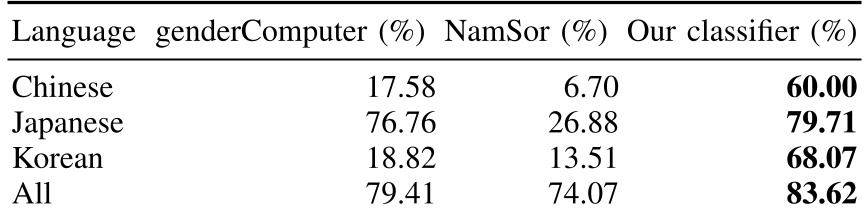 Table 1: The paper's custom classifier outperforms standard tools, especially in East Asian name sets.
Key Insights: Why Diversity Matters for Women
The survival models revealed a fascinating interaction between gender and expertise:
- High Stakes for Newcomers: Disengagement is most likely in the first three months. If you survive the "onboarding" phase, your social capital becomes even more predictive of long-term stay.
- The Diversity Buffer: For women, simply being in a cohesive team isn't enough. However, when a team has high Language Heterogeneity (members with diverse coding backgrounds), the risk of women quitting drops significantly.
- The "Outsider" Effect: In male-dominated fields, "cohesive" networks can sometimes become "exclusionary silos." Diversity breaks these silos, making it easier for underrepresented groups to integrate without needing to be part of the "old boys' club."
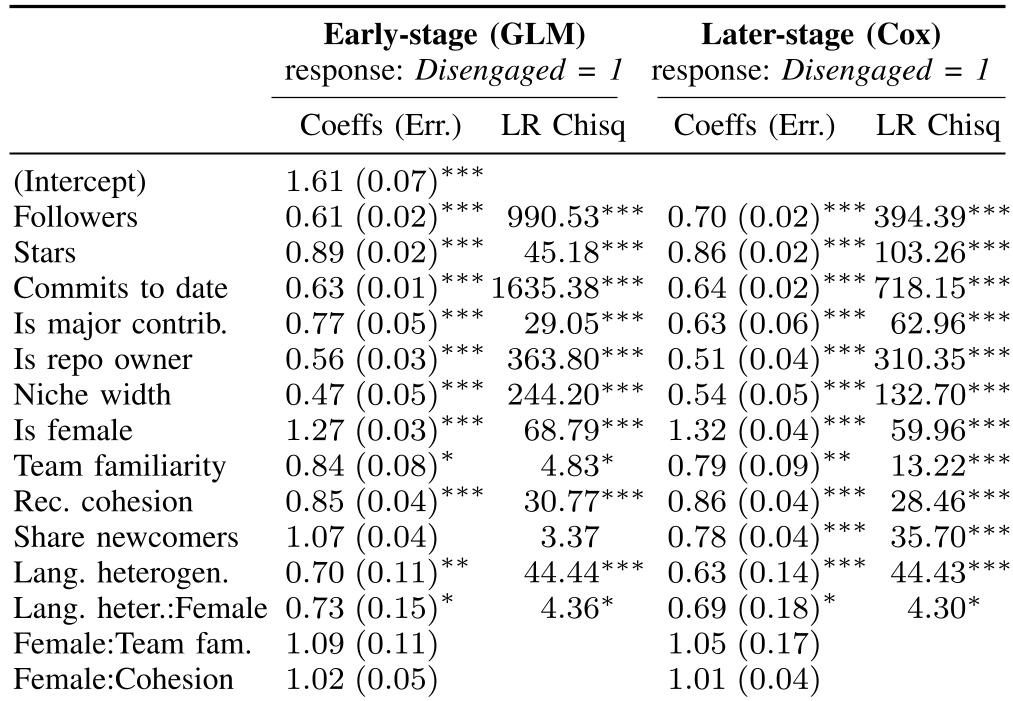 Table 2: Cox regression results. Note the significant interaction between 'Is Female' and 'Language Heterogeneity'.
Conclusion & Perspective
This work shifts the focus of OSS health from code quality to community structure.
Takeaways for Project Maintainers:
- Don't just hire for skill; hire for diversity. It isn't just a "nice to have"—it's a retention strategy.
- Foster "Transitive" Ties. Encourage members who have worked together before to mentor newcomers.
Takeaways for Platforms (GitHub):
- Recommendation engines should recommend projects not just based on "Languages you know," but on "Teams where you'll build the most social capital."
While the study is limited by the binary assumption of gender and the lag in GHTorrent data, it provides a rigorous foundation for a more "human-centric" view of software engineering.