
Gossip-based OSN Partitioning: Beyond Greedy Heuristics for Social Graphs
Gossip-based Partitioning and Replication for Online Social Networks
The paper introduces a gossip-based partitioning and replication scheme designed specifically for Online Social Networks (OSNs). By utilizing local metabolic moves and simulated annealing, the method minimizes replication overhead while ensuring one-hop data locality, outperforming random partitioning by 4x and the state-of-the-art SPAR by 2x.
TL;DR
Researchers have developed a distributed, gossip-based algorithm that intelligently partitions and replicates Online Social Network (OSN) data. By replacing standard random partitioning and naive greedy heuristics with a self-organizing gossip protocol and simulated annealing, they reduced replication overhead by up to 4x while maintaining perfect data locality for user news feeds.
Context: The Social Data Silo Problem
Modern OSNs like Facebook and Twitter generate petabytes of data characterized by strong community structures. When you fetch a news feed, the system must aggregate data from your friends (one-hop neighbors).
The industry standard—Random Partitioning—is disastrous for these workloads. If friends are scattered across different servers, the system either suffers from massive network latency or is forced into "Full Replication" (copying every user to every server) to keep data local.
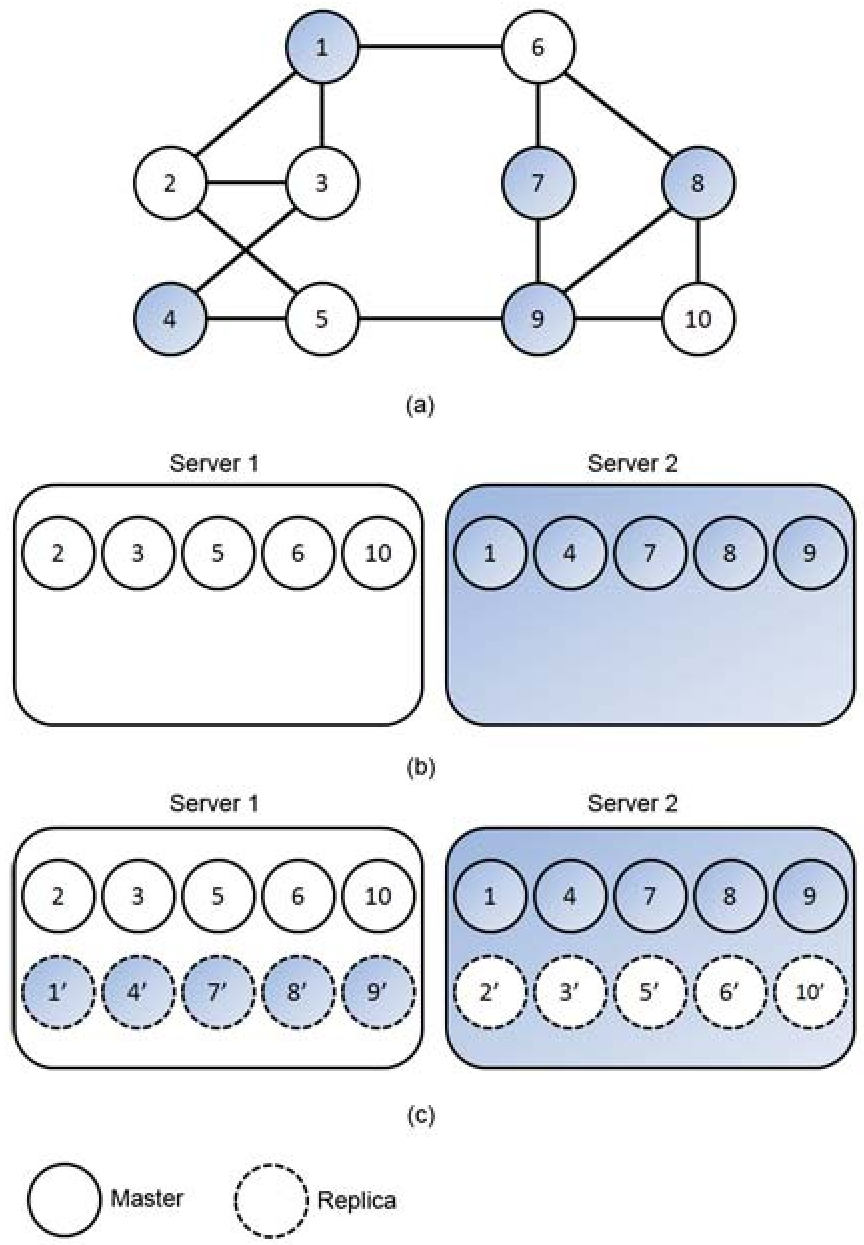
Previous SOTA methods like SPAR attempted to solve this using greedy optimization. However, SPAR is often "blind" to the global graph structure, getting stuck in local optima where a single bad placement decision cascades into dozens of unnecessary replicas.
The Core Innovation: Distributed Gossip & Annealing
Instead of a centralized "one-shot" placement, this paper treats partitioning as a dynamic, evolving process.
1. Peer Selection via Random Walks
Nodes don't just talk to their friends. To ensure a global view, the algorithm uses a hybrid peer selection:
- Local moves: Swapping server assignments with immediate neighbors.
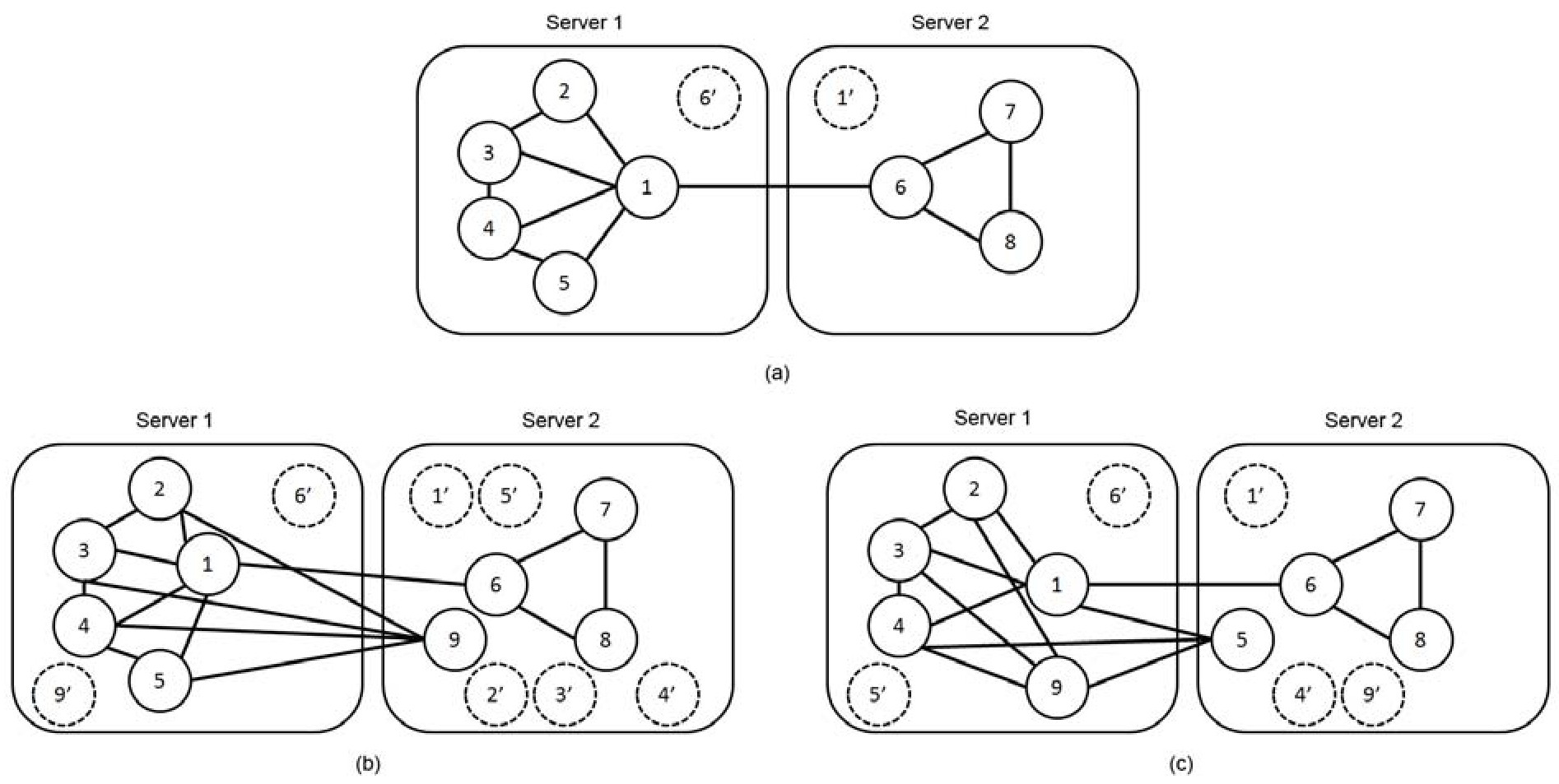
- Global exploration: Using a Random Walk (typically 6 steps) to find distant peers for potential swaps.
2. The Cost Function & Simulated Annealing
The algorithm defines a cost function based on the number of replicas required to maintain one-hop locality. Two nodes will swap their master server locations if it reduces the total system cost.
To avoid the local optima trap that plagues SPAR, the authors introduce Simulated Annealing. Early in the process (High Temperature ), the system allows "bad" swaps to explore the solution space. As cools (Cooling Rate ), the system "freezes" into a highly optimized configuration.
Experimental Battleground
The researchers tested the method against Facebook (Snap and WSON datasets), Twitter, and synthetic graphs across clusters of up to 64 servers.
Key Findings:
- Replication Overhead: The proposed algorithm consistently outperformed SPAR. In highly clustered synthetic graphs, it halved the overhead.
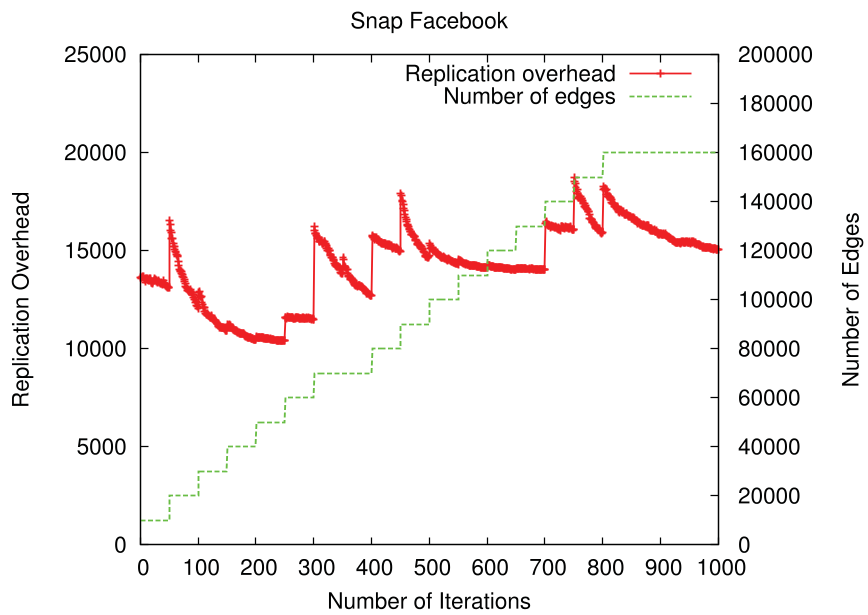
- Convergence: On real-world social graphs, the system converges within ~200 iterations, proving it's practical for periodic offline optimization (e.g., daily or weekly re-balancing).
- Dynamic Handling: When new edges are added, the algorithm exhibits a small spike in overhead which it rapidly "cools" back down through iterative gossiping.
Academic Insight: Why it Works
The success of this approach lies in its Inductive Bias. OSN graphs aren't random; they have "small-world" properties. By combining direct neighbor swaps with random walks, the algorithm mimics the way information flows through social communities. While SPAR tries to be "smart" once, this gossip approach is "continuously learning," allowing it to navigate complex community overlaps that centralized heuristics simply cannot see.
Conclusion & Future Outlook
This work demonstrates that for massive-scale social data, distributed autonomy beats centralized planning. By letting individual nodes "negotiate" their positions, the system achieves a degree of efficiency that static sharding cannot match.
Limitations: The primary trade-off is the CPU cost of the gossiping process itself. However, since this can be run as an offline metadata optimization, the real-world network and storage savings from reduced replicas far outweigh the compute cost. Future iterations could likely adapt this to real-time "hot-spot" management in edge-computing scenarios.