
Gossip-Based Sampling: Bridging the Gap in Restricted Social Overlays
Short: Gossip-Based Sampling in Social Overlays
This paper introduces a gossip-based Peer Sampling Service (PSS) designed for restricted networks like social overlays and wireless networks. The method enables the construction of a uniform random overlay on-the-fly while providing efficient routing paths between non-adjacent nodes.
TL;DR
Most Peer-to-Peer (P2P) systems operate on the idealized assumption that any node can "ping" any other node. In the real world of NATs, firewalls, and privacy-focused Social Networks, this is impossible. This paper presents a novel gossip protocol that constructs a random overlay network over these restricted topologies by intelligently pruning routing paths and equalizing delays, ensuring every node has a uniform random sample of the entire network.
The Connectivity Illusion
In academic gossip protocols like CYCLON, a node is just an IP address away. However, in Restricted Overlays (such as Decentralized Online Social Networks), communication is often limited to "friends-to-friends" links.
The core challenge is two-fold:
- Connectivity: How do you reach a "random" node if you can only talk to your neighbors?
- Bias: Short paths are faster than long paths. If we simply exchange samples, nodes that are "closer" in the underlying topology will be sampled more frequently, destroying the mathematical properties of a uniform random graph.
Methodology: Shortcuts and Synchronization
The authors propose a system where nodes maintain a cache of paths rather than just IDs.
1. On-the-Fly Path Pruning
Instead of letting routing paths grow indefinitely (which would kill scalability), the paper introduces Algorithm 1: Path Construction. As a gossip message travels from node A to node B, every relay node inspecting the path looks for "shortcuts" using its local neighborhood knowledge (up to 2 hops).
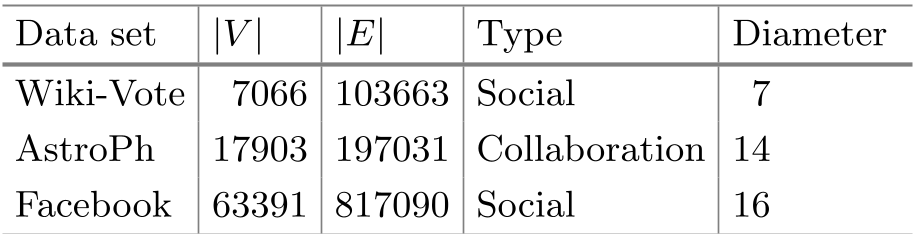 Table 1: Datasets used to validate the resilience across different social and collaboration graph structures.
2. Eliminating Bias with and
To prevent the system from favoring nearby nodes, two constraints are introduced:
- (Max Path Length): Any path longer than is discarded, ensuring the overlay remains "small-world."
- (Maximum Delay): A delay mechanism waits for a duration proportional to . This ensures that gossip rounds happen at a uniform frequency regardless of physical distance, neutralizing the "speed bias."
Experimental Validation
The researchers tested their protocol on three major datasets: Wiki-Vote, AstroPh, and Facebook.
Convergence to Randomness
A key metric for a random overlay is the Clustering Coefficient (CC). In a truly random graph, the CC should be near zero (specifically ). As shown in the results, the proposed protocol converges to this ideal value across all datasets, regardless of the initial social graph density.
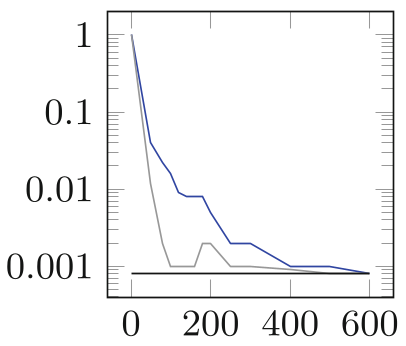 Clustering Coefficient convergence for different settings on the AstroPh dataset.
Unbiased In-Degree
If the sampling were biased, certain "popular" nodes would appear in everyone’s cache. The experiment showed a normal distribution of in-degrees, proving that the sampling is indeed uniform and independent of the underlying social graph's degree distribution.
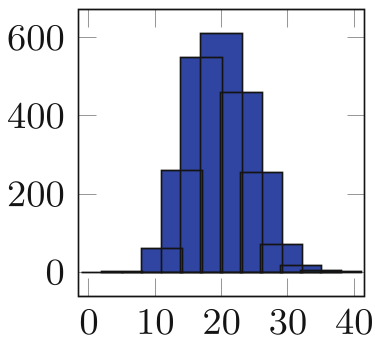 Final In-degree distribution on the Facebook dataset, demonstrating balanced node representation.
Critical Analysis & Conclusion
The brilliance of this work lies in its simplicity. By treating the routing path as a first-class citizen in the gossip exchange and applying local geometric corrections (pruning), the authors enable global property emergence from purely local interactions.
Limitations:
- The protocol assumes nodes are non-malicious (willing to relay). In a hostile environment, a "black hole" attack by relay nodes could disrupt the sampling.
- The use of a fixed delay might slow down the system to the pace of the slowest allowed path, which could be a bottleneck in high-churn environments.
Future Impact: This approach is particularly relevant for modern dApps and Private P2P networks. It allows developers to build search, discovery, and broadcast functions on top of restricted social layers without compromising the privacy constraints that define those layers.