
GPOP: Mastering the "Middle Ground" of Social Media Popularity Prediction
GPOP: Scalable Group-level Popularity Prediction for Online Content in Social Networks
The paper introduces GPOP (Group-level POpularity Prediction), a scalable framework for forecasting online content trends in social networks. It bridges the gap between noisy individual user-level predictions and coarse population-level counts by utilizing network-constrained graph clustering and coupled PARAFAC tensor decomposition.
TL;DR
Predicting which post goes viral is notoriously difficult due to "noise" at the user level and "vagueness" at the total count level. GPOP solves this by targeting group-level popularity. By clustering users based on both their social ties and historical interests, and then applying a sophisticated hierarchical tensor decomposition, GPOP achieves SOTA accuracy with linear scalability.
The Granularity Dilemma: Why Groups Matter
In the world of social network analysis, researchers traditionally pick one of two poisons:
- User-level models: These attempt to predict if "User A" will like "Image B." This is computationally expensive and highly sensitive to human caprice (noise).
- Population-level models: These predict the total "Like" count. While easier, they offer no insight into who is driving the trend, making them useless for targeted marketing.
The authors of GPOP argue that users naturally form interest clusters. Within these clusters, behaviors are remarkably consistent. By focusing on groups, we gain the precision of user-level models without the crippling noise and overhead.
Methodology: The Two-Pillar Approach
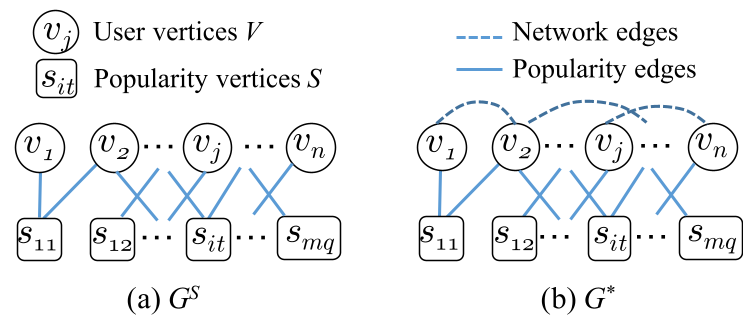
1. Network-Constrained Popularity Graph (Clustering)
Most clustering algorithms ignore either social links or content history. GPOP creates a unified graph that bridges both.
- The Insight: If a user is inactive, we use their friends' data to "anchor" them into a group. This prevents users from drifting between groups just because they haven't posted recently.
- The Constraint: The algorithm uses a balancing factor () to ensure user groups are of manageable, comparable sizes, avoiding the "one giant cluster" trap.
2. Hierarchical Coupled Tensor Decomposition
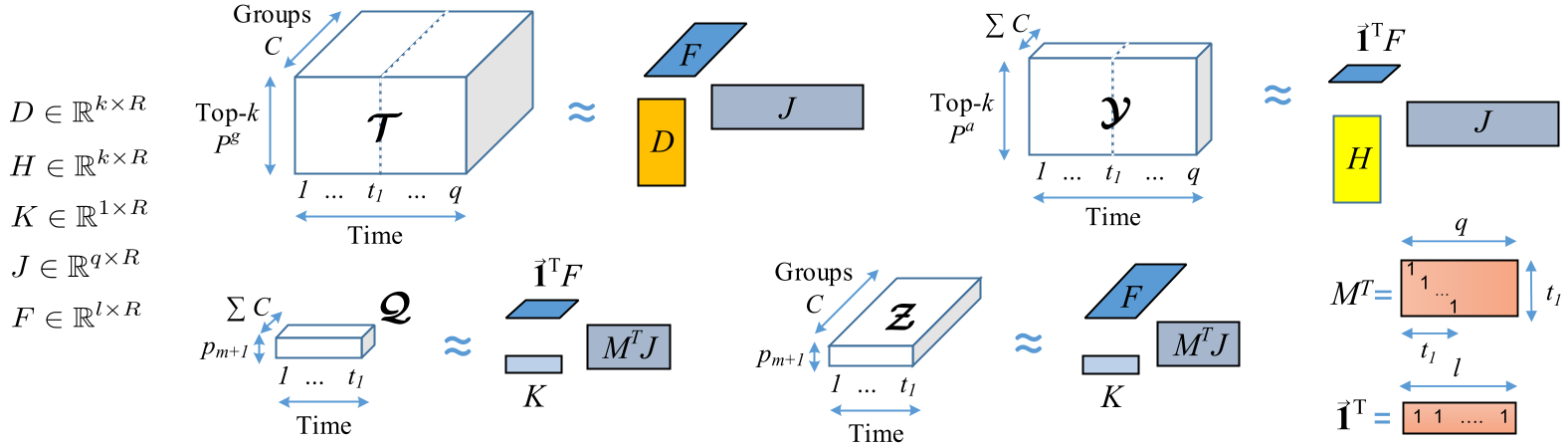
Once groups are established, the problem becomes a completion task: "Given the first 3 days of data, fill in the next 7." GPOP utilizes PARAFAC decomposition, but with a twist. It simultaneously models the data at both the group level () and the population level ().
By sharing the group factor matrix () and the time factor matrix () across these levels, the model "regularizes" the noisy group-level data using the more stable population-level trends.
Experimental Battleground
The model was tested on massive datasets from Behance and Twitter.
- Accuracy: GPOP outperformed classic time-series models (ARIMA, ETS) and other tensor methods (CMTF, TriMine). For instance, in "Relative Error for Population" (REP), GPOP maintained a low error of ~7-11%, whereas user-level models like CMTF exploded into four-digit errors due to sparsity.
- Scalability: While complex coupled models took hours or days, GPOP's gradient descent approach scales linearly with the number of users () and contents (), averaging 1.5 seconds per prediction.
Critical Insight: The "Top-k" Wisdom
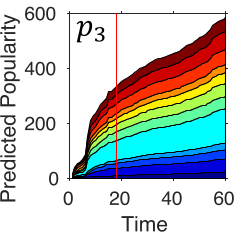
A key takeaway from the paper is the Top-k similarity query. Instead of training on all past social media posts (most of which are irrelevant), GPOP identifies the most similar historical "information cascades." By normalizing these by their early-stage popularity, the model can predict the trajectory of a new post with startling accuracy, even if the absolute numbers are different.
Conclusion & Limitations
GPOP proves that structured sparsity—via user groups—is the key to scaling social network analytics.
Limitations: The model assumes that group structures stay relatively stable during the prediction window. In events of extreme social upheaval or platform-wide algorithm changes, the "historical similarity" might break down. Future work could benefit from integrating real-time Graph Neural Networks (GNNs) to update cluster memberships dynamically.