
Towards Grad-CAM in Law: Visualizing the "Reasoning" of Legal AI
Towards Grad-CAM Based Explainability in a Legal Text Processing Pipeline. Extended Version
This paper introduces a novel application of Grad-CAM, a visual explanation technique from computer vision, to provide interpretability for legal text processing. Using a 1D-CNN architecture, the authors demonstrate how different embeddings (BERT, Law2Vec, word2vec) influence model decisions in legal sentence classification tasks, achieving state-of-the-art diagnostic clarity for NLP in the legal domain.
Executive Summary
TL;DR: This research bridges the gap between vision-based explainable AI (XAI) and legal NLP. By repurposing Grad-CAM (Gradient-weighted Class Activation Mapping), the authors provide a way to "see" which words a neural network prioritizes when classifying legal documents. It’s not just about accuracy—it's about verifying that the model is looking at the right legal concepts.
Background: In the legal domain, a model's decision is only as good as its explanation. This paper sits at the intersection of Legal Knowledge Representation and Deep Learning, moving beyond simple "attention weights" to a more robust, gradient-based interpretation of the model's inner workings.
Problem & Motivation: The Black Box in the Courtroom
In law, we distinguish between the ontological view (what data is used) and the epistemic view (how the decision is reached). While BERT and word2vec have boosted accuracy in legal text classification, they have remained "black boxes."
The authors argue that we need a "plug-in" solution to compare how different embeddings handle legal context. Why does one version of BERT outperform word2vec? Is it actually understanding the context, or just picking up on noise? Without visual evidence, legal professionals cannot ethically or practically adopt these tools.
Methodology: Adapting Grad-CAM for 1D Sequences
The core innovation is applying Grad-CAM to a 1D CNN. While images are 2D, sentences are 1D sequences of word vectors. The gradient of the predicted class score with respect to the feature maps of the last convolutional layer is captured to pinpoint word importance.
The Pipeline
- Embedder: Pluggable modules for word2vec, Law2Vec, and BERT.
- 1D CNN: A convolutional layer followed by pooling and fully connected layers.
- Visualization Module: Generates heatmaps and calculates new metrics like F (Fraction of elements above threshold) and I (Intersection over Union).
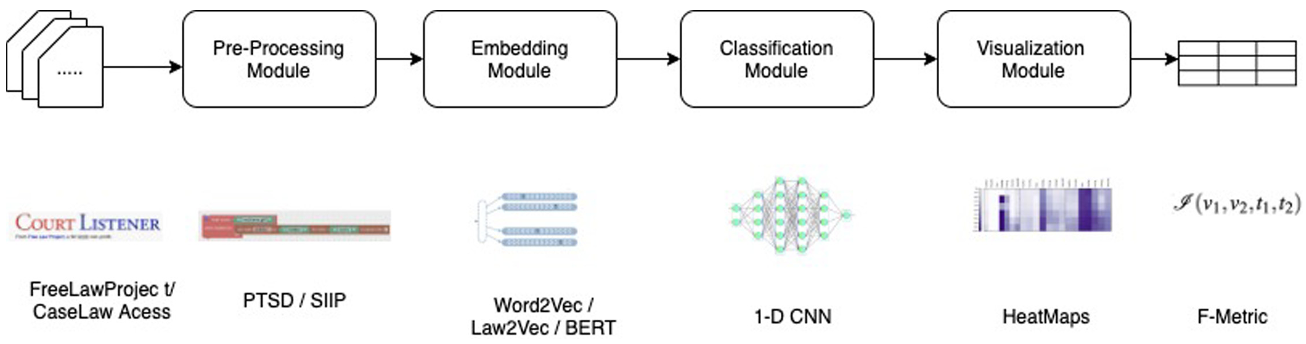
Figure 1: The proposed legal text processing pipeline with integrated Grad-CAM.
Experiments & Results
The authors tested their approach on two critical legal datasets: PTSD (classifying rhetorical roles in veterans' disability claims) and SIIP (statutory interpretation).
Key Findings
- Contextual Superiority: BERT-based models typically take a "wider" look at the sentence. The F(t) metric proved that DistilBERT considers a larger portion of the input compared to word2vec, which tends to focus on isolated keywords.
- Expert Alignment: A user study with legal professionals showed that BERT and Law2vec produced heatmaps that most closely matched where human lawyers looked when analyzing a case.
- Data Optimization: The authors discovered they could "whitelist" only the words the Grad-CAM highlighted as important. By feeding only these words back into the model, they maintained high accuracy while significantly reducing the data footprint.
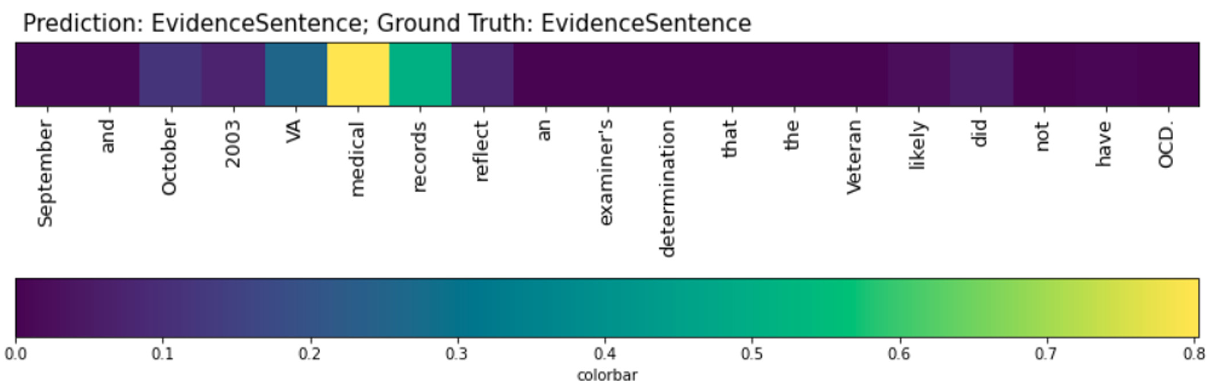
Figure 2: Grad-CAM heatmap showing the model focusing on "medical records" to classify a sentence as "Evidence".
Critical Analysis & Conclusion
Takeaway
The study proves that Grad-CAM isn't just for images. In a legal pipeline, it serves as a powerful diagnostic tool to:
- Validate that the model follows legal logic.
- Compare the "contextual depth" of different language models.
- Prune datasets to include only salient legal information.
Limitations & Future Work
The training of domain-specific BERT models is still computationally expensive. The authors suggest that future work should focus on "Context-Drift"—how a slight change in a legal term changes the entire model's attention. Furthermore, integrating these heatmaps into Argumentation Schemes could help lawyers build better-supported cases by identifying the "base premises" the AI identifies as most influential.
Final Thought: If AI is to become a "co-pilot" for judges and lawyers, it must be able to point at the text and say, "I decided this because of these specific words." This paper brings us one step closer to that reality.