
Granular Neural Networks: Fusing Numerical Precision with Linguistic Intuition
Granular neural networks for numerical-linguistic data fusion and knowledge discovery
The paper introduces Granular Neural Networks (GNN), a novel architecture integrating granular computing with fuzzy and neural systems to perform Knowledge Discovery and Data Mining (KDDM). By converting linguistic data into numerical features, GNNs achieve seamless fusion and prediction of mixed numerical-linguistic data, outperforming classical neural networks in training speed and interpretability.
TL;DR
Bridging the gap between human language and machine-readable data has long been a hurdle for classic neural networks. This paper introduces the Granular Neural Network (GNN), a framework designed to process "granular" information—be it exact numbers or fuzzy words like "around 5." By utilizing Fuzzy logic and a Heuristic Learning Algorithm, GNNs can transform raw, messy databases into clean, interpretable IF-THEN rules while significantly speeding up training.
Academic Positioning: This work sits at the intersection of Soft Computing and Knowledge Discovery (KDD), extending Zadeh's "Computing with Words" into a practical neural architecture for data fusion and compression.
The "Linguistic Gap" in Traditional ML
Most machine learning models live in a world of pure numbers. However, real-world databases are often hybrid, containing numerical features alongside linguistic labels. Standard Crisp Neural Networks (CNNs) view these as black boxes, leading to:
- Loss of Intuition: Neural weights are just numbers; they don't explain the "why."
- Sluggish Learning: Random weight initialization ignores the inherent structure of fuzzy data.
- Rule Extraction Difficulty: It is notoriously hard to extract human-understandable logic from a standard MLP.
Methodology: The Architecture of Granularity
The core innovation lies in the Granular Feature Extraction system. Instead of simple one-hot encoding, linguistic variables are mapped into trapezoidal or Gaussian vectors.
1. Feature Mapping
A fuzzy set is described by a vector that captures its center, width, and "fuzziness" (slopes). For instance, "almost 100" becomes a specific geometric expression rather than a single point.
2. The GNN Variants
- CGNN (Crisp GNN): Uses standard Backpropagation (BPA) but operates on the newly extracted feature vectors.
- FGNN (Fuzzy GNN): The more advanced variant. It employs a Multi-FNNKD (Fuzzy Neural Network for Knowledge Discovery) layer. Each FNNKD focuses on a specific aspect of the output fuzzy set (e.g., one predicts the center, another the width).
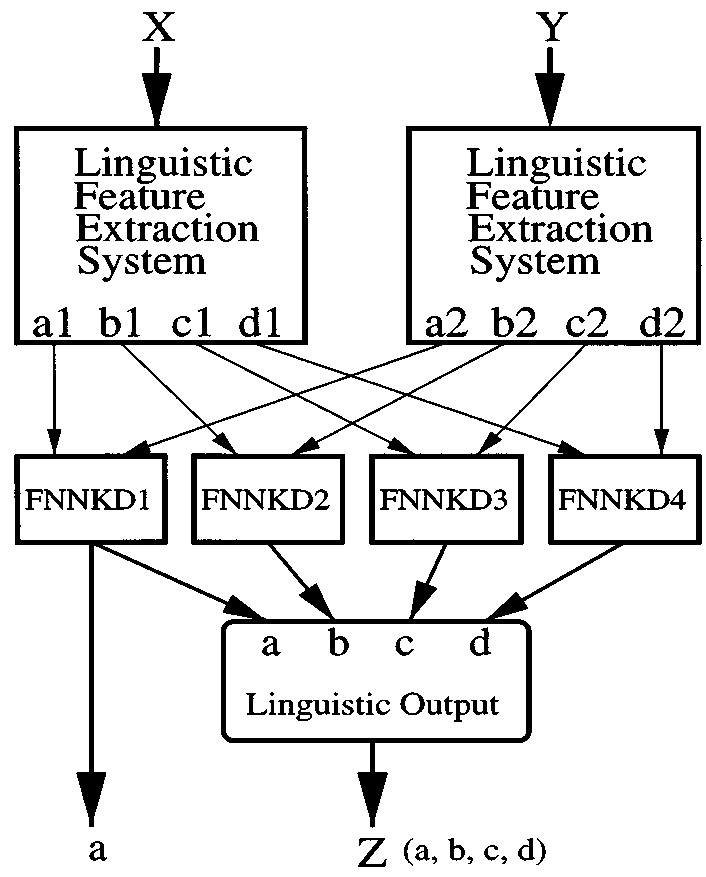 Figure 1: The general architecture of a CGNN showing how mixed data flows through specialized feature extraction layers.
Experiments: Multiplication and Wave-Hat Prediction
The authors validated the GNN on two primary tasks:
Task A: Numerical-Linguistic Multiplication
Could a network learn that "around 2" times "around 3" equals "around 6"?
- FGNN Results: Error of 0.224.
- CGNN Results: Error of 0.303. The FGNN not only captured the math more accurately but did so much faster due to its Heuristic-Knowledge-Based Learning Algorithm (HLA), which initializes parameters based on data segments rather than random noise.
Task B: Knowledge Discovery (The Wave-Hat Function)
The goal was to compress 1,089 records of sample points from a complex 3D surface (the "Wave Hat") into a handful of rules.
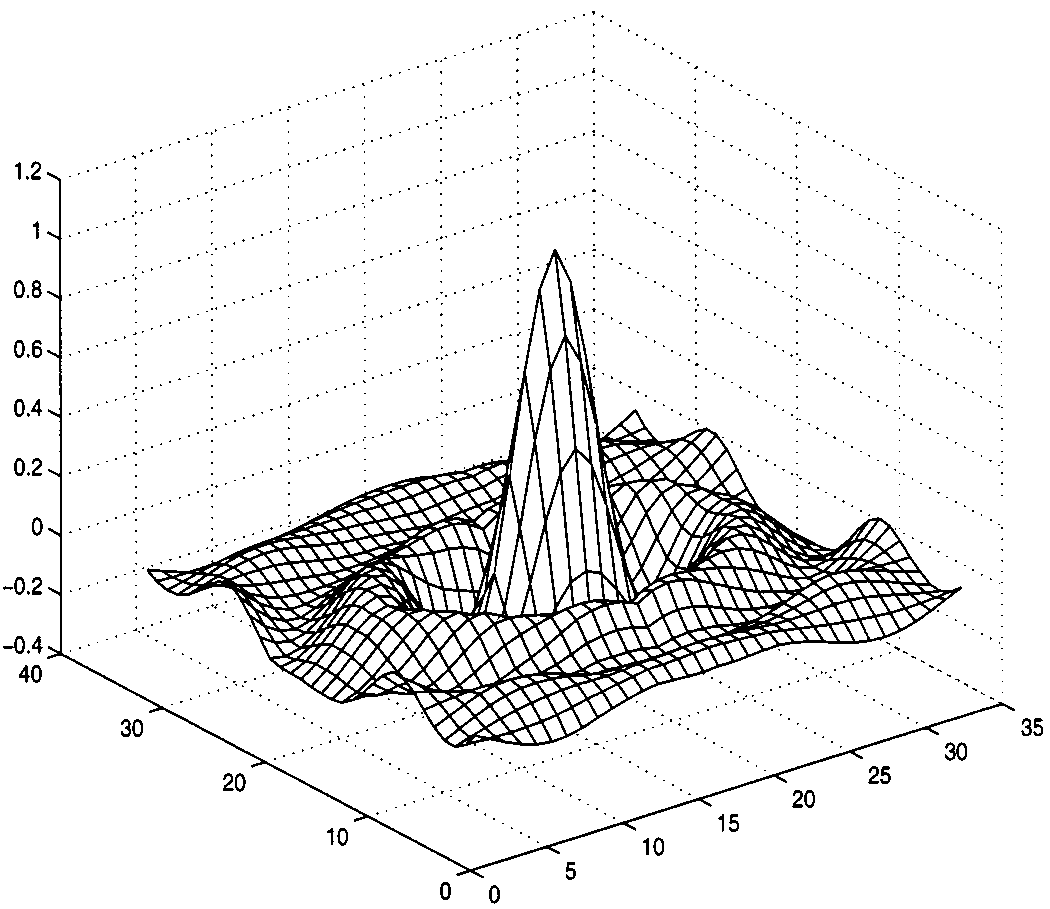 Figure 2: The learned wave-hat surface reconstructed using just 81 fuzzy rules, showing high fidelity to the original mathematical function.
Data Compression Battle:
- The FGNN compressed 1,089 records into 49 or 81 fuzzy rules.
- This represents a massive data compression rate, effectively turning a database into a compact, executable "knowledge base."
Critical Insight: Why This Works
The "magic" isn't in deeper layers, but in the mapping of the input manifold. By acknowledging that linguistic data is a "granule" (a range of values with a probability distribution) rather than a scalar, the GNN provides a stronger Inductive Bias. This allows the network to find the "internal relations" between concepts much more efficiently than a model trying to guess the relationship from scratch.
Conclusion & Future Outlook
The GNN framework proves that neural networks don't have to be uninterpretable "black boxes." By integrating fuzzy logic:
- We get high-speed training through heuristic initialization.
- We get interpretability via IF-THEN rule extraction.
- We get data fusion capability for heterogeneous sources.
Limitations: The current study focuses on relatively low-dimensional "understandable" examples. The next frontier for GNNs is scaling these architectures to Huge Databases (VLDB) through parallel and distributed learning algorithms—a path the authors are currently investigating.