
Graph-Based Family Recognition: Moving Beyond Simple Face Verification
Graph Based Family Relationship Recognition from a Single Image
This paper introduces a graph-based framework for recognizing kinship relationships among all members in a single family photo. The method leverages VGGFace for feature extraction and age/gender prediction, constructing connected subgraphs that use social logic and kinship rules to correct erroneous pairwise classifications, achieving an average accuracy of over 90% on the TSKinFace dataset.
TL;DR
Recognizing a family isn't just about spotting similar noses or eyes; it's about understanding the "logic" of a social unit. This paper presents a graph-based framework that reconstructs an entire family tree from a single image. By treating family members as nodes in a connected subgraph and applying "kinship rules," the model can actually correct its own mistakes, achieving a significant accuracy leap from 72.8% to 90.7%.
Problem & Motivation: The "Pairwise" Trap
Traditional AI kinship research has mostly focused on Kinship Verification: given two faces, do they belong to the same family? This is a binary "Yes/No" task that ignores the rich context of a real-world family photo.
The authors identify three major pain points in previous work:
- Isolation: Treating a family as a collection of independent pairs ignores the fact that if A is the father of B, and B is the sibling of C, then A must be the father of C.
- Specifics: Most models don't distinguish between a "Father-Son" and a "Mother-Daughter" relationship.
- Scalability: Previous graph models were computationally "heavy," often limited to only four people per image.
Methodology: Logic Over Individual Pixels
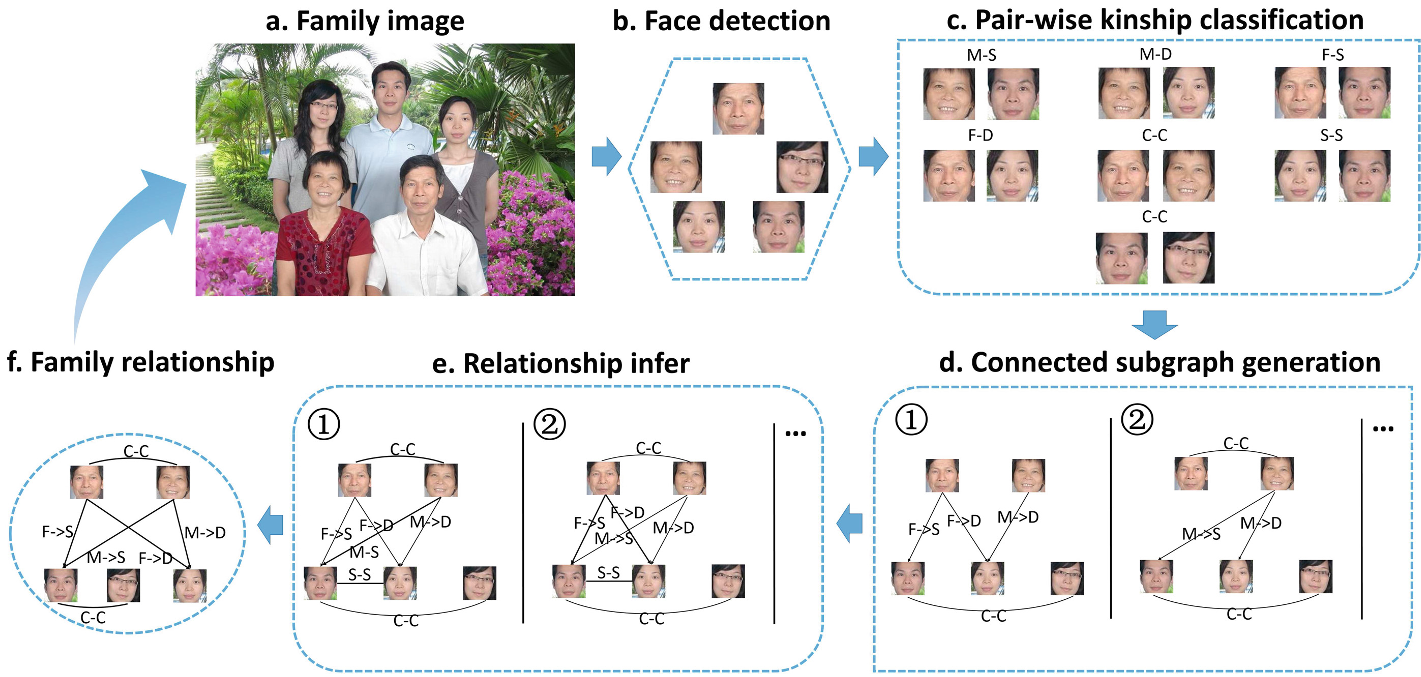
The core insight of this paper is the Connected Subgraph Model. Instead of calculating every possible relationship (which grows exponentially), the model finds the most reliable "skeleton" of relationships and infers the rest.
1. The Feature Engine
The pipeline starts by detecting faces and extracting high-dimensional features using VGGFace. Crucially, the authors include an Age Prediction module. Why? Because age is a powerful physical constraint in kinship—a child cannot be older than their parent.
2. The Relationship Graph
Once pairwise probabilities are generated (e.g., "70% probability this is a father-son pair"), the system constructs a graph.
3. Inference and Constraint Checking
This is where the "Expert System" logic kicks in. The model applies two types of rules:
- Generation Rules: Transitive logic (e.g., If A and B are a couple and A is the parent of C, then B is also a parent of C).
- Constraint Rules: Biological reality checks (e.g., One person cannot have two fathers; a parent must be older than the child).

Experiments & Results: The Power of Context
The authors tested their method on the TSKinFace database and a custom dataset of 115 family photos.
Performance Gains
The results are striking. When looking at individual pairs, the model is somewhat prone to error. However, when the Graph Model is applied to look at the "Whole family," the accuracy for specific relationships like "Father-Son" jumps from 79.39% to 92.54%.
| Relationship Type | Pairwise Accuracy | Graph-Based Accuracy |
|---|---|---|
| Father-Son | 79.39% | 92.54% |
| Mother-Daughter | 78.51% | 92.98% |
| Sibling-Sibling | 68.42% | 88.60% |
Family Size vs. Accuracy
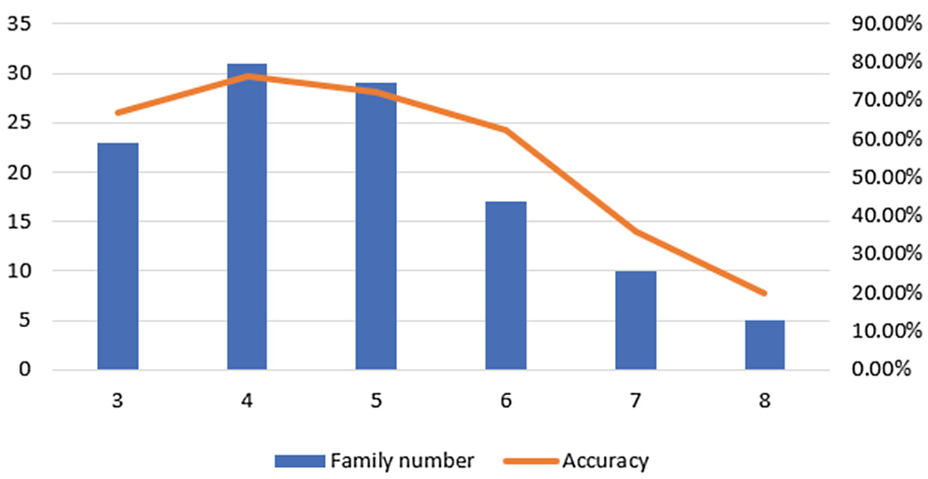
The model performs best on families of 4-5 people. As the family group grows to 7+ members, the accuracy dips. This suggests that in very large groups, the visual noise and complex non-nuclear relationships (uncles, cousins) become significantly harder to resolve.
Critical Analysis & Conclusion
Takeaway
This research proves that kinship recognition is a global optimization problem. Visual features get you 70% of the way there, but social and biological "rules" provide the final 20% of accuracy needed for real-world applications.
Limitations
- The "Nuclear" Bias: The current rules focus heavily on parents, children, and siblings. It might struggle with blended families or extended relatives (uncles/aunts) without adding more complex rules.
- Classification Foundation: The graph's success is still tethered to the quality of the initial pairwise classification. If the base features are completely wrong, the graph might choose the "least incorrect" version rather than the truth.
Future Outlook
By scaling this to larger datasets like "Families in the Wild" and replacing the SVM classifiers with modern Graph Neural Networks (GNNs), we could see a future where AI can instantly index digital photo libraries based on deep genealogical understanding.