
RWUU: Enhancing Social Recommendations via Co-Tagging Graph Dynamics
Graph-Based Recommendation on Social Networks
This paper introduces a graph-based recommendation framework utilizing Random Walk with Restarts (RWR) that integrates social tagging information. The authors propose the RWUU algorithm, which leverages co-tagging behaviors to measure user similarity, achieving significant precision improvements over standard RWR baselines.
TL;DR
Researchers from Peking University have developed a graph-based recommendation algorithm that utilizes social tagging behavior to overcome the perennial "data sparsity" problem. By shifting from a simple user-item bipartite graph to a more complex social graph where users are connected via co-tagging similarity (RWUU), the system achieves a significant performance boost in precision, especially for users with minimal rating histories.
Problem & Motivation: The Sparsity Trap
Most modern recommender systems suffer from the Cold Start and Data Sparsity problems. In a typical movie dataset, a user might only rate a handful of films out of thousands. This makes the traditional User-Item graph extremely "thin," leaving graph-based algorithms like Random Walk with Restarts (RWR) with very few paths to explore, leading to stagnant and inaccurate recommendations.
The authors' insight lies in Web 2.0 Folksonomies. Even if two users haven't watched the same movie, they might use the same tags (e.g., "Cyberpunk", "Noir") across different media. This co-tagging behavior provides a latent bridge between users that traditional rating-only systems completely ignore.
Methodology: Beyond Direct Ratings
The paper explores two distinct ways to integrate tags into the RWR framework:
1. The RWUR Approach (User-Resource)
This method assumes that if a user tags a movie, it is functionally equivalent to a rating. The algorithm adds an edge directly between the user and the item.
- Result: Surprisingly, this decreased performance. The authors conclude that tagging an item doesn't necessarily imply a "positive" preference; a user might tag a movie just for organization without actually liking it.
2. The RWUU Approach (User-User Similarity) - The Winner
Instead of linking users to items via tags, this method links users to other users. By calculating a cosine similarity score based on the frequency of tags used by two different people, a "Similarity Edge" is added to the graph.
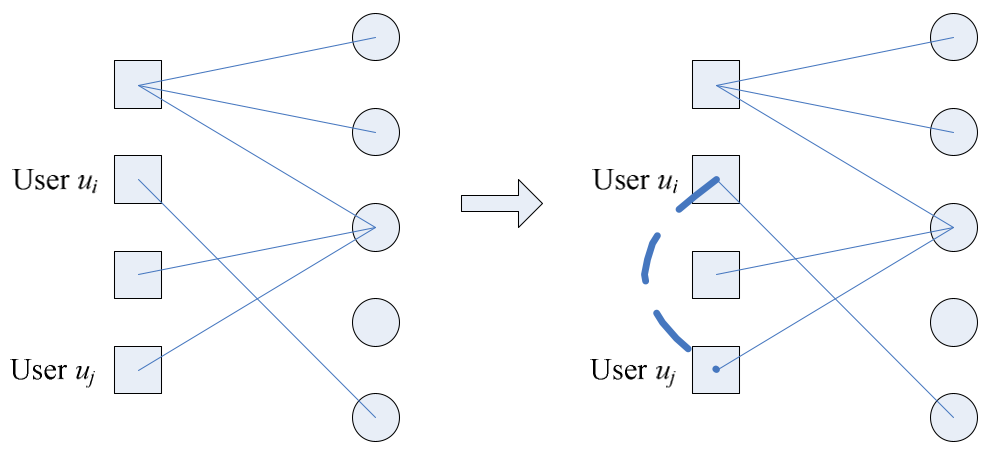
The core transition equation for the random walk remains: Where is the transition matrix and is the restart probability (personalization factor). By adding user-similarity edges, the matrix becomes much denser, providing "shortcuts" for the random walk to find relevant items through similar-minded peers.
Experimental Validation
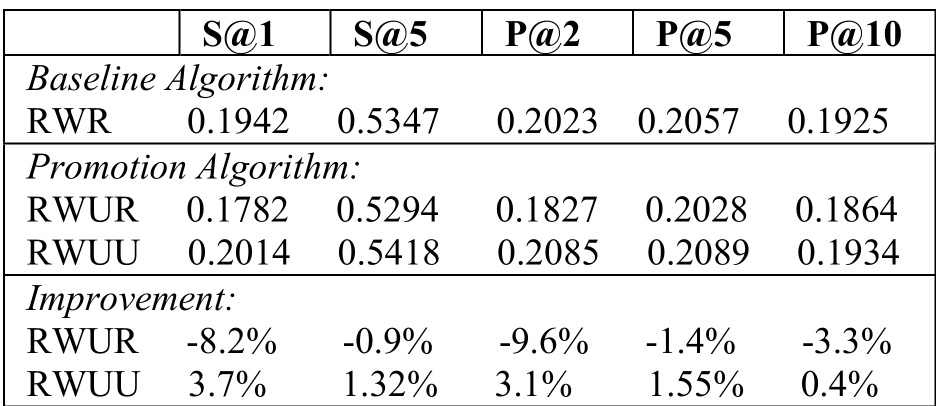
Using the MovieLens dataset (561 users, 1688 movies), the authors tested their hypothesis across several metrics, including Precision at Rank K (P@K) and Success at Rank K (S@K).
Key Findings:
- The Power of RWUU: The User-User model consistently beat the standard RWR. Specifically, the "Success at Rank 1" (S@1) — the probability that the very first recommendation is a hit — increased by 3.7%.
- Impact on Sparse Data: The most impressive results were seen in "Group 1" (users with fewer than 100 ratings). In this sparse environment, user similarity links provided the necessary context that ratings lacked, leading to an 8.3% improvement in S@5.
Critical Analysis & Takeaways
The paper highlights a critical nuance in social recommendation: The semantics of an action matter.
- Tags are Social, not just Functional: Treating a tag as a "quasi-rating" (RWUR) fails because it ignores the intent. However, treating tags as a "language" shared between users (RWUU) effectively maps the latent interest manifold.
- Sparsity Mitigation: The study proves that graph-based methods are not doomed by sparse data if the graph is augmented with auxiliary social relationships.
Limitations: The computational complexity of RWR on extremely large-scale graphs remains a bottleneck for real-time online systems. Future work needs to focus on "Fast RWR" approximations or distributed "MapReduce" implementations to bring this tag-aware logic to billion-scale platforms.
Conclusion
By moving from a discrete bipartite graph to a dense social network of interests, RWUU demonstrates that how we model metadata (like tags) is just as important as the recommendation algorithm itself. In the quest for personalization, the links between people are the strongest signals we have.