
Bridging the Gap: 3EG Framework for Graph-Driven Healthcare Analytics
Graph databases for large-scale healthcare systems: A framework for efficient data management and data services
This paper introduces the "3NF Equivalent Graph" (3EG) transformation, a framework for automatically converting normalized healthcare relational databases (RDB) into graph databases. The approach seeks to harmonize data management and data services, achieving superior performance in complex relationship mining and collaborative filtering using Neo4J compared to traditional MySQL setups.
TL;DR
Healthcare data is trapped between the need for strict 3NF (Third Normal Form) normalization for management and the need for fluid relationships for analytics. This paper introduces 3EG (3NF Equivalent Graph), a transformation logic that automatically converts RDBMS schemas into Graph Databases. By leveraging Neo4J in tandem with MySQL, the researchers demonstrate that complex healthcare queries—like identifying self-referral fraud or building recommendation systems—can scale efficiently where traditional joins fail.
The Motivation: The "Orthogonality" Trap
In medical informatics, we face a paradox:
- Data Management demands "normalized" forms to ensure data integrity and zero redundancy.
- Data Services require "de-normalized" views to perform joins, searches, and trend analysis.
As systems grow, RDBMS schemas become a "spaghetti" of dozens of tables. Forcing complex relationship mining (e.g., "Find all shared providers between two patients across millions of records") through SQL joins leads to significant latency. The authors' insight is simple: Graph databases should act as the ultimate de-normalized layer.
Methodology: 3EG Transformation
The 3NF Equivalent Graph (3EG) transformation is a set of deterministic rules to "re-map" the relational world into the graph world:
- Nodes: Every unique record (tuple) in a 1NF table becomes a node.
- Edges: Foreign keys and relationships between keys in bridge tables are converted into direct links.
- Properties: Non-key attributes (the "facts" about the key) are stored as node properties.
This ensures that the graph remains a semantically equivalent mirror of the source RDBMS, allowing for automated synchronization.
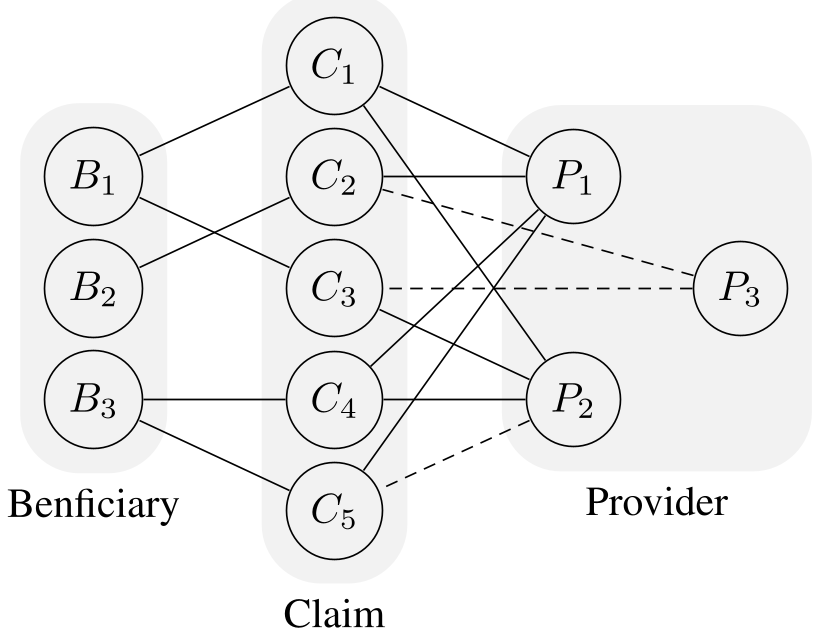 Figure: The 3EG-transformed graph schema showing entities like Bene (Beneficiary), Prov (Provider), and Claims as interconnected nodes.
Experiments: Where Graphs Shine
The researchers tested eight use cases ranging from "Shared Disease" tracking to a "Collaborative Filtering" engine for doctor recommendations.
Key Finding 1: Complexity Scalability
In "Case 8" (Collaborative Filtering), which involves multi-hop traversals (Patient -> Doctor -> Referred Claim -> New Doctor), MySQL's performance plummeted as data scaled to 50 million claims. Neo4J, however, maintained stable query times.
Key Finding 2: Node Degree vs. Table Size
An RDBMS’s speed is generally a function of the size of the tables being joined. In contrast, a Graph Database’s speed is a function of the degree of the nodes being traversed. In healthcare, since a single patient typically visits a finite number of doctors regardless of how many millions of total patients are in the database, the graph approach remains highly performant at scale.
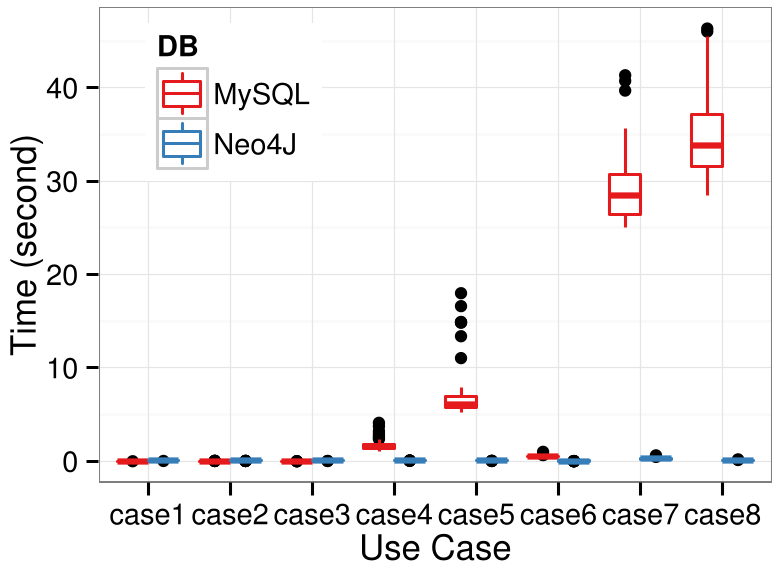 Figure: Performance comparison across 8 cases. MySQL struggles significantly in Cases 7 and 8 (complex relationships) compared to the stable performance of Neo4J.
The Future: An Ensemble Framework
The authors conclude that we shouldn't throw away RDBMS. Instead, they propose an Ensemble Framework:
- RDBMS: Handles the "Ground Truth," heavy transactional updates (OLTP), and traditional reporting (sums/averages).
- Graph DB: Handles relationship-rich data services, using the 3EG transform to stay in sync.
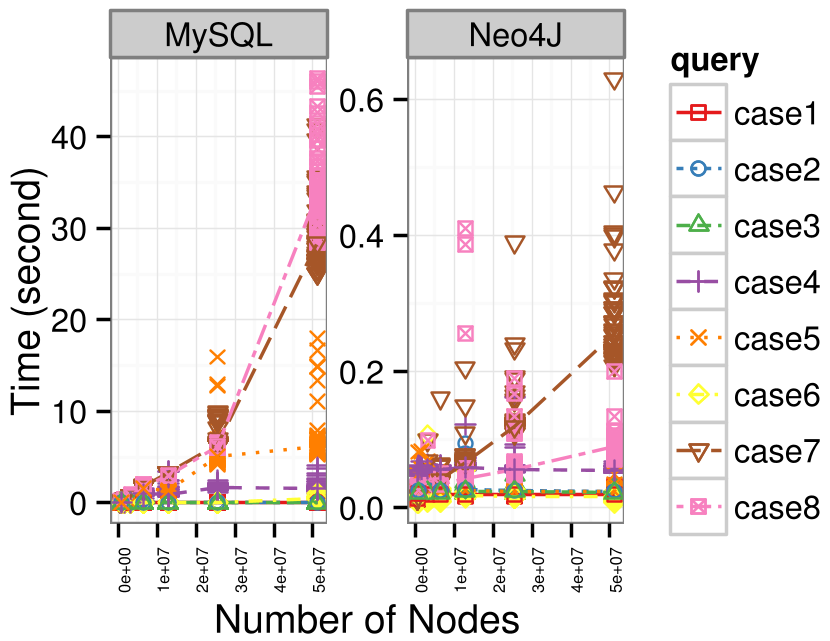 Figure: The proposed architecture where an Access Layer routes queries to either the RDBMS or Graph DB based on the analytical objective.
Critical Analysis
While the 3EG transform provides a clear path for migration, the paper primarily uses Neo4J community edition on a single node. In modern production environments, "Large-Scale" often implies distributed clusters and real-time streaming updates. However, the fundamental takeaway stands: the physical layout of graph data (index-free adjacency) is natively superior for the "relational" nature of healthcare ecosystems.
Final Takeaway: By mapping 3NF rules directly to graph theory, 3EG offers a cost-effective way to unlock advanced clinical analytics without rebuilding legacy healthcare infrastructure from scratch.