
MDL-STag: Merging Multimodal Deep Learning and Social Graphs for Smarter Image Tagging
Image annotation in social networks using graph and multimodal deep learning features
The paper introduces MDL-STag (Multimodal features Deep Learning approach for Social image Tagging), a hybrid framework combining CNNs, RNNs, and Graph-based social propagation for personalized image annotation. By merging visual features from AlexNet and textual history features from an LSTM, the method achieves SOTA performance on Flickr and Instagram datasets, significantly improving tag precision.
TL;DR
The explosion of shared imagery on platforms like Instagram and Flickr has created a "tagging crisis"—either tags are missing, or they are too generic to be useful for search engines. MDL-STag bridges this gap by combining Convolutional Neural Networks (CNN) for vision, Recurrent Neural Networks (RNN) for user history, and Social Graph Analysis to propagate high-quality tags from similar neighbors.
The "Precision" Problem in Social Media
Why is automatic image annotation so hard?
- Ambiguity: A photo of a "jaguar" could be a car or an animal.
- Personalization: User A might tag a sunset as
#nature, while User B tags it as#photography. - Cold Start: New images have no metadata to guide search engines.
Existing methods often fail by looking at only one dimension (only the pixels or only the text). MDL-STag posits that to truly understand an image, we must look at what it looks like, what the user has tagged before, and what their friends are tagging.
Methodology: The MDL-STag Architecture
The system operates in two distinct phases: an offline training phase and an online prediction phase.
1. Dual-Engine Feature Extraction
- Visual Engine (AlexNet): Uses a pre-trained CNN to extract 4096-dimensional feature vectors (
fc7layer). This captures the "what" of the image. - Textual Engine (TagNet LSTM): Processes the sequence of a user's previous 5 tags. By treating tags as a sequence, the LSTM captures the "style" and "preference" of the annotator.
2. Social Graph & Tag Propagation
Instead of searching the entire internet for similar images, MDL-STag looks at the user's social community. It builds a graph where nodes are images and edges represent social connections.
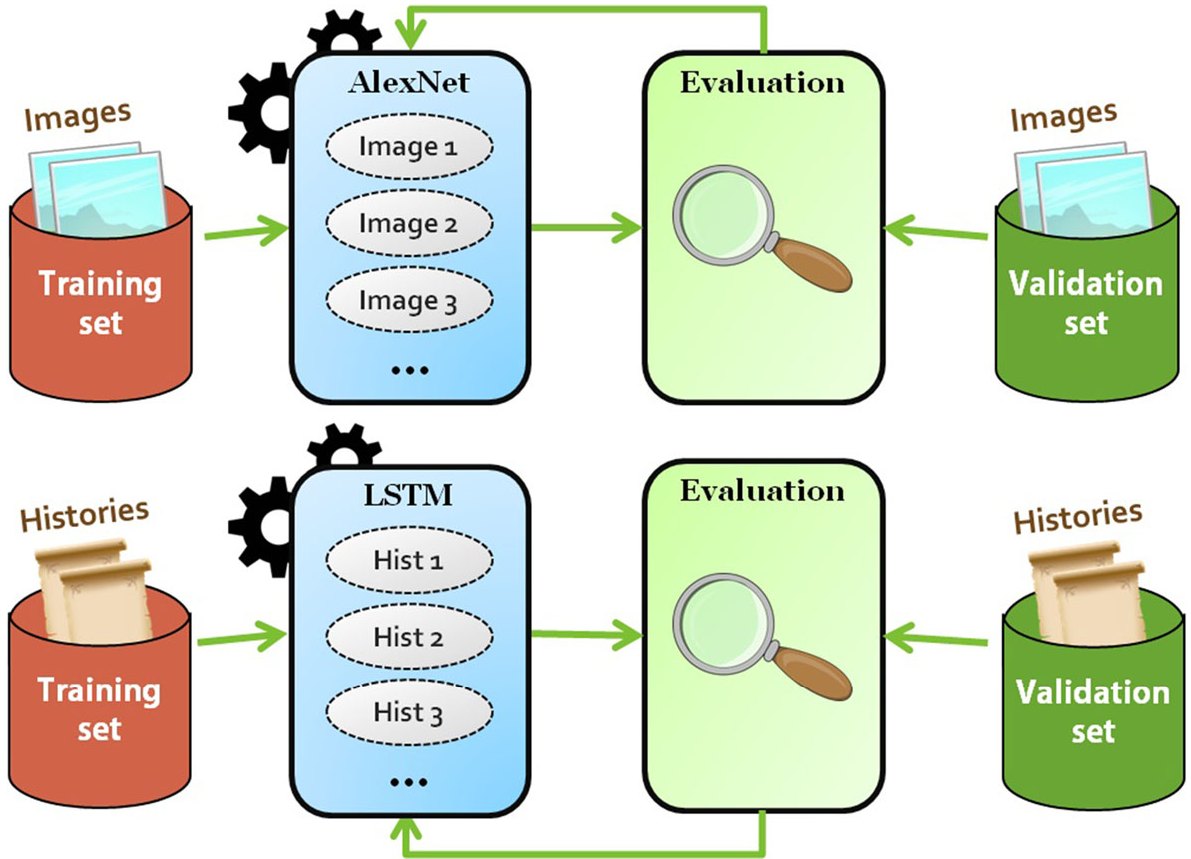
The Propagation Logic: The system filters the community to find the top 30 semantically similar images (via LSTM) and then the top 10 visually similar images (via AlexNet). Tags from these "elite neighbors" are propagated to the target image based on a combined similarity weight.
Performance & Experiments
The authors tested MDL-STag against standard baselines on Flickr and Instagram datasets.
Precision@K Results
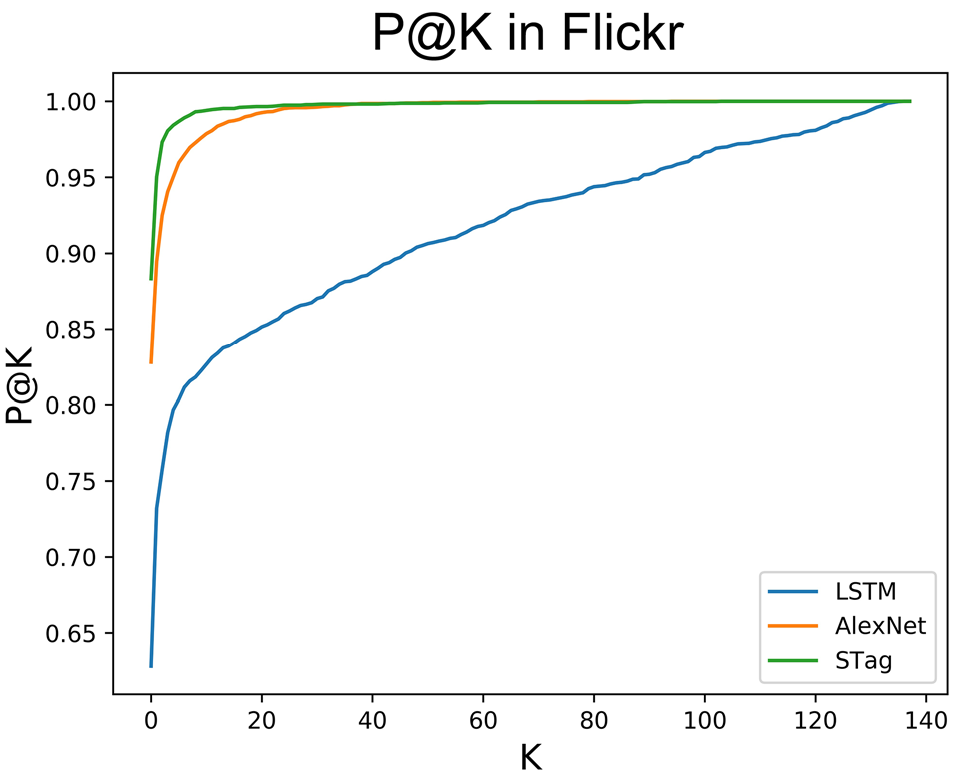
MDL-STag consistently outperformed standalone AlexNet and LSTM models, especially at lower values (where precision is most critical for user experience).
Benchmark Success (NUS-WIDE)
On the NUS-WIDE benchmark, which features a highly imbalanced tag distribution (e.g., "sky" vs. "map"), MDL-STag remained stable. It achieved a Harmonic F1-score (HF1) of 57.05%, outperforming complex CNN-RNN architectures.
Critical Insight: Why Does It Work?
The magic of MDL-STag lies in its voting mechanism. By initializing tag weights using the target user's models and then "boosting" those weights using labels from socially connected neighbors, the model ensures that the tags are both content-accurate and socially relevant. It effectively uses the "Wisdom of the (Immediate) Crowd" to refine deep learning predictions.
Conclusion & Future Outlook
MDL-STag proves that multimodal fusion is not just about stacking layers, but about choosing the right dimensions—Vision, History, and Social Context.
Future Directions:
- Dynamic Tag Counts: Moving beyond a fixed "Top K" to predict exactly how many tags an image needs.
- Attention Mechanisms: Replacing AlexNet with Transformers to capture finer spatial details.
- Efficiency: Reducing the online computation time for real-time mobile applications.
This research highlights a shift toward "Social-Aware AI," where the model's context is defined as much by human relationships as by raw data.