
GFAET: Revolutionizing Social Influence via the Physics of Thermodynamics
A Novel Greedy FluidSpread Algorithm With Equilibrium Temperature for Influence Diffusion in Social Networks
This paper introduces the Greedy FluidSpread Algorithm with Equilibrium Temperature (GFAET), a novel framework for Maximizing Positive Influenced Users (MPIU) in social networks. By modeling influence diffusion as a fluid dynamics system where user attitudes correspond to fluid temperatures, the method achieves superior performance in identifying influential seed nodes.
TL;DR
The quest for the most influential users in a social network—the Maximizing Positive Influenced Users (MPIU) problem—has traditionally been a game of graph theory and probability. However, a new paper introduces GFAET, a model that treats social influence like fluid flowing between containers. By applying Newton's Law of Cooling, the authors simulate how opinions "warm up" or "cool down" through interaction, achieving an activation rate 100% higher than traditional SOTA methods.
The Motivation: Why Social Graphs are Like Fluid Systems
Traditional models (like Independent Cascade or Linear Threshold) often treat users as binary switches. But human influence is messy: it depends on topic relevance and the "intensity" of a neighbor's opinion. The authors recognized a deep physical intuition—just as heat moves from a hot object to a cold one until equilibrium is reached, social influence spreads from "passionate" nodes to "neutral" ones until a community reaches a consensus.
The limitation of prior work (FluidSpread) was its lack of energy conservation and its simplified view of how users accept information. GFAET fixes this by introducing semantic vectors to determine "fluid height" and thermodynamic laws to determine the final "temperature" (attitude).
Methodology: Thermodynamics of an Opinion
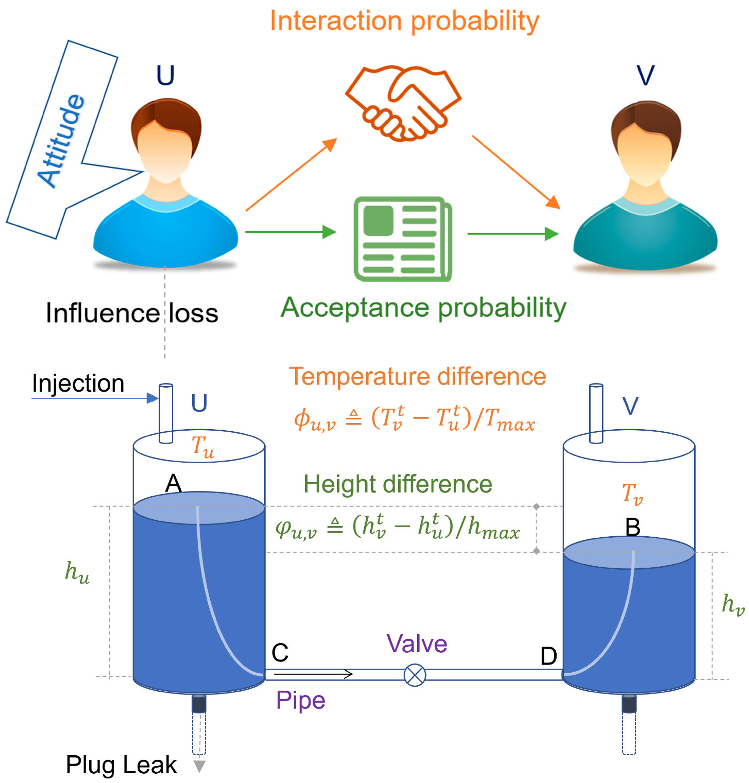
The GFAET framework is built on a sophisticated analogy where every social entity has a physical counterpart:
- Fluid Height (): Calculated via the scalar product of the User Interest Vector (UIV) and the Topic Distribution Vector (TDV). This represents the probability of acceptance.
- Fluid Temperature (): Represents the user’s attitude. Positive values (0 to 100°C) are positive attitudes; negative values are negative/neutral.
- The Cooling Law: When a "hot" (influential) node interacts with a "cool" node, GFAET uses Newton’s Law of Cooling with Finite Reservoirs to calculate the Equilibrium Temperature ().
The Update Logic
As fluid flows through modeled pipes (edges), the containers (nodes) update their temperature. A node is only "activated" if its temperature exceeds a specific threshold (). This ensures that influence is not just about connectivity, but about the thermal energy of the message being passed.
Experiments: SOTA Achievement
The authors tested GFAET against four major baselines across diverse network topologies, including scale-free (BA) and small-world (WS) networks, as well as real-world Facebook data.
Key findings include:
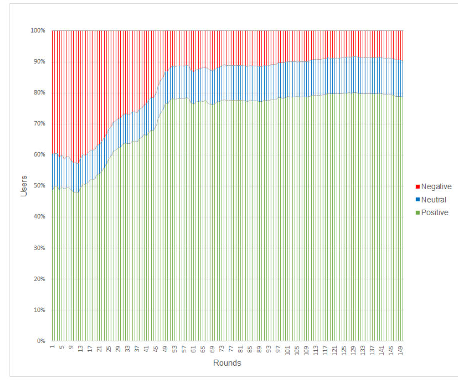
- Activation Power: GFAET consistently activated the highest number of nodes. For instance, on the BA network with positive influence, it outperformed competitors by a massive margin (705 activated nodes vs. 56 for the next best).
- Semantic Robustness: By testing on real Twitter and Slashdot topics, the model proved it could handle real-world content biases better than purely structural algorithms.
- Efficiency: Despite the complex physics, the greedy selection process remains computationally feasible, often running faster than MOO or OVM due to the faster convergence of the fluid model.
Critical Analysis & Conclusion
GFAET is a landmark example of Isomorphic Modeling. By mapping social influence to thermodynamics, the authors provide a rigorous mathematical backbone to the otherwise fuzzy concept of "opinion change."
Takeaway: If you want to maximize your message's reach, don't just find the person with the most followers; find the person whose "heat" (attitude) and "fluid height" (interest alignment) can create the highest equilibrium temperature in their community.
Limitations: Currently, the model assumes all "containers" are identical. Future work could improve accuracy by giving individual users different "heat capacities"—reflecting that some people are harder to convince (higher thermal inertia) than others.