
SCD2D-MAC: Leveraging Social Trust for Energy-Efficient 5G D2D Networks
SPECIAL SECTION ON GREEN COMMUNICATIONS AND NETWORKING FOR 5G WIRELESS
This paper introduces a social-aware perspective to Green Device-to-Device (D2D) communication and proposes the SCD2D-MAC protocol. By exploiting social ties to prioritize "friendly" relays and utilizing network coding, the method significantly optimizes energy efficiency and content exchange speed in 5G cellular offloading scenarios.
TL;DR
To solve the bottleneck of user reluctance in Device-to-Device (D2D) networks, this research proposes SCD2D-MAC. This protocol shifts the paradigm from purely distance-based relaying to socially-aware relaying, using Network Coding and priority-based access to reduce battery drain by up to 58% while speeding up content exchange.
The Human Bottleneck in D2D Communication
While D2D communication is a cornerstone of 5G for offloading cellular traffic, most existing protocols treat mobile devices as altruistic machines. In reality, devices are controlled by humans. A user is unlikely to let their battery be depleted to relay data for a stranger. This "social reluctance" leads to:
- Low Participation: High-quality relay candidates might simply refuse to cooperate.
- Inefficient MAC Design: If a protocol attempts to use a reluctant node, it wastes time-slots and energy on failed handshakes or ignored requests.
- Privacy Risks: Users are hesitant to have their private data flow through unknown devices.
Methodology: Bridging the Social and Physical Domains
The core innovation of this paper is the SCD2D-MAC protocol. It operates on the intuition that social ties (friends, colleagues) translate to a natural "incentive" for cooperation.
1. Social Discovery and Multicasting
The protocol utilizes social information (extracted from apps like Facebook or LinkedIn) to build a social preference list. When a D2D pair needs assistance, it sends a Social-Cooperation-Request (SCR) targeted specifically at a multicast group of "friendly" nodes.
2. Prioritized Backoff & Network Coding
To maximize efficiency, the protocol doesn't just pick any friend. It uses Network Coding (NC). If a relay has successfully eavesdropped on packets from both users in a pair ( and ), it can XOR them and transmit a single packet .
The MAC layer enforces this by assigning shorter backoff ranges to relays that have both packets, ensuring the most efficient nodes win the contention for the wireless medium.
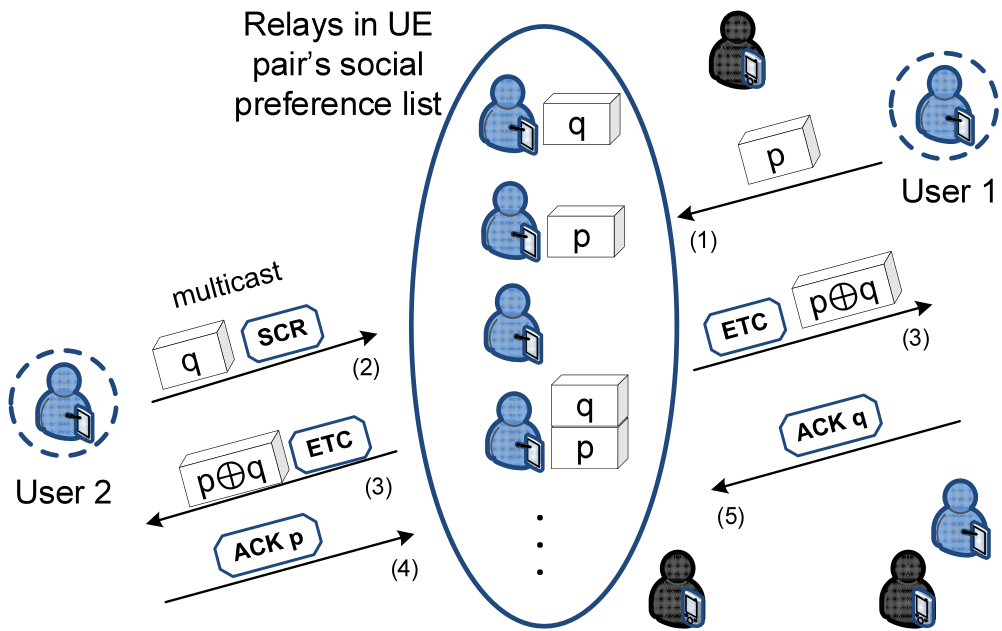 Figure: The interaction flow of the SCD2D-MAC protocol, showing the differentiation between friendly and unknown relays.
Experimental Performance: The Power of Friendship
The authors compared SCD2D-MAC against ACNC-MAC and NCCARQ-MAC across two scenarios: static file exchange (Scenario A) and real-time video streaming (Scenario B).
Key Findings:
- Speed: In Scenario A, SCD2D-MAC achieved a 45% reduction in completion time compared to NCCARQ-MAC when 40% of the neighbors were friends.
- Energy Consumption: By excluding "stranger" nodes that cause contention without contributing to the pair's specific goal, the average battery drain was slashed by 58%.
- Efficiency: Unlike typical protocols where more nodes usually mean more collisions, SCD2D-MAC scales better because its "social filter" maintains a manageable and cooperative contention window.
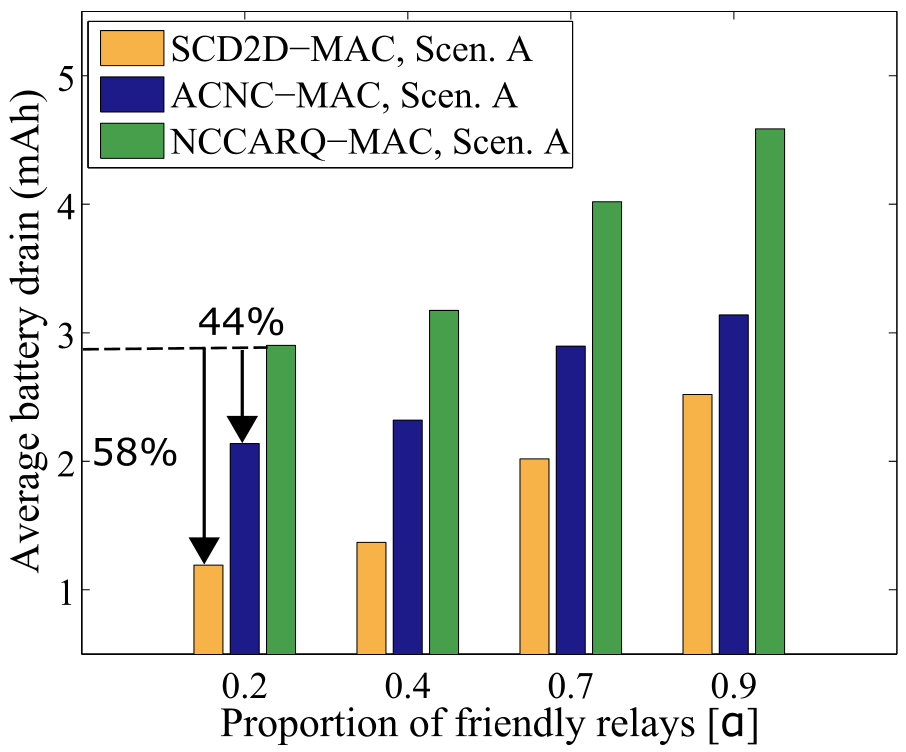 Figure: Energy efficiency comparison showing SCD2D-MAC outperforming social-unaware baselines across varying proportions of friendly relays (alpha).
Critical Insight & Future Outlook
The brilliance of this work lies in recognizing that energy efficiency in D2D is as much a social problem as it is a physical one. By filtering the participant pool based on trust, the network becomes "virtually" less congested.
Challenges to overcome:
- Privacy: How do we share social lists without compromising user anonymity?
- Signaling Overhead: The cellular network must manage these social lists, which could increase core network load.
- Incentive Homogeneity: Not all friends are equal. Future work could weight relay priority based on the strength of the social tie (e.g., family vs. casual acquaintance).
Conclusion
Social-aware D2D is a vital step toward making 5G (and eventually 6G) technologies truly "human-centric." By aligning protocol logic with human social patterns, we can build wireless networks that are not only faster but significantly greener.