
SW-SVR: Transforming Greenhouses with Dynamic Agricultural AI
Greenhouse Environmental Control System Based on SW-SVR
The paper introduces a smart greenhouse control system leveraging Sliding Window-based Support Vector Regression (SW-SVR) and wireless scattered light sensors. By predicting nitrogen absorption in real-time and automating environmental adjustments, the system aims to replicate expert farming intuition, achieving a 1.54x increase in tomato sugar content.
TL;DR
Researchers have developed a smart greenhouse system that uses a specialized variant of Support Vector Regression called SW-SVR. By focusing on real-time adaptation and localized data extraction, the system reduced prediction errors for nitrogen absorption by over 50% and produced tomatoes with 1.5 times more sugar than standard cultivation methods.
Background: The Gap Between Sensors and Experts
Modern greenhouses are filled with sensors, yet most still run on simple "if-then" rules set by humans. Expert farmers, however, perform "prediction control"—they look at the weather, the growth stage of the plant, and the current environment to decide on watering or fertilization before the plant shows stress. Replicating this "gut feeling" with AI is difficult because plants are biological entities whose behavior changes as they grow and as seasons shift.
The Problem: The "Melted" Model
Standard machine learning models like SVR (Support Vector Regression) suffer from a "memory" problem in agriculture. If you train a model on October data and use it in January, the prediction error spikes because the plant's metabolism has changed. Retraining on the entire history every day is computationally expensive ( to complexity) and often introduces "noise" from irrelevant past seasons.
Methodology: The SW-SVR Breakthrough
The core innovation is SW-SVR (Sliding Window-based SVR), which treats data not as a static pile, but as a moving stream.
1. Short distance Data Collection (SDC)
Instead of using all historical data, SDC selects a "neighborhood" of training points that are geometrically close to the current state .
- The Intuition: If it's a cloudy morning with 80% humidity today, the model should only look at similar cloudy, humid mornings from the past to make its prediction.
- Dynamic Radius: The system calculates a radius based on how fast the environment is moving, ensuring the training set is always "context-aware."
2. Automatic Rebuilding
The model doesn't just retrain on a fixed schedule. It monitors its own accuracy. If the gap between the predicted value and the actual sensor reading exceeds a calculated threshold (the error within the SDC circle), the AI triggers a rebuild.
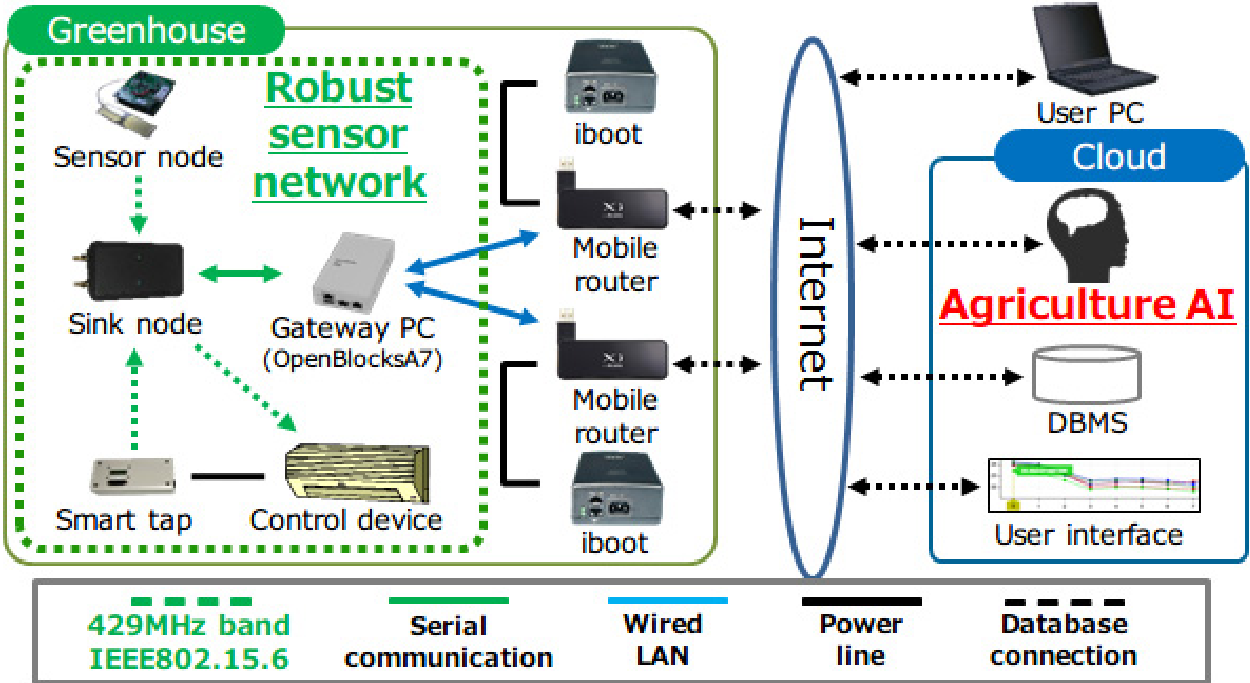 Figure 1: The architecture integrates a "Robust Sensor Network" with a Cloud-based "Agricultural AI."
3. Growth Sensing via Scattered Light
To "see" how the plants are growing, the authors used scattered light sensors. These estimate leaf area index (LAI) indirectly, providing a crucial independent variable for nitrogen absorption—since more leaves mean more transpiration and more nutrient uptake.
Experimental Results: Sweeter Tomatoes
The prototype was tested on a hydroponic tomato farm in Shizuoka, Japan.
- Accuracy Boost: SW-SVR smashed the baseline SVR. It followed the volatile peaks of nitrogen absorption far more closely, especially after major environmental shifts (like solution replacement).
- Efficiency: By ignoring irrelevant data, the system reduced the training workload by 43.07%, making it feasible for low-power edge/cloud deployment.
- The "Sugar" Metric: The ultimate test was the fruit itself. The tomatoes grown under SW-SVR control had 1.54x higher sugar content than those grown with conventional methods.
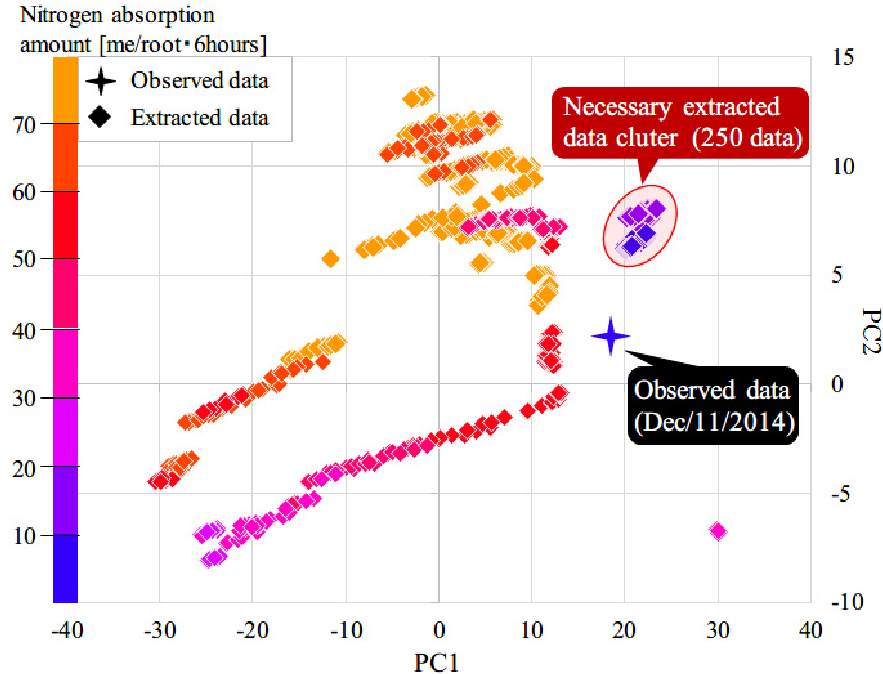 Figure 2: Comparison of true values vs. predicted values. SW-SVR (solid line) tracks the actual nitrogen absorption significantly better than standard SVR.
Critical Insight & Limitations
The strength of SW-SVR is its inductive bias: it assumes that the near future will behave like past instances that looked just like the present. However, the study noted a failure case on Dec 11, 2014, where SW-SVR underperformed. The reason? The system lacked air-side nitrogen concentration data.
The Takeaway: No matter how smart the algorithm is at selecting data, if a critical physical variable is missing from the input, the "similarity" calculation becomes blind to the real cause of change.
Conclusion
This work marks a shift from "Big Data" (using everything) to "Relevant Data" (using the right window). By combining robust 429MHz wireless networks with specialized SVR, the researchers have moved one step closer to an autonomous greenhouse that doesn't just monitor—but actually "understands"—plant physiology.