
GremoBot: Can an AI Moderator Save Your Team from a Toxic Group Chat?
GremoBot: Exploring Emotion Regulation in Group Chat
The paper introduces GremoBot, an AI-powered chatbot designed to monitor and regulate group emotions in text-based collaboration tools like Slack. By leveraging sentiment analysis and pre-defined emotion regulation strategies, GremoBot intercedes during negative emotional states or communication lulls to maintain a positive group climate.
CL;DR
GremoBot is an experimental chatbot designed for Slack that acts as a "digital therapist" for teams. By analyzing the sentiment of messages in real-time, it intervenes when the vibe turns sour or when productivity stalls. While it successfully boosts morale in creative brainstorming, it reveals a fascinating tension: in high-stakes decision-making, even a well-meaning bot can become an "annoying" distraction.
The "Invisible Leader" Problem in Digital Spaces
In physical offices, a good leader senses tension in the room through body language or a heavy silence. In the world of Slack, Teams, and Discord, these cues vanish. Self-managing teams often spiral into negativity or stall in awkward silences because no one is officially "in charge" of the emotional climate.
The researchers from HKUST recognized that while we have bots for scheduling and file management, we lack bots for emotional maintenance. Their insight? Use AI to provide the "external process of emotion regulation" that human leaders usually provide.
Methodology: The Anatomy of an Emotional Intervention
GremoBot doesn't just "feel"; it calculates. The architecture follows a tripartite loop: Monitor, Evaluate, and Modify.
- Monitoring: Using Microsoft and IBM’s sentiment APIs, the bot tracks sentiment scores (0 to 1) and specific tones like "Joy," "Confidence," or "Analytical."
- Triggering Situations:
- Long Silence: If the chat stops for too long, the bot assumes progress is stalled.
- Negative Status: If the collective sentiment score drops below 0.33 or negative messages pile up.
- The Intervention: The bot posts a message that combines a positive reinterpretation, a visualization of the team's emotional trend, and a tactical tip.
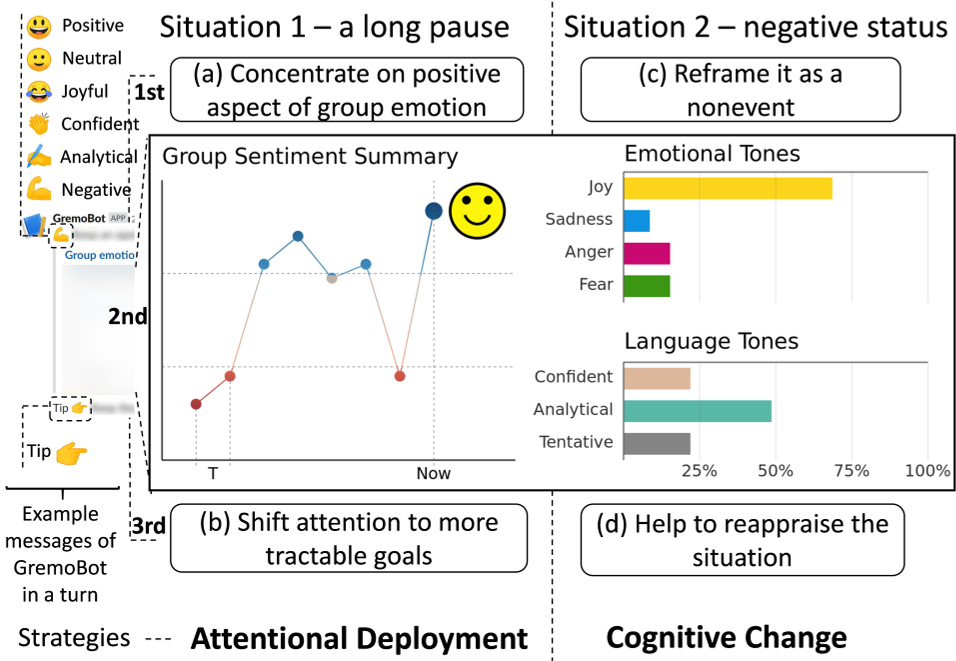 Figure 1: GremoBot's anatomy of a message, showing visualization and strategy-based text.
Experiments: Context is Everything
The researchers tested GremoBot across three distinct scenarios: Decision-Making (DM) (high conflict), Creativity (Cr) (collaborative), and Debate (Db) (competitive).
Key Findings:
- The Reinforcement Effect: Users reported that seeing a "joyful tone" or an upward-ticking line chart made them feel more relaxed and encouraged them to use more emojis, creating a positive feedback loop.
- The Annoyance Factor: GremoBot was rated significantly more annoying in Decision-Making tasks. Why? When users are "in the zone" solving a logic puzzle, a bot popping up to talk about "feelings" feels like an interruption.
- Visualization vs. Text: Users paid far more attention to the visual charts than the pre-written text tips. The data visualization served as a "mirror," allowing teams to self-correct their behavior without being told what to do.
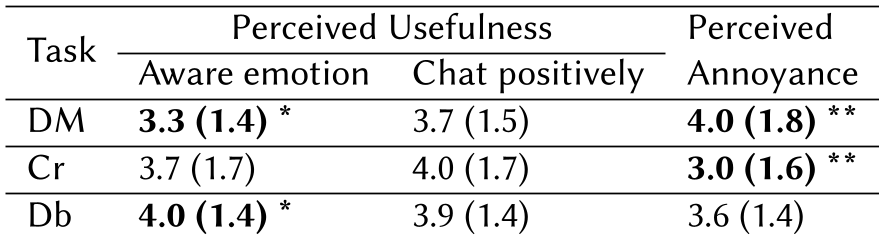 Table 2: Comparison of perceived usefulness and annoyance across different task types.
Critical Analysis & Future Outlook
While GremoBot is a brilliant proof-of-concept, it highlights a major hurdle for AI in social spaces: Social Intelligence vs. Algorithmic Accuracy.
Limitations:
- Semantic Nuance: Participants noted that the bot sometimes misread the room—failing to distinguish between "productive disagreement" (necessary for good decisions) and "toxic negativity."
- UI Friction: The bot’s messages "pushed" older, important messages up the screen, breaking the team's cognitive flow.
The Future of Group AI: The takeaway for designers is clear: Ambient over Active. Instead of a bot that "interrupts" the conversation with a post, emotional feedback should perhaps be an integrated, persistent UI element—like a small "weather icon" in the corner of the app that shifts from sunny to cloudy based on the chat's health.
Ultimately, GremoBot proves that while AI can't replace the empathy of a human leader, it can act as a crucial "early warning system" for the digital workplace.
Conclusion
GremoBot marks a shift from functional bots to socially-aware agents. Its success in creative tasks suggests that for teams with high "collective goals," AI-led emotion regulation can significantly enhance the collaborative experience.