Deciphering Deception: A Psychological Journey into Opinion Spam Ground Truths
Identifying ground truth in opinion spam: an empirical survey based on review psychology
This paper provides an empirical survey of opinion spam detection, shifting the focus from purely linguistic analysis to the "ground truth" problem through the lens of review psychology. It categorizes deceptive reviewers into crowdsourcing and expert spammers, identifying behavioral footprints as more reliable indicators than textual features.
TL;DR
Detection of fake reviews has long been stalled by the "Ground Truth" problem—how do we train models when we can't definitively say which reviews are fake? This survey by Li et al. breaks the deadlock by using Review Psychology to uncover "quasi ground truths." By shifting the focus from what is said to why and how it is posted, the paper identifies behavioral footprints (like burstiness and rating deviation) as the true North Star for anti-spam systems.
Background Positioning
In the academic coordinate system, this work acts as a structural bridge between machine learning and behavioral psychology. It moves past the "bag-of-words" era, acknowledging that if even human experts can be fooled by a well-written fake, our models must look at the metadata of human intent.
The "Ground Truth" Paradox
Why is detecting opinion spam so difficult?
- Expert Forgery: Sophisticated spammers (experts) use "Equity Motives" to mimic legitimate complaints or praise.
- Unreliable Benchmarks: Early datasets used Amazon Mechanical Turk (AMT) workers, but these workers don't share the same incentives or pressure as real industrial spammers, making the data non-representative.
- The Truth Bias: Psychologically, humans are inclined to trust information, making crowdsourced labeling inherently flawed.
Methodology: The Psychological Camouflage
The authors dismantle the spamming process into three phases: Pre-spam (the decision to hit), Spamming (the execution), and Post-spam (performance tracking).
1. The Five Motives
The paper identifies five primary drivers for reviewing:
- Altruism: Helping others (easy to mimic).
- Equity: Restoring balance after a very good/bad experience.
- Problem-solving: Seeking support.
- Social Benefit: Seeking community approval.
- Profit: The only "honest" spammer motive, which they hide using the other four.
2. Behavioral Footprints vs. Linguistic Cues
The core insight is that while an expert spammer can hide their style, they cannot easily hide their footprint.
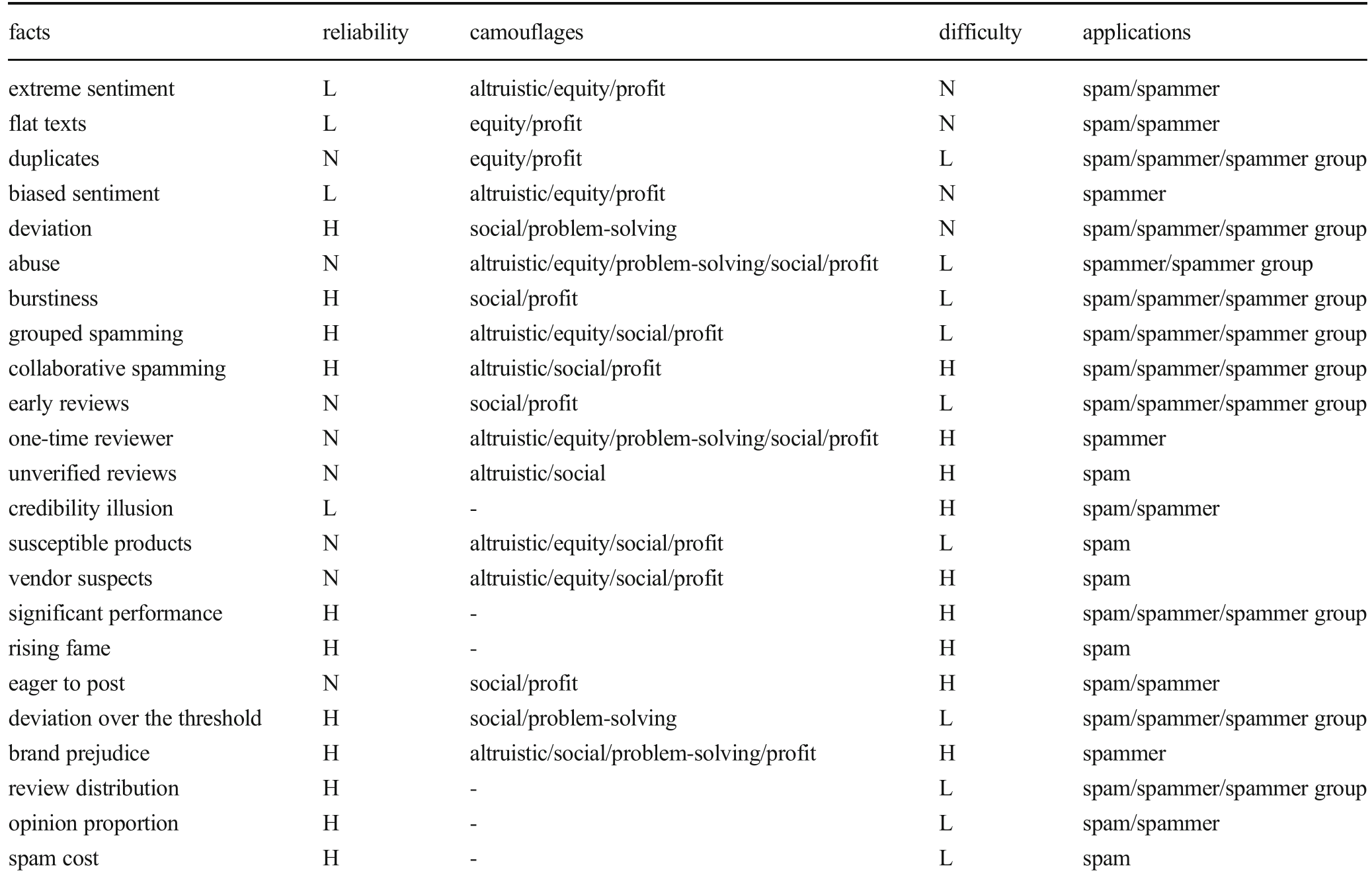 Table: Reliability of various facts. Note that High (H) reliability is almost exclusively linked to behavioral patterns like Deviation and Burstiness.
Key Insights: Crowdsourcing vs. Experts
The survey draws a sharp line between two types of threats:
- Crowdsourcing Spammers: Motivated by "quick money," they leave messy trails. Their spam is characterized by "flat texts," high burstiness, and occurring in large scales within narrow time windows.
- Expert Spammers: These are the "ghosts" in the system. They write long, logical reviews and utilize domain-independent "word abuse" (overusing generic positive terms) to mask their lack of actual product experience.
The Power of Anomaly Detection
The authors argue that we should look for "Unfalsifiable Anomalies":
- The Rising Fame Curve: Logically, most products' ratings decline over time. A steady rising curve is a red flag.
- Poisson Distribution Violation: Authentic review arrivals are random events. Spammer campaigns create "bursts" that violate traditional survival analysis and temporal patterns.
Critical Analysis & Future Directions
The paper concludes that Behavior > Text. While NLP is useful for "Expert Spammers" (who might overuse certain psycholinguistic filler words), it is the Grouped Spamming and Review Distribution analysis that provides the most robust defense.
Limitations
The survey primarily focuses on English-language and text-based platforms. As e-commerce migrates to video-centric reviews (TikTok/Instagram), the psychological motives remain, but the "lexical truths" identified here will need to be reinvented for visual signal processing.
Conclusion
Li et al. provide a vital roadmap for anyone building anti-fraud platforms. The takeaway is clear: stop trying to catch the liar by their words; catch them by their shadow—the timing, the frequency, and the deviation from the crowd's psychological norm.