
GBGCN: Cracking the Code of Social Group-Buying Recommendation
Group-Buying Recommendation for Social E-Commerce
This paper introduces GBGCN (Group-Buying Graph Convolutional Network), the first personalized recommendation framework specifically designed for social e-commerce group buying. By constructing directed heterogeneous graphs and utilizing multi-view embedding propagation, the model achieves a significant performance boost of 2.69%-7.36% over state-of-the-art baselines on a large-scale real-world dataset.
TL;DR
Social e-commerce platforms like Pinduoduo have revolutionized online shopping through group buying. However, recommending the right product for a user to launch a group is a complex puzzle involving social influence and dual user roles. This paper introduces GBGCN, a Graph Convolutional Network that models initiators and participants separately, leveraging a multi-view architecture and a unique "double-pairwise" loss function to achieve new SOTA results.
The Motivation: Why Social Group-Buying is Different
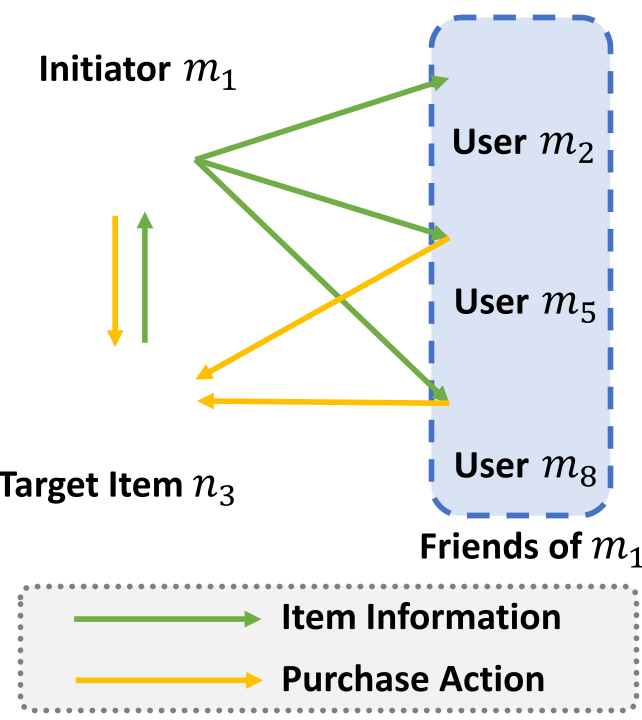
In standard e-commerce, it's just You vs. The Item. In group buying, a transaction only "clinches" if an Initiator picks an item and convinces enough Participants (friends) to join.
Current SOTA models fall short because:
- Role Ambiguity: A user is an initiator today but a participant tomorrow. Their tastes change based on the role.
- Social Friction: Success depends on whether your friends like what you shared.
- Complex Feedback: If a group fails, does it mean the initiator hated the item? No, they paid for it! It means their friends weren't interested. Standard loss functions can't process this nuance.
Methodology: The Multi-View Architecture
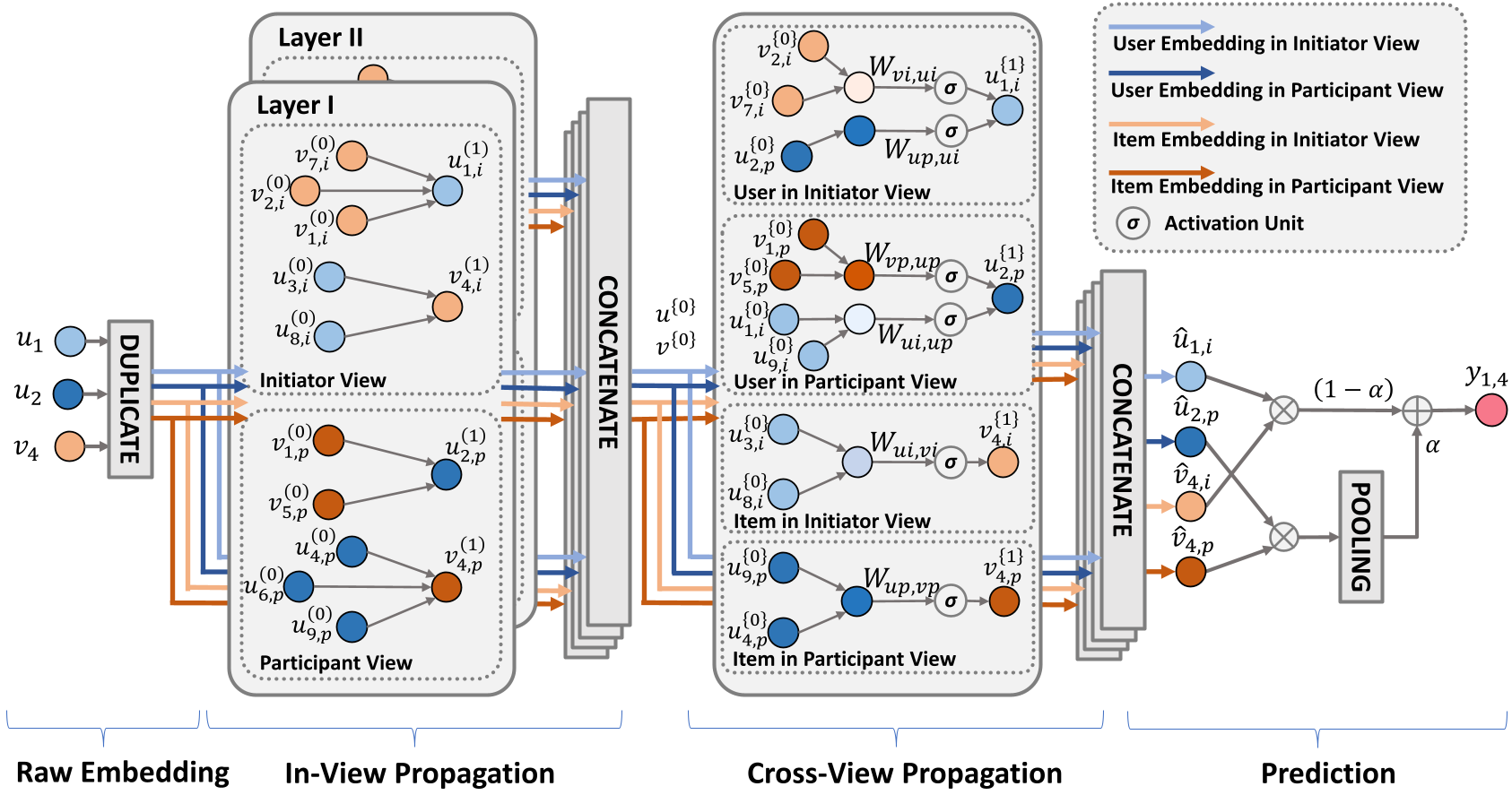
The core innovation of GBGCN lies in its Directed Heterogeneous Graph. Instead of one big user-item matrix, the authors split the world into two "views":
1. In-View Propagation (Learning Roles)
The model runs specialized GCN layers for the Initiator View (who launches what) and the Participant View (who joins what). This allows the system to learn that a user might launch high-prestige items to influence friends but join groups for basic necessities.
2. Cross-View Propagation (Modeling Influence)
This is where the magic happens. The model uses "Sharing" and "Joining" edges to pass information between views. It simulates social influence: if User A often convinces User B to join, User A's "Initiator Embedding" begins to incorporate User B's "Participant Preferences."
3. Double-Pairwise Loss: Learning from Failure
Most models ignore failed transactions. GBGCN uses them.
- Successful Group: Initiator likes item AND participants like item.
- Failed Group: Initiator likes item BUT participants DISLIKE item. By framing this as a double-pairwise optimization, the model learns the fine-grained boundaries of social influence.
Experiments & SOTA Comparison
The researchers tested GBGCN against 9 baselines (MF, NCF, NGCF, etc.) on a massive dataset from Beibei, China's largest maternal e-commerce platform.
Key Findings:
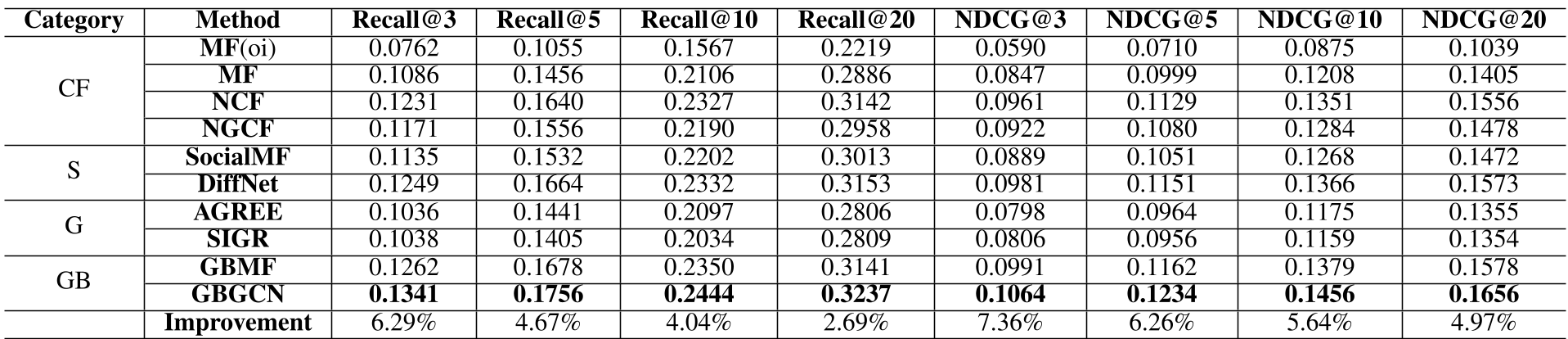
- Significant Gains: GBGCN outperformed the strongest baseline (GBMF) by over 7% in NDCG@3.
- Small-K Superiority: The model is particularly effective at top-tier ranking (Recall@3/Recall@5), which is crucial for mobile apps where screen space is limited.
- Role Awareness Matters: Ablation studies (removing user or item roles) led to a consistent drop in performance, proving that "one-size-fits-all" embeddings are suboptimal for social commerce.
Deep Insight: Visualizing the Dual Identity
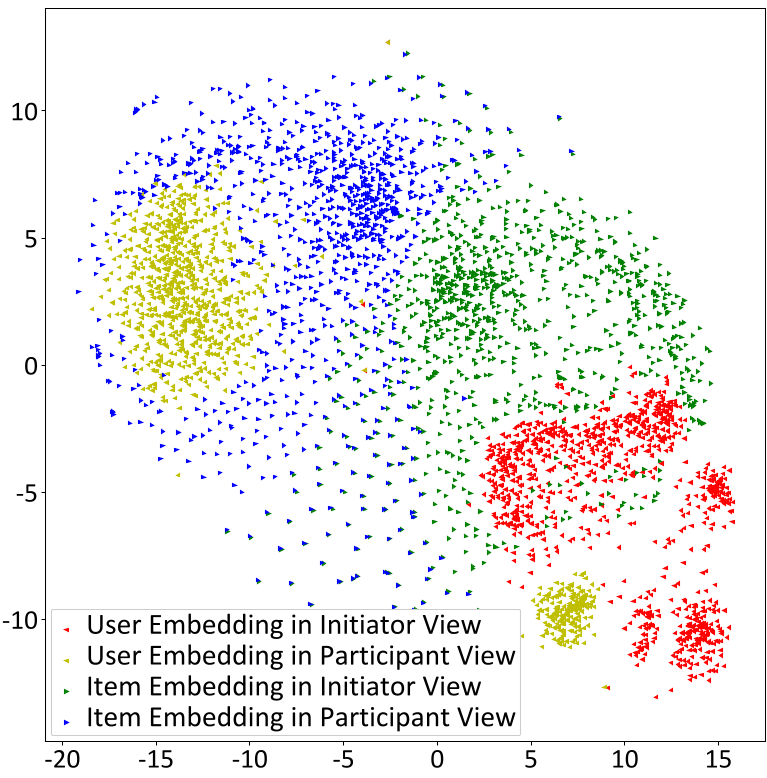
Using t-SNE visualization, the authors demonstrated that the embeddings for the same user in the "Initiator" vs. "Participant" view actually occupy different areas of the latent space. This confirms the "Social Identity" hypothesis: we are different shoppers when we are leading a group than when we are following one.
Conclusion
GBGCN is a significant step forward because it treats social e-commerce as a unique graph problem rather than just "regular recommendation plus social links." By capturing the interplay between the initiator's intent and the participants' social compliance, it provides a blueprint for the next generation of group-buying algorithms.
Future Outlook: The next frontier will likely involve "Dynamic Thresholding"—predicting exactly how many friends are needed for a specific item to clinch, further optimizing the sales funnel.