
Group Disappearance in Social Networks: Maintaining the Pulse of Information Flow
Group disappearance in social networks with communities
The paper proposes a novel framework for managing the disappearance of node groups in social networks while preserving information flow quality. It introduces the JOAN/JOAN-C extensions to classify leaving groups as scattered, contiguous, or hybrid, and employs homophily-based link restoration and substitute selection.
TL;DR
When a group of nodes vanishes from a social network—be it an office team resigning or a cluster of users going private—the network's ability to spread information can collapse. This paper introduces a systematic framework to restructure networks after such "Group Disappearances." By classifying groups and identifying optimal substitutes, the authors ensure the network remains connected with a minimal number of new links, effectively preserving the "Information Flow Quality."
The "Group-Level" Gap in Network Resilience
Most social network analysis (SNA) focuses on growth—how links are formed (Link Prediction) or how information spreads (Influence Maximization). However, node removal is an equally vital, yet under-researched, dynamic.
The authors identify a critical gap: existing algorithms like JOAN handle one node at a time. In reality, nodes often disappear in clusters. If you treat a contiguous group removal as a series of individual removals, you waste computational resources creating links to nodes that are about to disappear anyway.
Methodology: The Architecture of Restoration
The core insight of the paper is the classification of the leaving group () into three types:
- Scattered: Nodes have no direct ties. Handled via iterative application of single-node JOAN/JOAN-C logic.
- Contiguous: Every node in the group is connected (directly or indirectly). These are handled "in one shot" by finding a group substitute.
- Hybrid: A mix of the above, requiring decomposition.
The Search for Substitutes
Instead of random link addition, the authors use the Homophily Principle ("birds of a feather flock together"). They look for substitutes within the Total Common Neighbors () or Partial Common Neighbors () of the leaving group.
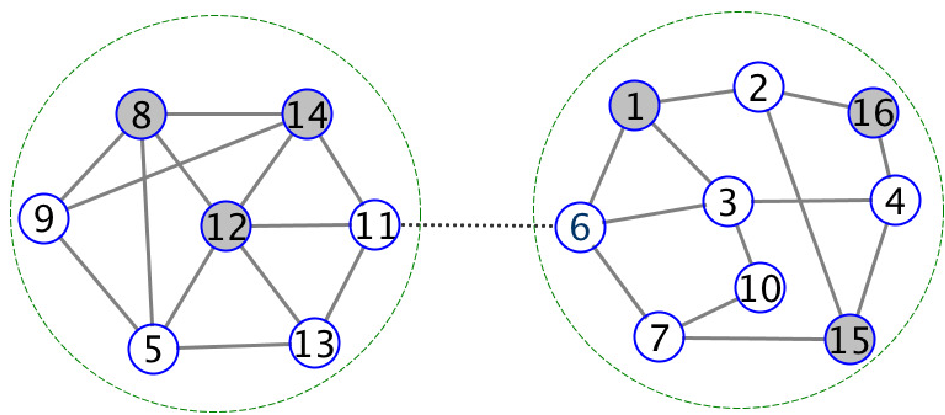
If no common neighbors exist, the algorithm gathers a set of nodes from the neighborhood with the highest group degree centrality to act as a collective replacement, ensuring the network's "witness" (the most central node) remains within reach of all other members.
Engineering Efficiency: The Community Advantage
A standout feature of this research is its adaptation for Overlapping Communities.
- Parallelization: By identifying which communities a disappearing group belongs to, the algorithm can run restructuring tasks in parallel across different machines.
- The Relay Node Strategy: Nodes belonging to multiple communities are treated as "critical" because they act as vital bridges. When they disappear, the algorithm prioritizes finding a substitute in the largest community to maximize potential re-connectivity.
Experimental Results: Less is More
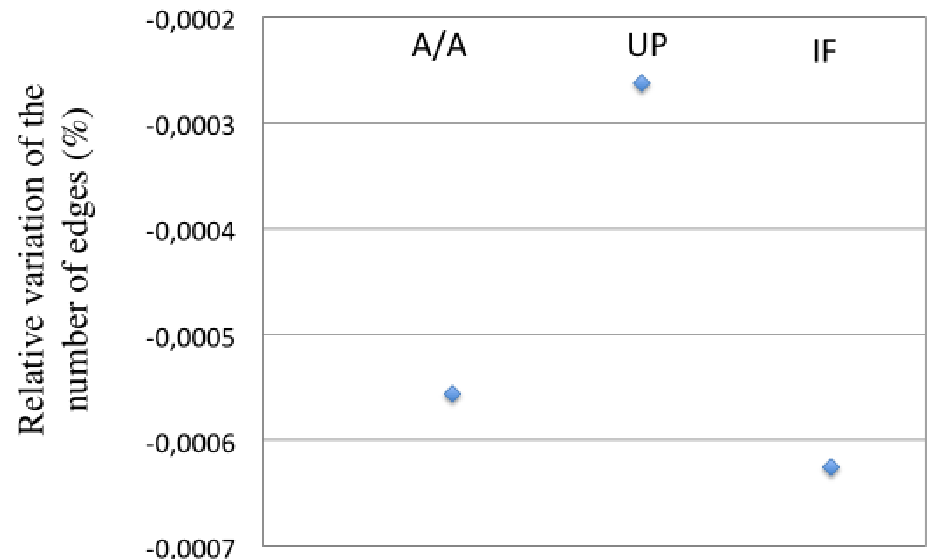
Tested against the Adamic/Adar (A/A) distance and User's Preferences (UP) approaches, this method (denoted as IF - Information Flow) proved significantly more efficient.
- Parsimonious Updates: While A/A and UP often cause a "link explosion," this method adds the fewest edges possible to maintain connectivity.
- Performance Stability: In the Internet routers dataset (AS-733), even when 40% of the network disappeared, the number of added links per node remained incredibly low (approx. 0.22).
- Speed: In a cloud-based infrastructure, processing group disappearances within communities was significantly faster than processing the network as a single giant component.
Critical Insight & Conclusion
The true value of this work lies in its minimalist philosophy. In industrial applications (like organizational management or server network maintenance), we don't want to over-complicate the structure; we want the shortest path to restoration.
Limitations: The paper currently assumes undirected and unweighted links. In complex environments like high-frequency trading or nuanced social hierarchies, the weight and direction of the "substitute link" would be as important as its existence.
Future research direction is clear: moving beyond binary connectivity to capture the latent roles of ties, ensuring that when a group leaves, the meaning of their interaction is as preserved as the topology itself.