
LIM: Leveraging Community Impact for Local Influence Maximization
Group Impact: Local Influence Maximization in Social Networks
The paper introduces Local Information Maximization (LIM), a community-aware framework for maximizing influence spread in social networks. By partitioning networks into communities and selecting seeds based on local "group impact," it achieves efficient influence propagation compared to traditional heuristics.
TL;DR
Influence Maximization (IM) is the art of picking the "perfect few" to trigger a massive cascade of information. While traditional methods treat the network as a monolithic entity, the Local Information Maximization (LIM) approach recognizes that social networks are collections of tight-knit tribes. By shifting the focus from global centrality to Local Group Impact, LIM offers a more efficient and realistic way to spark viral trends.
The Problem: The High Cost of Global Influence
Since the seminal work of Kempe et al. (2003), the IM problem has been defined as selecting a seed set of size to maximize the expected spread . While mathematically elegant using submodular functions, it faces two massive hurdles:
- Computational Deadlock: Evaluating global influence spread requires thousands of Monte Carlo simulations, making it prohibitively slow for large-scale graphs.
- Structural Ignorance: Most models ignore the "Birds of a Feather" (homophily) principle. In reality, a Jazz influencer has a massive impact on the Jazz community but near-zero impact on a Heavy Metal cluster.
The Insight: Influencing the "Tribes"
The authors propose that propagation is naturally a local phenomenon. If you influence the leader of a community, the internal ties of that cluster will do the heavy lifting for you.
The Methodology: The LIM Workflow
The LIM algorithm operates through a three-stage pipeline:
- Network Partitioning: Using the Walktrap algorithm, the network is broken into communities. Walktrap utilizes random walks; because edges are denser within communities, a "walker" is likely to stay trapped within a local group.
- Relative Importance (RI) Calculation: Not all communities are equal. LIM calculates an RI score for each sub-graph. Denser, more connected communities are prioritized for seeding.
- Local Seeding: Instead of running a global greedy search, LIM identifies seeds within high-priority communities based on their local marginal gain ().
 Equation 1: The objective function for maximizing influence within partitioned sub-graphs.
Experimental Evidence
The researchers tested LIM on synthetic networks generated via the Forest Fire model, which mimics real-world properties like heavy-tailed degree distributions and community structures.
- NW1: 500 nodes, 1,127 edges.
- NW2: 2,000 nodes, 4,965 edges.
As shown in the evaluation results for NW2, LIM significantly outperforms standard heuristics. By focusing on communities, the algorithm avoids wasting seeds on "isolated" nodes that have high degrees but poor connectivity to larger, reachable clusters.
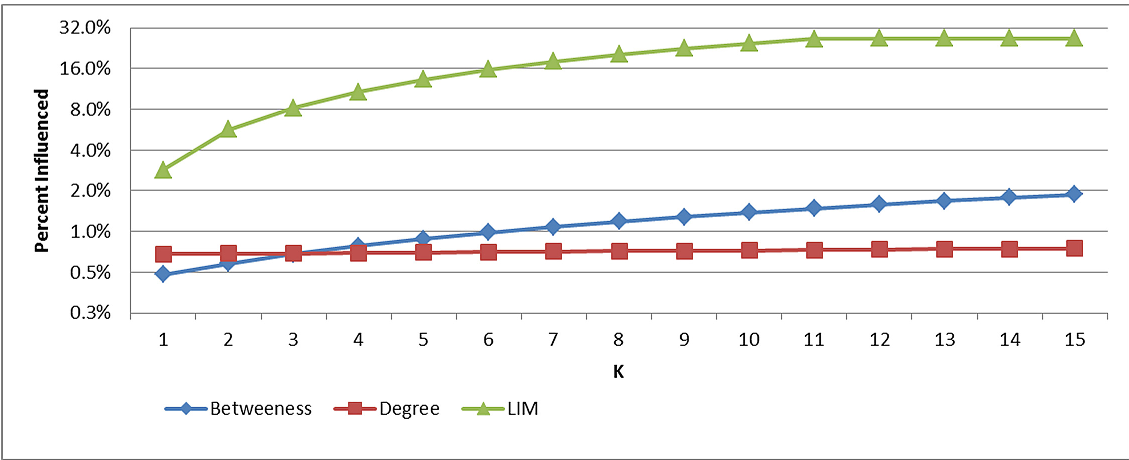 Fig: Evaluating LIM performance against traditional heuristics in NW2.
Critical Analysis: Why This Matters
The beauty of LIM lies in its scalability. By ignoring "tiny" subgroups where the marginal gain is minimal, it effectively prunes the search space.
Limitations:
- The current study focuses on synthetic data. Real-world social networks often have "overlapping" communities (one person belonging to multiple groups), which the current partitioning might oversimplify.
- The performance is highly dependent on the choice of the community detection algorithm.
Summary & Future Outlook
The LIM approach proves that "Local is the New Global." For practitioners in viral marketing or public health, the takeaway is clear: stop looking for the most popular person on the whole platform; find the most influential person within the specific "tribe" you want to reach.
Future research will likely expand this into Dynamic Community Detection, where the algorithm adapts as communities form and dissolve in real-time.