
GroupLink: Boosting Team Cohesion through Digital Traces and Optimal Connectedness
GroupLink: Group Event Recommendations Using Personal Digital Traces
GroupLink is a group event recommendation system designed to foster face-to-face interactions in non-work settings for small-to-medium groups (3-8 people). It leverages "Immersive Recommendation" by extracting user preferences from personal digital traces (social media, email, streaming history) and employs a "best-minimum-connected" greedy strategy to optimize group cohesion.
TL;DR
GroupLink is an innovative recommendation system that suggests local events to small groups by analyzing their Personal Digital Traces (social media, emails, etc.). By moving away from boring surveys and using a "Best-Minimum-Connected" strategy, it ensures that no team member is left behind, effectively preventing "lone wolf" scenarios and fostering genuine face-to-face interaction.
Background & Motivation: The "Lone Wolf" Problem
Organizing a team outing is a logistical and social nightmare. You have three common failure modes:
- The Subgroup Split: An event only appeals to a specific clique.
- The Lone Wolf: One person is miserable while everyone else has fun, damaging overall group trust.
- The Mediocre Middle: An event so generic (like a "safe" coffee chat) that it fails to excite anyone.
Existing research suggests that face-to-face interactions in non-work settings are critical for workplace creativity and trust. However, knowing what everyone likes—especially when the group is new—is a massive data acquisition challenge.
Method: Immersive Recommendation & Social Connectivity
GroupLink tackles these challenges with two core pillars:
1. Immersive Recommendation (Zero-Effort Profiling)
Instead of asking users to rate 50 movies or fill out an interests form, GroupLink uses Immersive Recommendation. By authorizing via OAuth, the system pulls data from:
- Facebook/Twitter: To gauge social interests.
- YouTube/Streaming: To understand entertainment preferences.
- Email: To capture professional and personal topical interests.
2. The Best-Minimum-Connected Strategy
Most group systems use "Mean Preference" (average happiness) or "Least Misery" (don't make anyone hate it). GroupLink goes further. It treats a group as a network and aims to maximize the minimum connectedness.
The Intuition: If Member A and Member B have zero overlapping interest in an event, they won't talk. The greedy algorithm picks a collection of events such that every pair of members has the highest possible probability of mutual engagement.
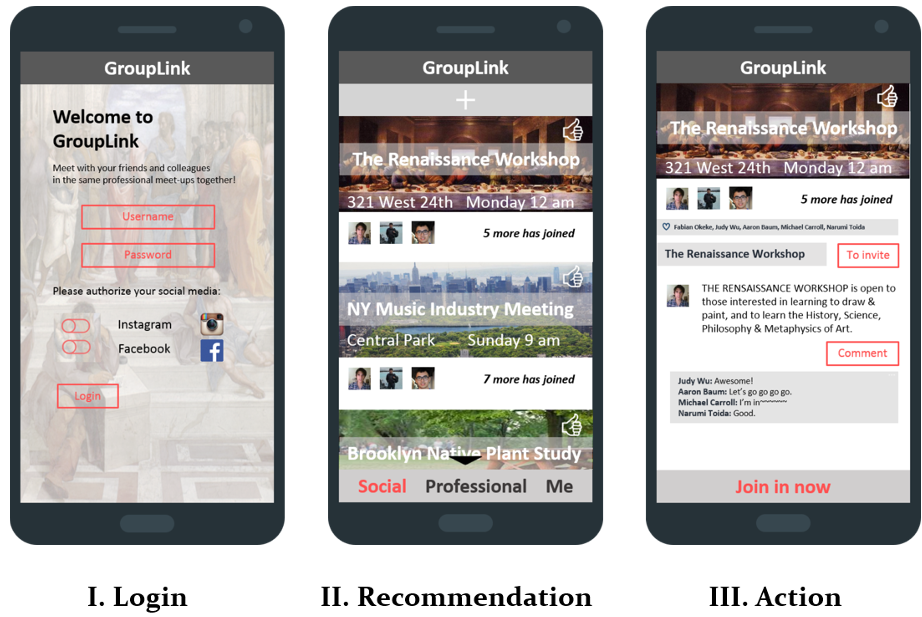 Figure 1: The GroupLink Workflow: (I) Onboarding via Digital Traces, (II) Group Recommendations, (III) Direct Action and Planning.
System Prototype & Evaluation
The prototype is a responsive web app pulling real-time event data from Meetup.com.
- Onboarding: Users link their digital identities.
- Group Formation: Users join groups via QR codes (perfect for conferences like CSCW).
- Recommendation: The engine suggests events that optimize for group-wide attendance.
- Action: A built-in communication channel allows the group to move from "recommendation" to "actual logistics" instantly.
 Figure 2: The UI focuses on showing which members are interested in which events to encourage social proof.
Critical Insights & Future Outlook
The Privacy Trade-off: The authors pivot on a crucial point—privacy. While these traces are personal, users are often willing to trade some privacy for the utility of a perfectly planned social event. However, the system must be designed to avoid "implicit exposure" where a recommendation reveals a sensitive interest to a colleague.
Conclusion: GroupLink demonstrates that the "Small Data" (personal traces) available on our phones and computers is enough to solve the "Cold Start" problem for human social groups. Future iterations will likely integrate "Feedback Loops" (tracking if people actually showed up) to further refine the underlying interest models.
Main Takeaway: By focusing on the "minimum connection" between members, we can design algorithms that don't just recommend content, but actually build human relationships.