
Geo-Group-Recommender: Why Group Outings Need Better Tech than Individual Suggestions
Where could we go? Recommendations for groups in location-based social networks
The paper introduces Geo-Group-Recommender (GGR), a hybrid recommendation framework designed for groups in Location-Based Social Networks (LBSNs). Tested on a large-scale Swarm/Foursquare dataset, GGR combines Kernel Density Estimation (KDE) with collaborative filtering and categorical features to provide personalized Point-of-Interest (POI) suggestions for user groups.
TL;DR
When you go out with friends, your choice of venue usually differs from what you would pick alone. Current recommendation systems often miss this nuance. This paper presents Geo-Group-Recommender (GGR), a system that stops treating groups as "averages" of people and starts treating them as unique entities. By combining geographical density (KDE) and group-specific behavior patterns, GGR outperforms state-of-the-art individual-aggregation methods in real-world cities.
The "Hamburger-Sushi" Conflict: Why Individual Models Fail
The core motivation of this research stems from a simple observation: conflicting tastes. If one person loves burgers and the other loves sushi, an "average" recommendation might suggest a mediocre fusion place that satisfies neither.
The authors identify that group behavior in Location-Based Social Networks (LBSNs) like Swarm follows different rules:
- Distance: Groups move less frequently and over shorter distances (75% within 5km) compared to individuals.
- Preferences: There is a low correlation (Kendall-tau around 0.4) between what a user likes alone versus what they like with a group.
- Location: Groups often frequent specific "social hubs" that don't overlap with the individual members' daily routines.
Methodology: The GGR Framework
The researchers moved away from the standard "Aggregate Individual Ratings" strategy. Instead, they built a profile for the group itself.
1. Spatial Filtering via KDE
Before calculating scores, the system uses a Gaussian Kernel Density Estimation (KDE) to understand where the group "lives" socially. This prioritizes venues in areas the group actually frequents.
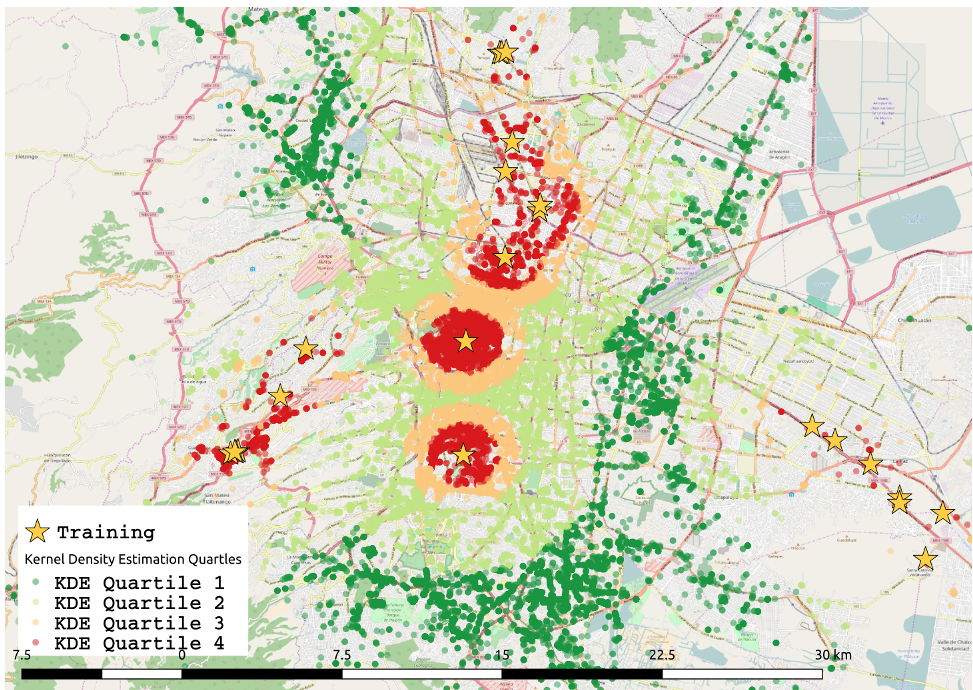 The map above shows how KDE scores prioritize POI candidates based on the actual history of group check-ins.
2. Hybrid Recommendation
The GGR system tests several backends, with KDE-iALS (Implicit Alternating Least Squares) and KDE-SGD-GEO emerging as winners. By incorporating categorical data (e.g., "Mexican Restaurant") and Cartesian coordinates, the model learns the latent relationship between the group's identity and the venue's attributes.
Experimental Results
The study utilized a massive dataset of 5.6 million check-ins. The evaluation compared GGR against traditional strategies like "Least Misery" (avoiding picks anyone hates) and "Average Individual Ratings."
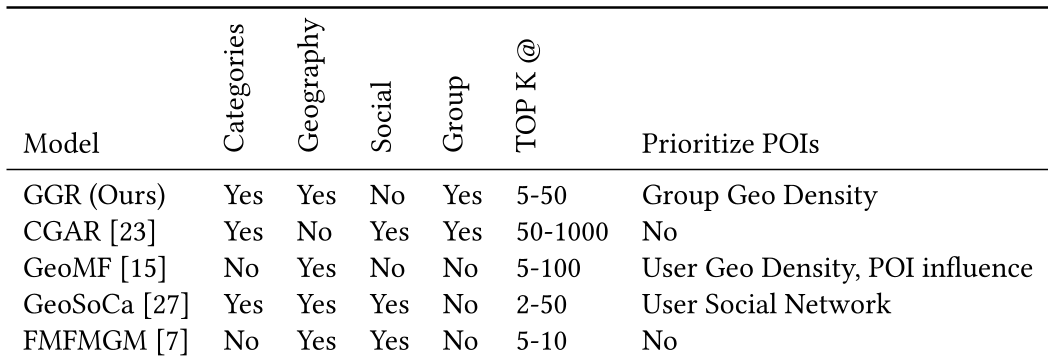
Key Findings:
- Direct Group Training > Aggregation: Training models directly on group check-in data consistently outperformed the AIR/ALM/AWM strategies across all cities (Istanbul, Izmir, Mexico City).
- The Power of KDE: Adding the geographical density filter improved the performance of all base algorithms (iALS, SGD, and Popularity-based).
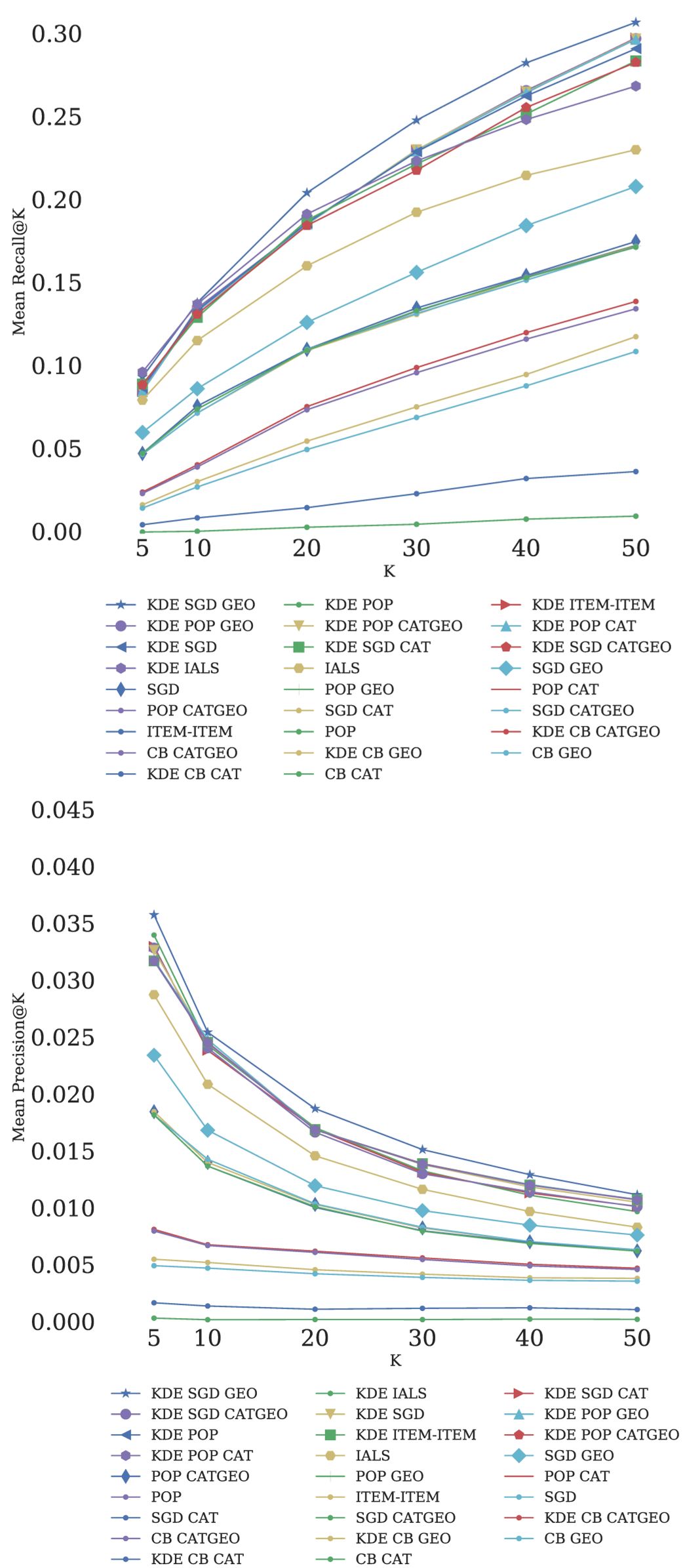 In Istanbul, the KDE-iALS method showed clear dominance in both Precision and Recall at various K-thresholds.
Critical Analysis & Conclusion
The paper effectively proves that group dynamics are a first-class citizen in recommendation logic. Simply aggregating individual preferences is a "lazy" approach that ignores the unique spatial and social constraints of group outings.
Limitations & Future Work
While GGR is a step forward, the authors acknowledge the "Cold Start" problem: what if the group has never met before? Future work could involve utilizing the Social Graph to predict a group's behavior based on the overlap of their friends' networks. Furthermore, the variability of performance across different cities (e.g., Izmir favoring SGD while Istanbul favors iALS) suggests that urban infrastructure and transit ease play a massive role in how groups decide "where to go."
Takeaway: Effective personalization for social groups requires a hybrid lens—one that respects the "physics" of the city (Geography) just as much as the "chemistry" of the friends (Categories/Preferences).