
Grouped ESN: Bridging Efficiency and Accuracy in Speech Emotion Recognition
Grouped Echo State Network with Late Fusion for Speech Emotion Recognition
The paper proposes a Grouped Echo State Network (GESN) with Late Fusion for Speech Emotion Recognition (SER), utilizing multivariate time series features (MFCC and GTCC). By employing parallel reservoirs and Bayesian hyperparameter optimization, the model achieves state-of-the-art (SOTA) performance on the SAVEE and FAU Aibo datasets.
TL;DR
Speech Emotion Recognition (SER) is traditionally dominated by heavy Deep Learning models. This paper shifts the paradigm by introducing a Grouped Echo State Network (GESN). By using parallel "reservoirs" and a smart late-fusion strategy, the authors achieved SOTA results (64.05% UA on SAVEE) with a model that is significantly more computationally efficient than standard RNNs or Transformers.
The Core Challenge: Sparse and Complex Temporal Data
Deciphering emotion from waves of audio is inherently difficult. While handcrafted features like MFCCs are effective, mapping them to emotional states requires capturing long-term temporal dependencies. Existing solutions typically fall into two traps:
- Over-complexity: Models like BiLSTMs are powerful but require massive data and compute for training.
- Instability: Standard Echo State Networks (ESNs) use fixed random weights, which can lead to inconsistent performance if hyperparameters aren't perfectly tuned.
Methodology: The Power of Parallel Reservoirs
The authors propose a Grouped ESN architecture. Instead of relying on a single reservoir, they utilize two parallel layers. This setup allows the system to capture a broader range of "independent information" from the audio signal.
1. Feature Engineering
The model uses 13 MFCC (Mel-Frequency Cepstral Coefficients) and 13 GTCC (Gamma-Tone Cepstral Coefficients) features, providing a 26-dimensional input vector that balances standard spectral analysis with noise-robust filtering.
2. The Grouped Architecture
The architecture relies on the principle of Reservoir Computing (RC), where internal weights are random and fixed. Training only occurs at the "readout" stage.
- Parallel Reservoirs: Two distinct reservoirs initialize different random mappings.
- PCA Dimensionality Reduction: The high-dimensional output from the reservoirs is compressed using PCA to avoid overfitting and reduce the "noise" of the sparse representation.
- Late Fusion: The outputs are combined in the "Reservoir Model Space," a generative interface that induces a metric relationship between samples.
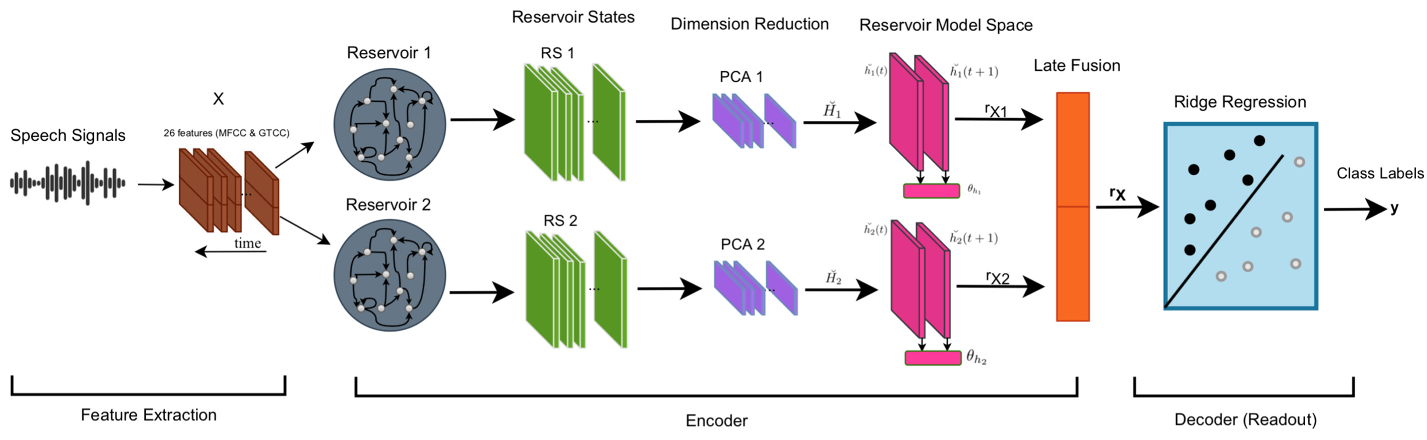 Figure 1: The overall workflow from feature extraction to the late fusion of grouped reservoirs.
Experiments and Results
The model was tested against two major benchmarks: SAVEE (acted) and FAU Aibo (spontaneous speech).
SOTA Comparison
In the speaker-independent LOSO (Leave One Speaker Out) test, the Grouped ESN showed a clear lead over prior methods.
| Dataset | Method | Year | UA% |
|---|---|---|---|
| SAVEE | Daneshfar et al. | 2020 | 55.00 |
| SAVEE | Proposed Grouped ESN | - | 64.05 |
| FAU Aibo | Zhao et al. | 2019 | 45.40 |
| FAU Aibo | Proposed Grouped ESN | - | 45.56 |
The Role of Optimization
One of the paper's critical insights is the use of Bayesian Hyperparameter Optimization. By systematically searching for the best internal unit size and regularization constants ( and ), the authors maximized the potential of the "untrained" reservoir.
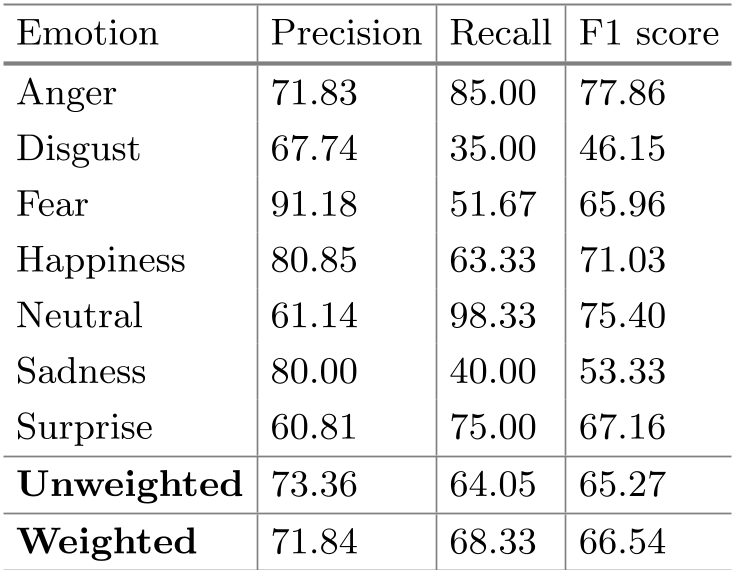 Table 1: Detailed performance metrics on the SAVEE dataset, showing strong precision across categories like Neutral and Happiness.
Critical Analysis & Takeaways
The brilliance of this work lies in its simplicity and efficiency. By moving the "intelligence" of the model into the architecture (parallel reservoirs) and the optimizer (Bayesian Search) rather than an expensive training process, the authors have created a viable model for real-time HCI applications.
Key Takeaways:
- Diversity Matters: Using multiple reservoirs with different initializations serves as a form of ensemble learning within a single model.
- Efficiency vs. Accuracy: You don't always need a deep Transformer to beat the state-of-the-art; well-tuned Reservoir Computing can hold its own.
- Limitations: While effective, the model still faces challenges with highly imbalanced datasets like FAU Aibo, where "Rest" and "Positive" classes show lower F1 scores compared to "Neutral."
Forward-looking researchers should consider applying this grouped reservoir approach to other modalities, such as physiological sensors or video gesture recognition, where temporal sparsity is a common hurdle.