
Guardian: Revolutionizing Social Trust Evaluation with Graph Convolutional Networks
Guardian: Evaluating Trust in Online Social Networks with Graph Convolutional Networks
This paper introduces Guardian, an end-to-end framework based on Graph Convolutional Networks (GCNs) for pairwise social trust evaluation. By modeling social trust as graph data, it achieves state-of-the-art accuracy while delivering a massive 2,827× speedup in inference compared to prior neural-walk methods.
TL;DR
Trust is the invisible currency of online social networks. While evaluating trust between strangers is vital for recommendation systems and security, doing so efficiently at scale remains a "Grand Challenge." Guardian is a novel GCN-based framework that breaks the trade-off between accuracy and speed, outperforming existing SOTA models by 19.8% in accuracy and accelerating the process by a staggering 2,800x.
The Core Problem: Why Trust is Hard to Calculate
In a network like Facebook or Advogato, you might trust your friend Alice, and Alice trusts Bob. Does that mean you trust Bob? This is the Propagative Nature of trust. If multiple friends trust Bob, that's the Composable Nature. Finally, trust is Asymmetric: you might trust a celebrity's advice, but they don't even know you.
Previous attempts to automate this fell into two traps:
- Handcrafted Rules (Walk-based): Relying on domain-specific logic that doesn't scale.
- Matrix Factorization/Neural Walks: Computationally expensive ( or heavy matrix inversions) that crash on large datasets like PGP (Pretty Good Privacy).
Methodology: Popularity vs. Engagement
The breakthrough in Guardian lies in its Trust Convolutional Layers. Instead of treating an edge as a simple link, Guardian splits the interaction into two latent factors:
- Popularity Trust (pTr): Aggregates incoming signals. How much do others trust this user?
- Engagement Trust (eTr): Aggregates outgoing signals. How willingly does this user trust others?
By stacking these layers, Guardian allows "trust signals" to propagate through -hops of the network. Because GCN parameters are shared across all nodes, the model size doesn't explode as the network grows.
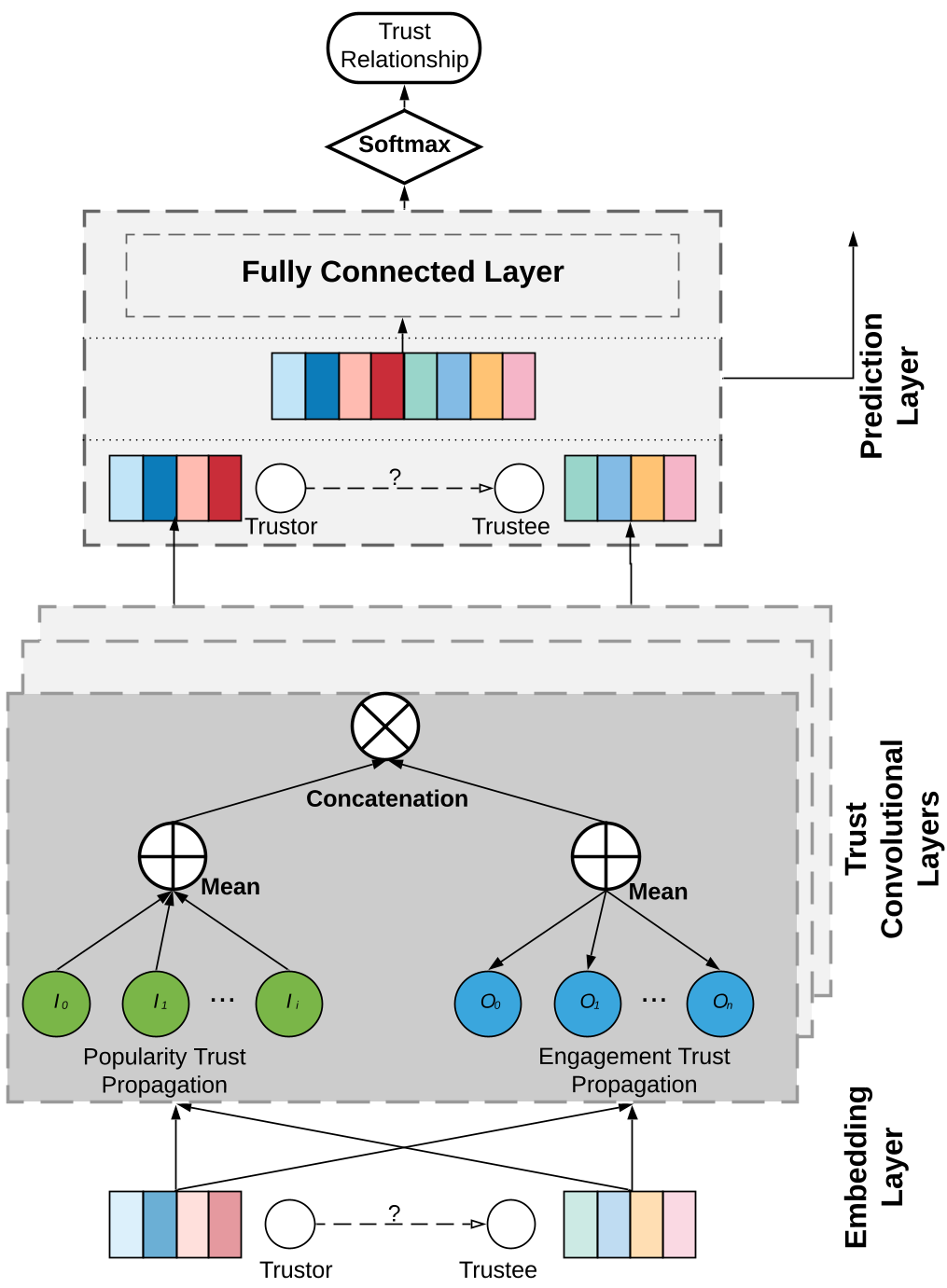 Figure 1: The Guardian framework featuring initial embedding, trust convolutional layers, and a final prediction head.
Scalability and Performance
The experimental results are where Guardian truly shines. In the PGP dataset, previous SOTA models like NeuralWalk ran for 52 hours before crashing due to memory exhaustion. Guardian processed the same data in segments of seconds.
Key Comparisons:
- Accuracy (F1-Score): Guardian hit 87.1% on Advogato, significantly higher than Matrix Factorization (Matri) at 68.3%.
- Efficiency: On the full test set, Guardian's training time is measured in seconds (approx. 28s for Advogato), whereas traditional approaches take several minutes or hours.
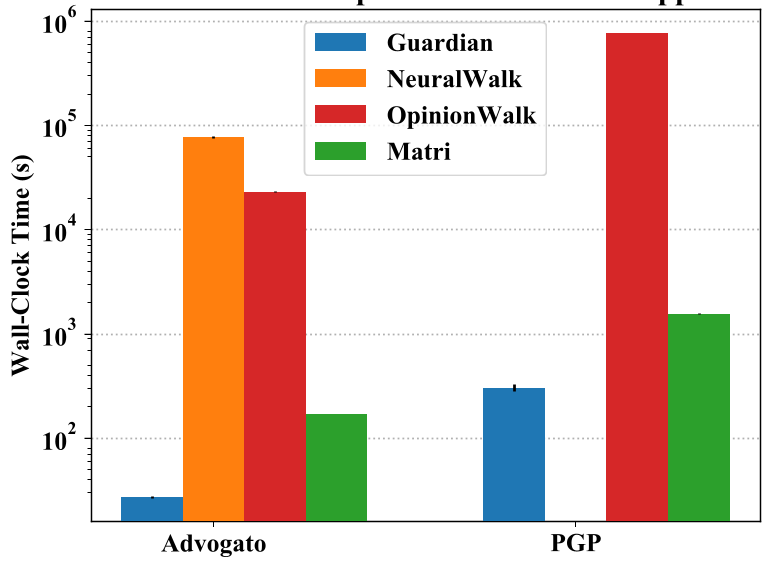 Figure 2: Wall-clock time comparison—Guardian maintains a flat growth curve relative to the exponential explosion of Matri.
Why it Works: The GCN Advantage
Guardian's success stems from its Inductive nature. Unlike Matrix Factorization, which requires a full re-calculation if a new user joins, Guardian learns the general rules of trust propagation. If a new user enters the system, the model can infer their trustworthiness based on local neighborhood connections without retraining the entire world-state.
Critical Insight & Future Outlook
While Guardian solves the scalability issue, the authors acknowledge a remaining frontier: Trust Dynamics. Social trust isn't static; it decays over time or shatters after a single bad interaction.
The transition from walk-based logic to GCN-based latent learning marks a milestone. For developers of recommendation systems or anti-fraud engines, Guardian provides the blueprint for building "Webs of Trust" that are both accurate and fast enough for production environments.
Author Perspective: As a technical lead in GNN research, I find Guardian’s separation of Popularity and Engagement trust to be its most elegant feature—it effectively mirrors the sociological reality of "Influence" vs. "Gullibility" in a mathematical framework.