
Bridging the Gap: How to Train Professionals to Support Technology for Ageing-in-Place
How to Guide the Use of Technology for Ageing-in-Place? An Evidence-Based Educational Module
This paper introduces an evidence-based educational module designed to train care and technology professionals on facilitating technology adoption for ageing-in-place. It translates field research from 53 interviews into a multidisciplinary curriculum featuring personas, film scenes, and a conceptual model of six technology-use determinants.
TL;DR
Aging in place is the goal for most seniors, yet the technology meant to help them often collects dust. This study addresses the professional knowledge gap by developing an evidence-based educational module. By transforming research with 53 older adults into personas, films, and cross-disciplinary workflows, the authors provide a framework for care and tech professionals to move beyond "selling gadgets" to "supporting life."
The "Implementation Gap" in Care Technology
The problem isn't a lack of technology; we have alarm systems, eHealth tools, and smart home sensors. The problem is acceptance and sustained use. Current research focuses heavily on the "pre-purchase" phase and safety devices, ignoring the daily realities of mobility, household chores, and the social dynamics that influence whether a senior actually uses a device after the professional leaves the room.
Furthermore, care professionals often feel unequipped to talk about tech, while engineers may not understand the physical or emotional constraints of a 80-year-old living alone.
Methodology: From Qualitative Interviews to Personas
The researchers didn't just speculate; they visited 53 seniors in their homes, inspecting everything from washing machines to tablets.
1. The Conceptual Model
The study identified six pillars that determine the "level of technology use":
- Individual Living Challenges: What does the senior actually struggle with?
- Behavioural Options: Are there non-tech alternatives (like family help)?
- Personal Thoughts: Self-confidence and perceived competence.
- Social Network: Influence of children and peers.
- Organizations: Health insurance and care provider support.
- Physical Environment: Home infrastructure (e.g., Wi-Fi availability).

2. Personas: Humanizing the Data
To make this data "teachable," the team developed four personas: Peter, Charles, Maria, and Corry. Each represents a different intersection of health, financial status, and tech-readiness. For example, "Charles" is an 85-year-old widower who values utility over "gadgetry," while "Corry" enjoys tech for fun but gets "stuck" easily.
A Unified Professional Workflow
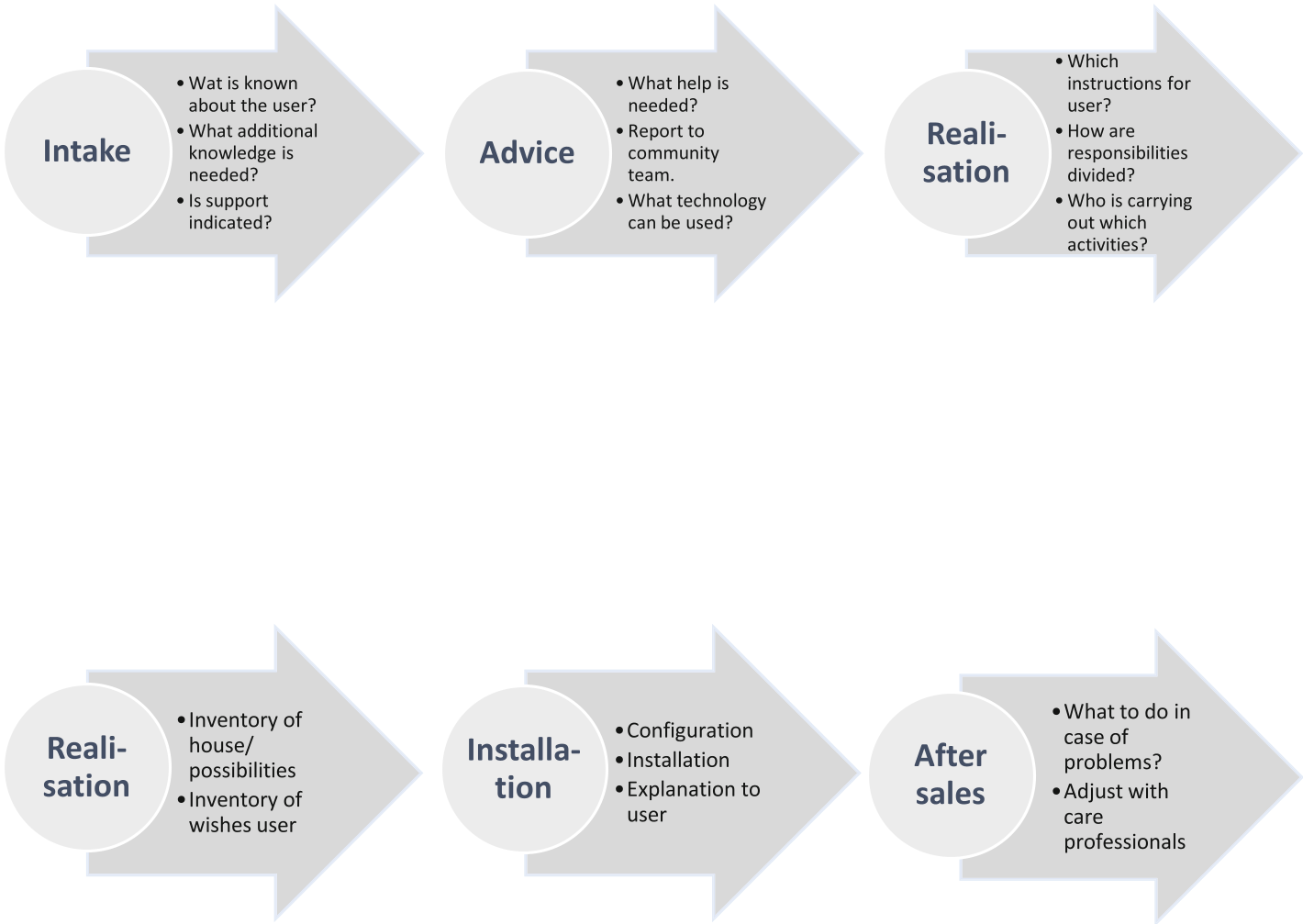
A core contribution of this work is the Inter-disciplinary Workflow. It maps out exactly when a care professional is in the lead (Intake and Advice) and when the engineer takes over (Installation and After-sales), emphasizing that "Realisation" requires both.
Educational Innovation: The Charles Film
Instead of a dry textbook, the researchers worked with a film director to create a 12-scene movie based on the persona "Charles."
- For Students: Each scene is paired with three levels of questions, from basic comprehension to deep critical thinking.
- For Lecturers: The module provides a flexible guide that encourages inspiration over "checklisting."
Critical Insight: Technology as Social Innovation
The genius of this module lies in its recognition that technology implementation is a social innovation. It isn't just about the hardware; it's about changing the work processes of nurses and the communication styles of installers.
Limitations: While robust, the study only had the budget to film one persona. Furthermore, while the materials are in use, a formal quantitative evaluation of their impact on student clinical outcomes is still pending.
Conclusion
This paper serves as a blueprint for translating complex field research into actionable educational tools. By training the next generation of professionals to see the "social and physical context" of technology, we move one step closer to making "ageing-in-place" a sustainable reality rather than a policy buzzword.