
H2Hadoop: Breaking the Redundancy Cycle in Big Data Processing
H2Hadoop: Improving Hadoop Performance Using the Metadata of Related Jobs
The paper proposes H2Hadoop, an enhanced Hadoop architecture designed to optimize Big Data processing—specifically text and genomic data—by leveraging job metadata. By introducing a Common Job Blocks Table (CJBT), the system intelligently directs MapReduce tasks only to DataNodes containing relevant data blocks, avoiding cluster-wide execution.
TL;DR
H2Hadoop is an evolutionary upgrade to the native Apache Hadoop framework. It introduces a metadata-driven scheduling mechanism that "remembers" where specific data patterns (features) are located. By utilizing a Common Job Blocks Table (CJBT), it eliminates the need to scan an entire cluster for related subsequent jobs, resulting in nearly 90% reductions in CPU time and I/O operations for sequence-heavy workloads like genomic analysis.
The "Memoryless" Problem in Distributed Computing
In the world of Native Hadoop, every job is a stranger. Even if Job A just spent hours scanning a 1TB dataset to find a specific DNA motif, Job B (which might be searching for a slightly longer version of that same motif) will start the entire cluster-wide scan from scratch.
The root of the problem lies in the blind independence of the JobTracker. Native Hadoop lacks a mechanism to link the "content" of previous results to the "location" of the raw data blocks. This leads to:
- Excessive Data Movement: Reading blocks that are guaranteed to not contain the result.
- CPU Waste: Re-processing non-target raw data multiple times.
- Network Congestion: Moving tasks and intermediate data across the entire rack unnecessarily.
Methodology: High-IQ Scheduling with CJBT
The core innovation of H2Hadoop is the transformation of the NameNode from a simple file-mapper into an intelligent metadata coordinator.
1. The Common Job Blocks Table (CJBT)
H2Hadoop maintains a lookup table (implemented via HBase or NoSQL) that maps three critical fields:
- Common Job Name (CJN): Identifies the type of analysis.
- Common Feature (CF): The specific data pattern identified (e.g., a short nucleotide sequence).
- Block Name (BN): The specific HDFS blocks where that feature was found.
2. Intelligent Task Redirection
When a new job arrives, H2Hadoop checks the CJBT. If the job targets a feature (or a super-sequence of a feature) already stored in the table, the JobTracker only notifies TaskTrackers that hold the relevant blocks.
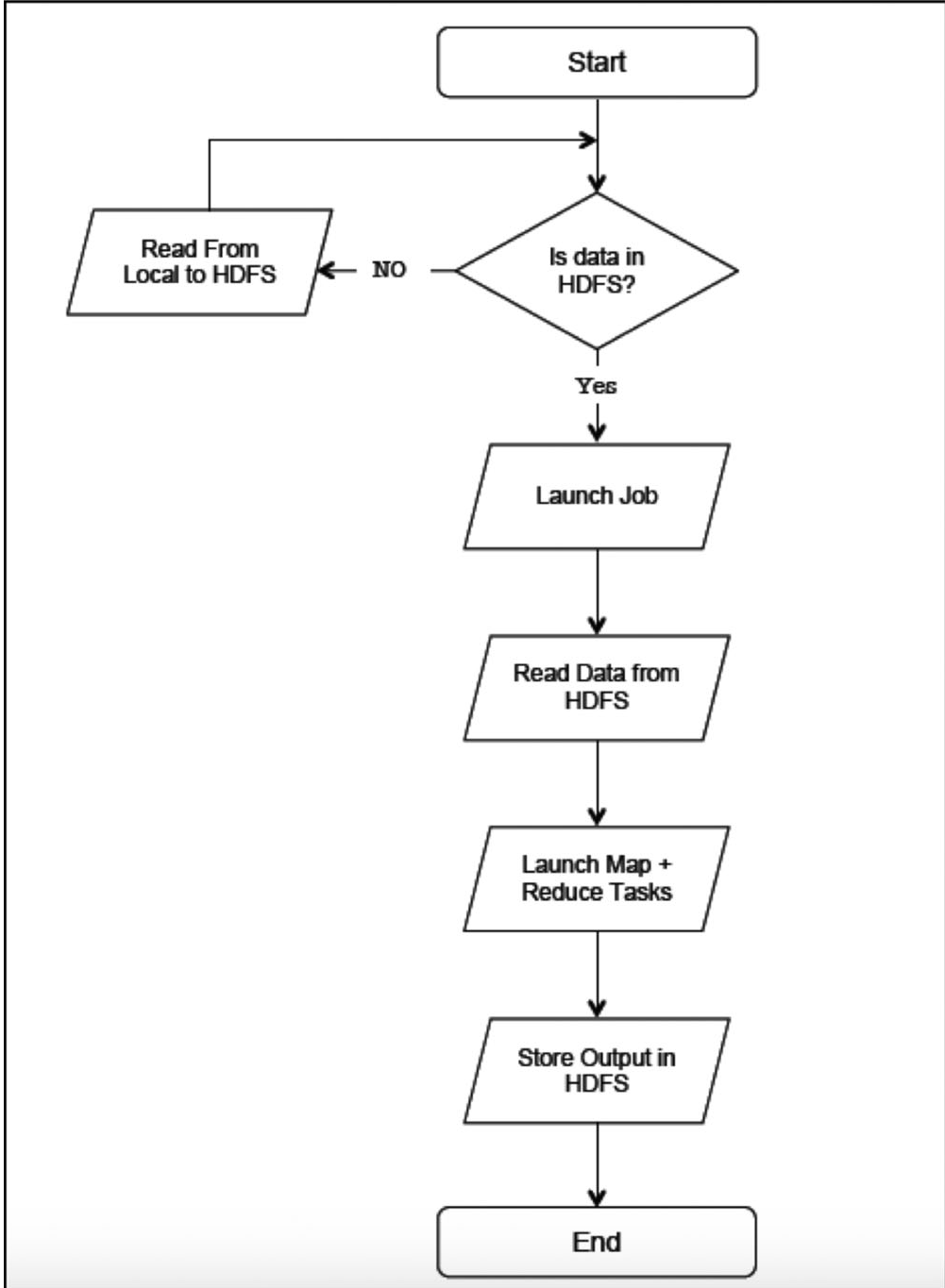 Figure: The H2Hadoop architecture enhances the software layer to allow metadata-based job assignment.
Experimental Validation: Genomics as a Case Study
The authors tested the system using DNA sequence data, where pattern matching is the primary workload.
Performance Gains
The results were striking. When searching for a sequence that appeared only in a small subset of the total blocks:
- Read Operations: Slashed from 109 (Native) to 15 (H2Hadoop).
- CPU Time: Reduced from 397 seconds to 50 seconds.
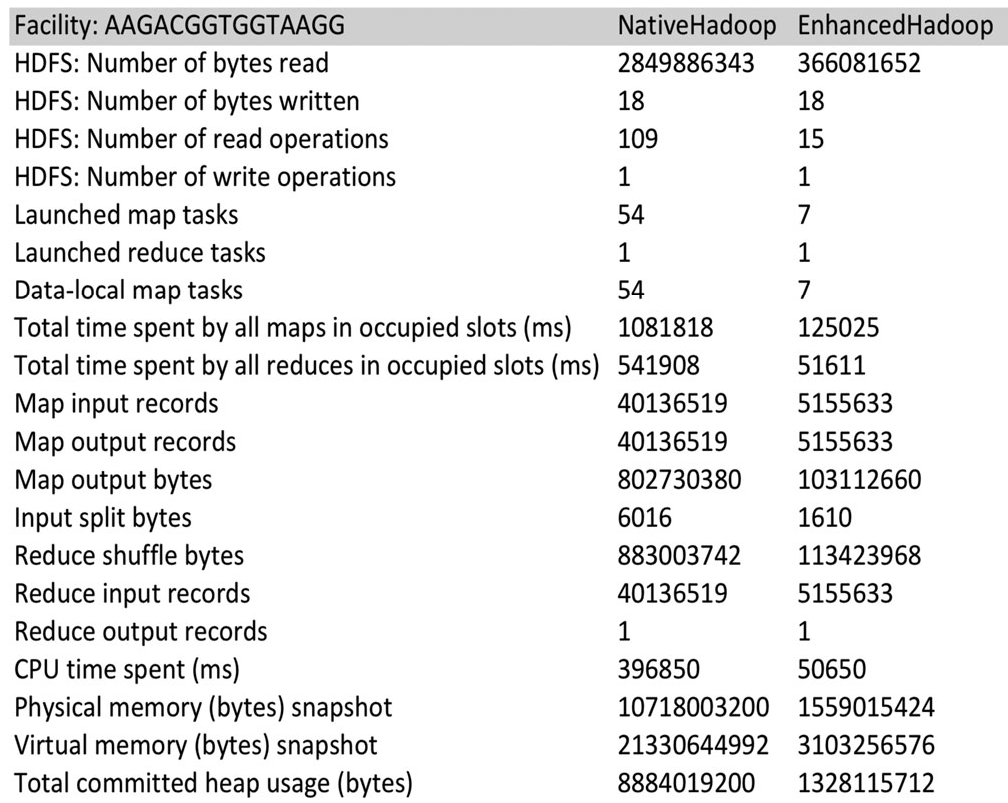 Table: Quantitative comparison shows H2Hadoop drastically reduces bytes read and physical memory snapshotting.
The "Overhead" Caveat
The authors objectively note that H2Hadoop introduces a slight delay due to the CJBT lookup process. In cases where a feature exists in every block (e.g., a very common sequence), H2Hadoop can be ~4% slower than native Hadoop due to this overhead. However, as sequence length increases (e.g., 12-15 nucleotides), the likelihood of universal presence drops significantly, making H2Hadoop vastly superior.
Critical Insight & Future Outlook
The beauty of H2Hadoop is its Inductive Bias toward structured text patterns. It treats the HDFS not as a "dumb" storage bucket, but as a searchable index that improves with every job execution.
Limitations:
- Currently optimized primarily for text data.
- The CJBT can grow linearly; the authors suggest using a "Leaky Bucket" algorithm to prune old or rare metadata to maintain performance.
Conclusion: H2Hadoop provides a roadmap for "Smarter Clouds." By moving away from purely stateless execution and toward a metadata-aware architecture, we can turn Big Data frameworks from brute-force scanners into precision surgical tools.