
Mapping the Evolution of Knowledge: A Neural-Data Mining Hybrid for Ontology Learning
Using Hamming Similarity to Map Ontology Learning: A New Data Mining System Choukri djellali
The paper introduces a semi-automatic data mining system for ontology learning from unstructured text. It employs a combination of Truncated Singular Value Decomposition (TSVD) for dimensionality reduction, Fuzzy Adaptive Resonance Theory (Fuzzy ART) for neural-based clustering, and Hamming similarity for aligning cluster labels with ontological entities.
TL;DR
Ontologies are the backbone of the Semantic Web, but they are notoriously difficult to maintain manually. This paper presents a semi-automatic system that uses Truncated Singular Value Decomposition (TSVD) to strip away noise and Fuzzy Adaptive Resonance Theory (Fuzzy ART) to discover new knowledge patterns. By aligning these patterns using Hamming Similarity, the system can update existing ontologies with minimal human intervention.
Context & Motivation: The Static Ontology Trap
In the landscape of the Semantic Web, an ontology is a living structure. However, most existing "Ontology Learning" tools focus only on the initial extraction from text, ignoring the evolution phase. Two major hurdles exist:
- Dimensionality Curse: Text documents contain immense noise; using every word as a feature degrades model accuracy.
- Structural Rigidity: Traditional clustering requires users to guess the number of categories (k-means), which fails when new, unforeseen topics emerge in the data.
Methodology: The Three Pillars of the System
1. Adaptive Noise Reduction (TSVD)
Instead of relying on raw term weightings, the author employs Truncated Singular Value Decomposition (TSVD). By analyzing the "additional variance" of singular values, the system identifies that the first 721 singular values account for over 91.13% of the variance. This allows the model to discard the "tail" of less informative variables that usually represent linguistic noise.
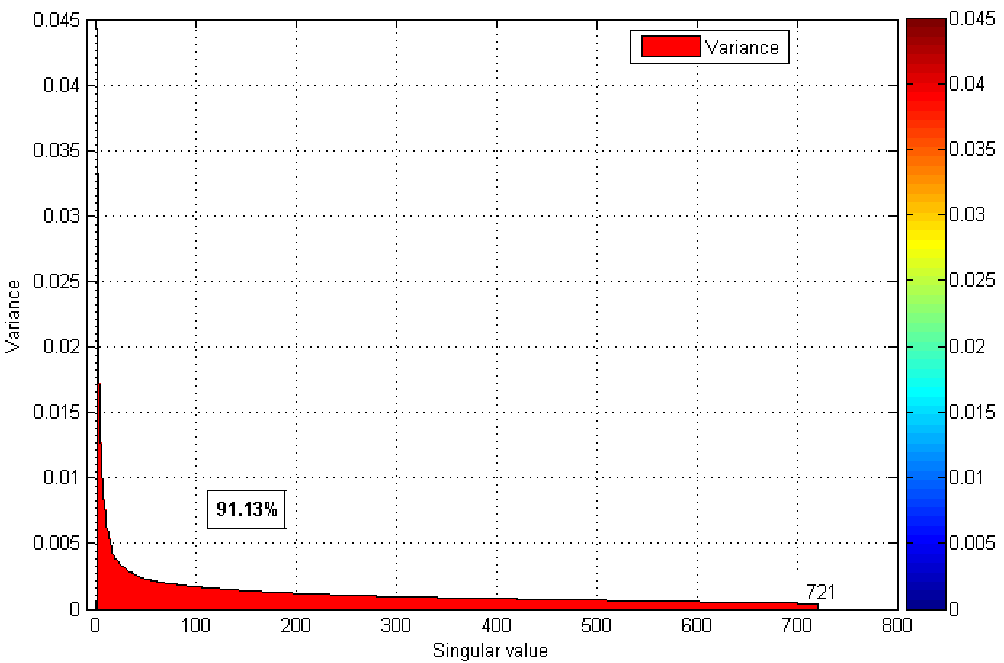 Figure: The system uses Scree plots to determine the optimal cut-off for singular values, ensuring only discriminative features remain.
2. Neural Clustering via Fuzzy ART
To solve the problem of unknown cluster counts, the author utilizes Fuzzy Adaptive Resonance Theory (Fuzzy ART).
- Plasticity-Elasticity: The network can learn new patterns without forgetting old ones.
- Dynamic Creation: If a new document doesn't fit existing "Winning Neurons" (clusters) based on a resonance threshold (), the system automatically creates a new category.
- Complement Coding: To prevent "category proliferation" (where the system creates too many tiny clusters), the author uses symmetric coding to preserve vector logic.
3. Syntax-Based Alignment (Hamming Similarity)
Once clusters are formed, their descriptive labels must be mapped back to the CRISP-DM-OWL ontology. The system uses Hamming Distance to measure the syntactic neighborhood between cluster labels and ontological entities.
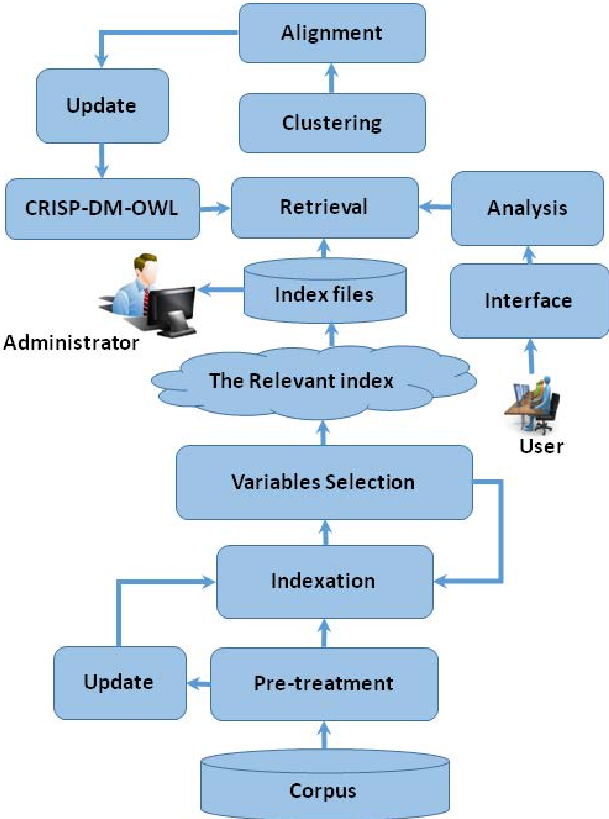 Figure: The holistic architecture from document acquisition to OWL update.
Evaluation: Ensuring Logic & Consistency
A "learned" ontology is useless if it is logically inconsistent. The author employs RacerPro, a Description Logic (DL) inference engine, to perform:
- T-Box Reasoning: Checking if the classes and properties (terminological axioms) are coherent.
- A-Box Instantiation: Verifying that specific "individuals" (data points) actually fit the defined classes.
Critical Insight: Why Hamming?
The author admits a critical trade-off: Hamming similarity is fast but syntactically rigid. While it works well for identifying mismatches in similarly structured strings (e.g., "association" vs "AssociationAlgorithm"), its probability of alignment is lower than more sophisticated heuristic metrics. The "Critical Dependence" on distance measures mentioned in the abstract suggests that while the system architecture is sound, the "mapping" layer is where future LLM-based semantic similarity could provide a massive boost.
Conclusion & Future Outlook
This work represents a bridge between connectionist AI (Neural Networks) and symbolic AI (Ontologies). By automating the "candidate change" detection, it moves ontology engineering away from labor-intensive manual editing toward a more fluid, data-driven evolution. For researchers, the takeaway is clear: the precision of your ontology is only as good as the dimensionality reduction (TSVD) and the resonance of your clustering.
Keywords: Ontology Learning, Fuzzy ART, TSVD, Hamming Distance, Semantic Web.