
Hardware-Oriented Raptor Codes: Bridging the Gap Between Rateless Flexibility and LDPC Performance
Hardware-Oriented Construction of a Family of Rate-Compatible Raptor Codes
This paper introduces a hardware-oriented construction for a family of rate-compatible Raptor codes that bridges the performance gap with LDPC codes. By utilizing a non-abelian group-based source matrix and structured LT row-encoding, the proposed architecture achieves LDPC-like error correction while maintaining hardware efficiency across various block lengths and rates.
TL;DR
Raptor codes provide unmatched flexibility through their rateless nature, but they typically lag behind LDPC codes in hardware efficiency and short-block performance. This paper presents a novel construction framework using non-abelian groups and structured LT row-encoding to create Raptor codes that match LDPC error rates while narrowing the gaps in decoding speed and memory overhead to near-parity levels.
The Problem: The "Rateless Tax" in Hardware
In Hybrid ARQ (HARQ) systems, rate compatibility is king. While Raptor codes (a concatenation of a high-rate precode and an LT code) are theoretically elegant, mapping them to silicon has traditionally been painful:
- Short Block Weakness: Performance degrades significantly at block lengths below 3000 bits.
- Convergence Lag: They often require 3x more iterations than LDPC to reach the same result.
- Memory Bloat: Storing messages for the bipartite graph usually consumes far more area than fixed-rate LDPC decoders.
The authors argue that these issues stem from a lack of "hardware-awareness" in the algebraic construction of the code's parity-check and generator matrices.
Methodology: The Three-Tier Innovation
1. The Non-Abelian Group Source Matrix
To ensure the decoder can access memory in a quasi-parallel fashion without bank conflicts, the authors construct the source matrix using a direct product of Dihedral groups () and cyclic groups ().
Why Non-Abelian? If the group were abelian (commutative), the precode would inevitably contain many low-weight codewords, leading to an early error floor. The non-abelian nature breaks these cycles while the structure allows the code to scale to equally spaced block lengths by simply varying the parameter .
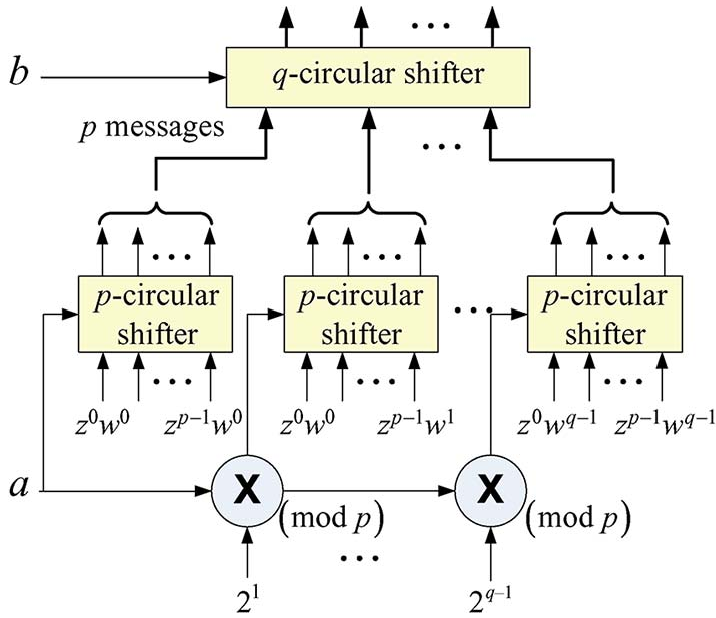 Figure 1: The Cpq-dependent permutation network facilitates hardware-efficient message shuffling.
2. Splitting-After-Merging Precodes
Moving away from high-rate regular precodes, the authors propose a "splitting-after-merging" flow. This allows the construction of irregular precodes with rates lower than 0.9. By splitting rows after merging them, the hardware-friendly properties of the base matrix are preserved even as the graph becomes more complex to improve error correction.
3. Structured LT Row-Encoding
This is perhaps the most significant departure from standard Raptor codes. Instead of simple row-splitting to generate LT bits, they use row-encoding. By allowing bit-partitions to overlap, they create local subcodes. In the absence of noise, these subcodes can be resolved locally, which drastically accelerates the spread of "information" across the graph, cutting down total iterations.
Experimental Results: Closing the Gap
The researchers tested a code instance with against the IEEE 802.16 (WiMAX) LDPC legacy.
- Error Correction: As shown in the FER curves, the Raptor code follows the LDPC waterfall almost perfectly.
- Convergence: By utilizing Turbo-Decoding Message Passing (TDMP), the gap in iterations was reduced to just 1.1x at rate 1/2.
- Memory Savings: The "local decoding" logic allows the system to store fewer messages than the total edge count would suggest, bringing memory usage to within 1.1x of LDPC benchmarks.
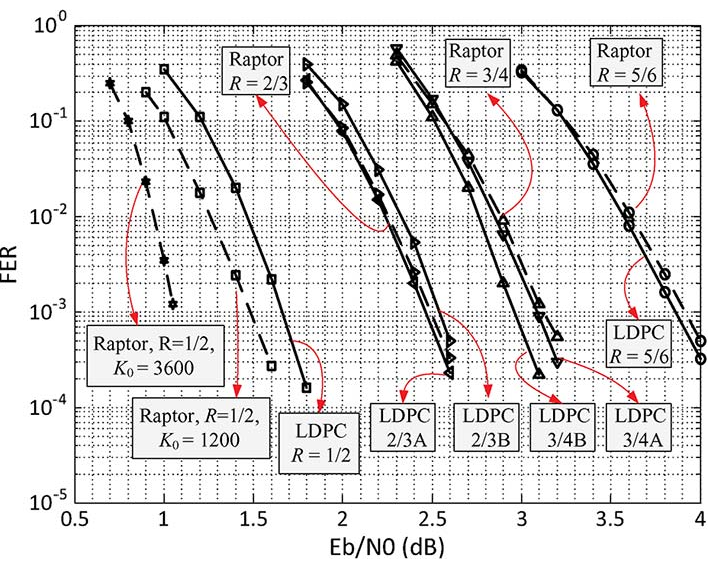 Figure 2: Frame Error Rate (FER) comparison showing Raptor performance tracking LDPC across various rates.
Critical Analysis & Future Outlook
Takeaway: This work proves that Raptor codes are not inherently "slow" or "bloated" for hardware; the problem was the construction method. By enforcing algebraic constraints that mirror the physical movement of data in a decoder (memory banking, permutation networks), one can have both rateless flexibility and high-speed throughput.
Limitations: The "row-encoding" step increases the complexity of check-node processing. While it saves memory and iterations, the logic depth of each check-node unit is higher. Further research is needed to quantify this logic-area trade-off.
Future Work: This framework opens the door for applying Raptor codes to ultra-reliable low-latency communications (URLLC) where rate-compatibility is needed but LDPC puncturing becomes too inefficient.