
Enhancing Social Network Connections via Robust Perceptual Hashing
A Hash Based Image Matching Algorithm for Social Networks
The paper proposes a specialized perceptual hashing algorithm for image matching in social networks. By integrating advanced preprocessing (border removal and tonality-based normalization), it achieves state-of-the-art robustness against rotations and framing modifications, moving beyond the limitations of standard pHash or aHash.
TL;DR
Researchers have developed a hash-based image matching algorithm that solves the "computational gap"—where humans see the same image, but computers see different data due to rotations or borders. By adding a smart preprocessing layer before generating a perceptual hash, the system boosts matching accuracy from 22% to 84% on transformed images.
Context & Motivation: The Social Discovery Challenge
In professional social networks, identifying users with shared interests is paramount. Often, these interests are expressed through shared imagery. However, images are rarely "clean" when re-shared; users add watermarks, apply filters, change formats, or—most problematically for algorithms—add borders and rotate the files.
Existing tools like pHash (Perceptual Hash) or aHash (Average Hash) are robust against tonality changes but fail catastrophically when an image is rotated 90 degrees or placed inside a frame. The authors recognized that for a social networking recommendation engine to work, it needs a "perceptual" eye that ignores these superficial edits.
Methodology: Preprocessing as the Secret Sauce
The core innovation isn't just a new hash, but a systematic way to "normalize" an image before it is hashed.
1. The Border Removal Logic
Adding a solid border changes the aspect ratio and the pixel distribution of an image. The system converts the image to grayscale, uses a binary threshold based on border tonality, and finds the largest contour to crop the image back to its original content.
2. Tonality-Based Rotation Normalization
To handle 90, 180, or 270-degree rotations, the algorithm divides the image into quadrants (North, South, East, West). It then rotates the image so that the "brightest" (highest mean tonality) section is always at a standard orientation (e.g., the top). This ensures that no matter how a user uploads an image, the system "sees" it the same way.
3. The pHash Variation
After normalization, the image is resized to 32x32 and transformed via Discrete Cosine Transform (DCT). The authors extract the top-left 12x12 coefficients—the low-frequency components that define the basic structure of the image—ignoring high-frequency "noise" like watermarks.
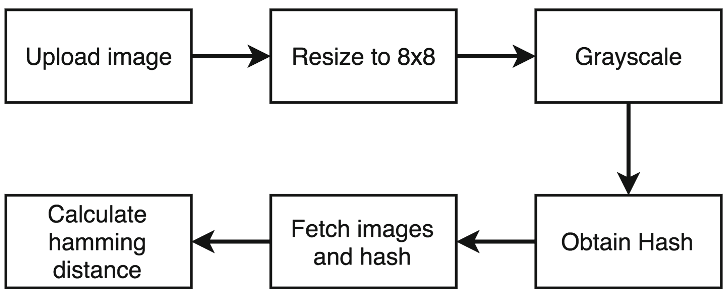 Figure 1: The preprocessing and hashing workflow highlighting the normalization of visual data.
Experimental Results: A Massive Leap in Robustness
The researchers tested their method against 1,000 modified images from a 200,000-image dataset (Pixabay). They compared their results against industry standards like pHash, dHash, and the TinEye API.
| Transformation | pHash | TinEye | Proposed System |
|---|---|---|---|
| None (Original) | 100% | 100% | 100% |
| Rotation (r) | 0% | 0% | 100% |
| Border (b) | 0% | 0% | 90% |
| Border + Watermark | 0% | 0% | 74% |
| Average Success | 22% | 22% | 84% |
The results are striking. While traditional hashes and TinEye are completely defeated by rotation and borders, the proposed system maintains high reliability.
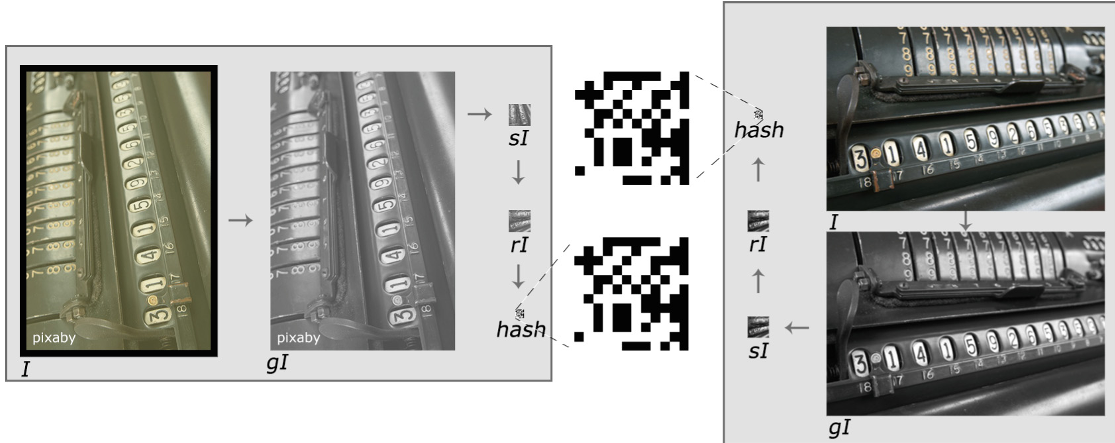 Figure 2: Despite a 90° rotation, yellow hue filter, border, and watermark, the system identified the image with 99.3% similarity.
Critical Insight & Future Outlook
While the system is highly effective for geometric edits, it remains slightly vulnerable to heavy watermarking that significantly obscures the image center. The authors concede that there is a trade-off between "detail" and "false positives."
Future Directions:
- Arbitrary Rotations: The current system handles 90-degree steps; future work aims for 360-degree precision.
- Deformation & Cropping: Handling images that have been stretched or partially cut.
- Social Suggestion Engine: Implementing this as a back-end for real-time contact suggestions based on shared visual "DNA."
In conclusion, the paper demonstrates that "intelligence" in image matching often lies in how you prepare the data, not just how you compute the final bitstring.