
Content Matters: Decoding Hate Groups through Structural and Textual Synergy
Content matters: A study of hate groups detection based on social networks analysis and web mining
The paper introduces a hybrid detection framework for identifying hate groups on Facebook by combining Social Network Analysis (SNA) and Web Mining (specifically Natural Language Processing). By integrating structural features like centrality with content-based features like TF-IDF keyword similarity, the authors achieve a 100% F-measure in group classification using Naïve Bayes.
TL;DR
In the digital age, social networking platforms like Facebook have become double-edged swords—fostering community while providing a breeding ground for hate groups. This paper proposes a hybrid detection system that proves content analysis is the "missing link" in traditional Social Network Analysis (SNA). By combining structural metrics with TF-IDF keyword similarity, the researchers achieved a perfect 100% classification accuracy for identifying hate groups.
Problem & Motivation: The Limits of Layout
Why is it so hard to spot a hate group automatically? Historically, researchers focused on SNA measurements—looking at who talks to whom (density, centrality, and "star" nodes). However, the authors argue that the structure of an online group focused on "loving" a brand often looks identical to a group "hating" that same brand. Both involve intense interactions, core influencers, and dense sub-clusters.
The authors' core insight is that to truly differentiate these groups, we must look at the intent encoded in their language. They posit that the "what" (content) is a more powerful discriminator than the "how" (network structure).
Methodology: The Hybrid Architecture
The proposed system operates through four distinct phases to create a comprehensive "Group Vector."
1. Data Extraction & Pre-processing
Using the Facebook API, the team collected data from 30 groups (15 "Hate" and 15 "Like") centered around 3C giants like Microsoft, Apple, and Sony. They modeled three types of relationships: Post, Reply, and Like.
2. Feature Extraction
- Structural Features: Metrics like Degree Centrality, Closeness Centrality, and Clustering Coefficient were calculated using UCINet to define the "shape" of the group.
- Content Features: Using NLP, the researchers extracted keywords (e.g., "suck," "evil," "fail") and applied TF-IDF to determine their importance. They then calculated Cosine Similarity between groups to measure semantic distance.
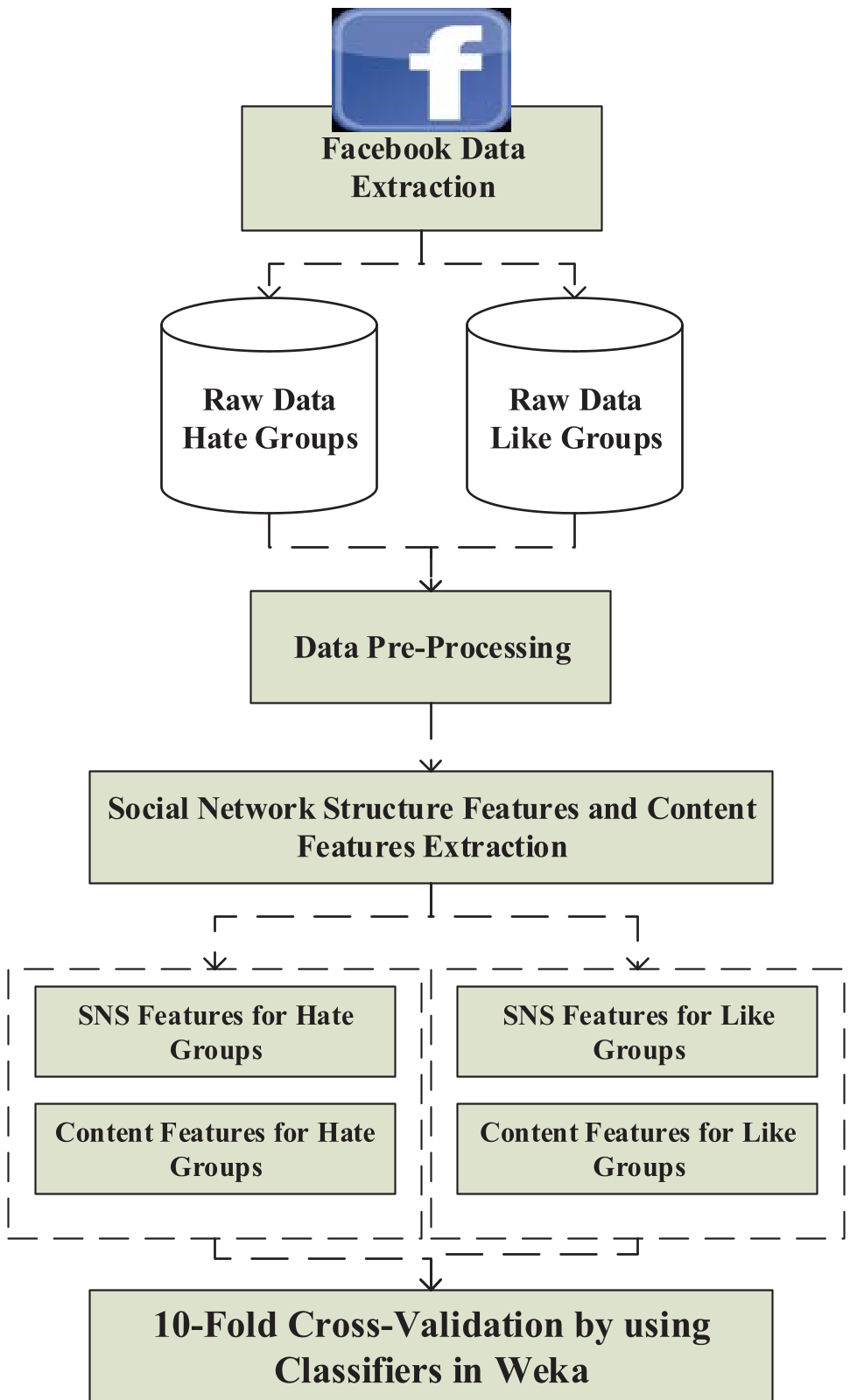
3. Classification
The final hybrid vector: (Where =Density, =Keyword Similarity, =Is Hate Group)
Experiments and Results: The Superiority of Text
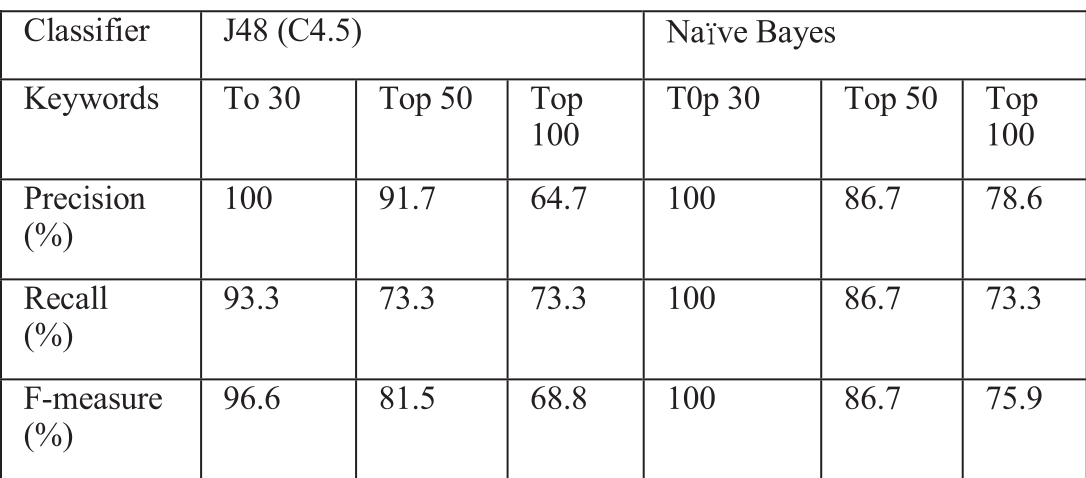
The study compared three approaches across two classifiers (J48 Decision Tree and Naïve Bayes).
| Feature Set | Classifier | Precision | F-Measure |
|---|---|---|---|
| SNA Only | Naïve Bayes | 50.0% | 59.5% |
| Hybrid (Top 30 Keywords) | Naïve Bayes | 100% | 100% |
| Content Only (Top 30) | J48 | 93.8% | 96.8% |
Critical Findings:
- SNA is weak alone: Structural data alone was barely better than a coin flip for identifying hate groups.
- The "Top 30" sweet spot: Performance actually decreased as the number of keywords increased from 30 to 100. This suggests that the signal for hate is concentrated in a small set of highly aggressive terms; adding more words only introduces noise.
- Naïve Bayes Dominance: When using fewer features (Top 30), Naïve Bayes reached the theoretical limit of 100% accuracy, proving highly effective for this specific classification task.
Deep Insight & Conclusion
This paper provides empirical evidence for the "Content Matters" hypothesis. While network science offers a view of the skeleton of social activity, Web Mining via NLP provides the muscle and intent.
Takeaways for the Future:
- Refinement of SNA: For future social monitoring tools, SNA should be treated as a contextual layer rather than a standalone classifier.
- Limitations: The dataset (30 groups) is relatively small. In real-world web-scale scenarios, the "sarcasm" or "irony" in "Like" groups might confuse simple TF-IDF models.
- Evolution: As we move toward 2026, the integration of Large Language Models (LLMs) to capture deeper semantic nuances rather than just keyword frequencies will likely be the next frontier in automating social safety.
Social networks are defined by the people within them, but they are characterized by the words they speak. This research concludes that if you want to find the hate, you have to read between the nodes.